Department of Pediatrics, University of Texas - Southwestern Medical Center at Dallas, Dallas, Texas 75390-9063, USA.
Nature. 2011 Nov 20;481(7381):385-8. doi: 10.1038/nature10642.
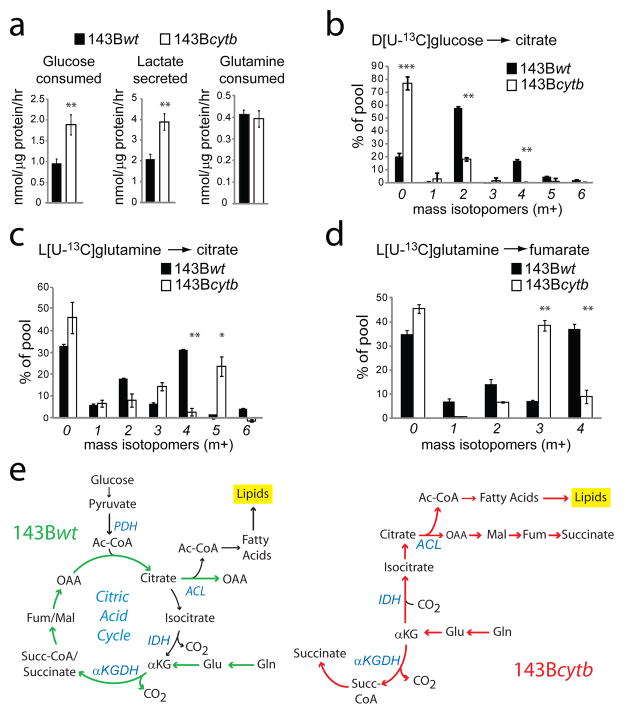
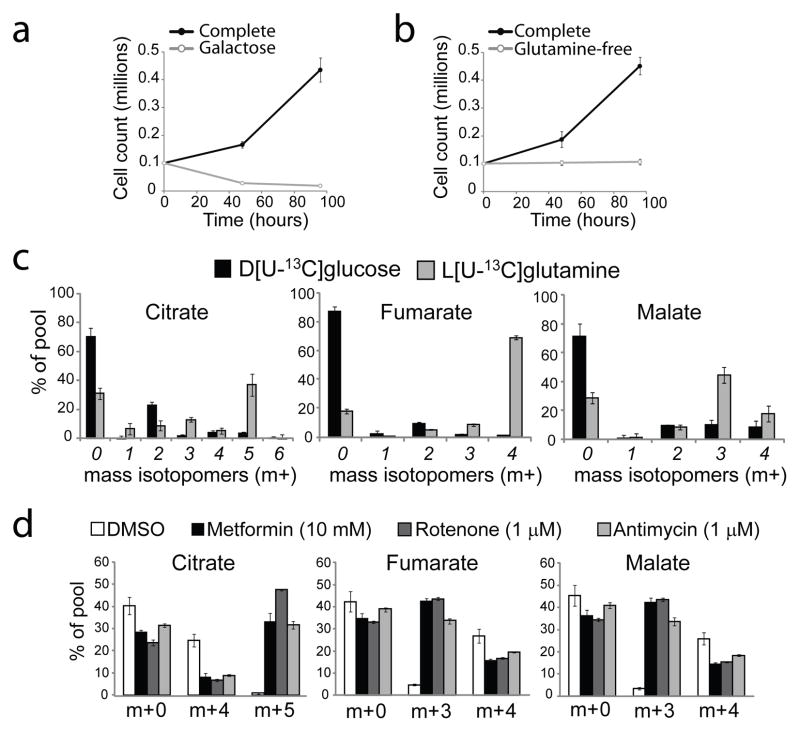
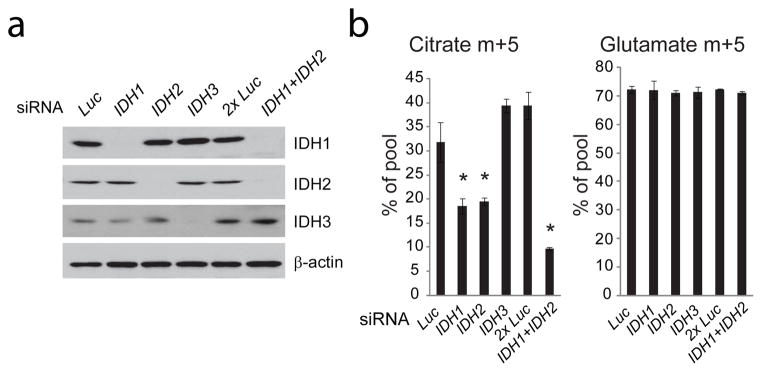
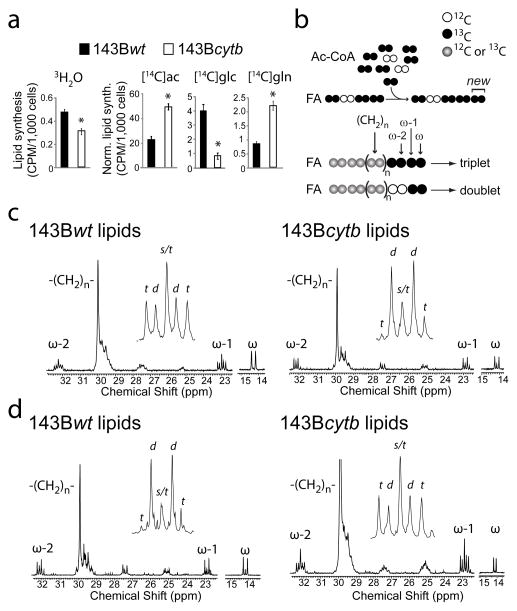
Mitochondrial metabolism provides precursors to build macromolecules in growing cancer cells. In normally functioning tumour cell mitochondria, oxidative metabolism of glucose- and glutamine-derived carbon produces citrate and acetyl-coenzyme A for lipid synthesis, which is required for tumorigenesis. Yet some tumours harbour mutations in the citric acid cycle (CAC) or electron transport chain (ETC) that disable normal oxidative mitochondrial function, and it is unknown how cells from such tumours generate precursors for macromolecular synthesis. Here we show that tumour cells with defective mitochondria use glutamine-dependent reductive carboxylation rather than oxidative metabolism as the major pathway of citrate formation. This pathway uses mitochondrial and cytosolic isoforms of NADP(+)/NADPH-dependent isocitrate dehydrogenase, and subsequent metabolism of glutamine-derived citrate provides both the acetyl-coenzyme A for lipid synthesis and the four-carbon intermediates needed to produce the remaining CAC metabolites and related macromolecular precursors. This reductive, glutamine-dependent pathway is the dominant mode of metabolism in rapidly growing malignant cells containing mutations in complex I or complex III of the ETC, in patient-derived renal carcinoma cells with mutations in fumarate hydratase, and in cells with normal mitochondria subjected to acute pharmacological ETC inhibition. Our findings reveal the novel induction of a versatile glutamine-dependent pathway that reverses many of the reactions of the canonical CAC, supports tumour cell growth, and explains how cells generate pools of CAC intermediates in the face of impaired mitochondrial metabolism.
线粒体代谢为生长中的癌细胞合成大分子提供前体。在正常功能的肿瘤细胞线粒体中,葡萄糖和谷氨酰胺衍生碳的氧化代谢产生柠檬酸和乙酰辅酶 A,用于脂质合成,这是肿瘤发生所必需的。然而,一些肿瘤携带柠檬酸循环(CAC)或电子传递链(ETC)中的突变,使正常的氧化线粒体功能失活,目前尚不清楚来自这些肿瘤的细胞如何为大分子合成生成前体。在这里,我们表明,线粒体功能缺陷的肿瘤细胞使用谷氨酰胺依赖性还原羧化作用而不是氧化代谢作为形成柠檬酸的主要途径。该途径使用线粒体和细胞质 NADP(+)/NADPH 依赖性异柠檬酸脱氢酶同工型,随后对谷氨酰胺衍生的柠檬酸的代谢为脂质合成提供乙酰辅酶 A,以及为产生剩余 CAC 代谢物和相关大分子前体所需的四碳中间产物。在含有 ETC 复合物 I 或 III 突变的快速生长的恶性细胞中,在携带延胡索酸水合酶突变的患者来源的肾癌细胞中,以及在经历急性药物 ETC 抑制的正常线粒体细胞中,这种还原的、谷氨酰胺依赖性途径是代谢的主要模式。我们的发现揭示了一种新颖的诱导多功能谷氨酰胺依赖性途径,该途径逆转了经典 CAC 的许多反应,支持肿瘤细胞生长,并解释了细胞如何在受损的线粒体代谢情况下产生 CAC 中间产物池。