Department of Virology, Institute of Microbiology, Faculty of Biology, University of Warsaw, Miecznikowa 1, 02-096 Warsaw, Poland.
Nucleic Acids Res. 2012 Mar;40(5):2119-30. doi: 10.1093/nar/gkr1039. Epub 2011 Nov 18.
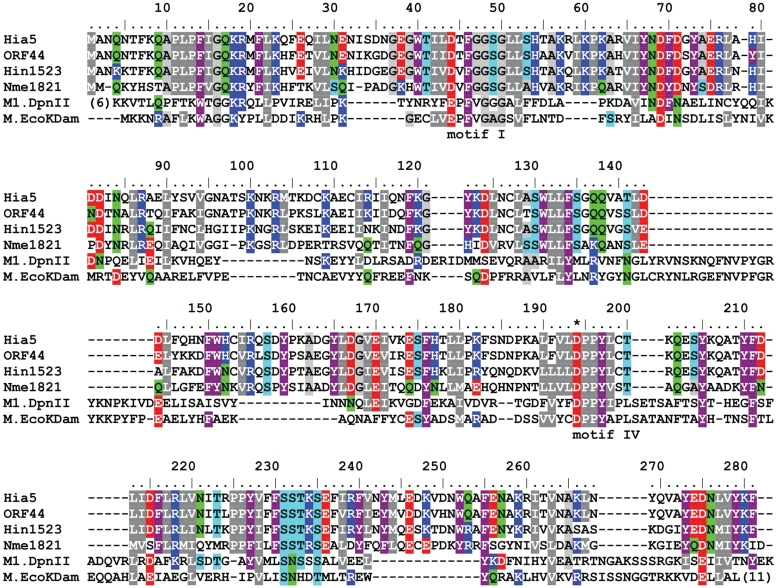
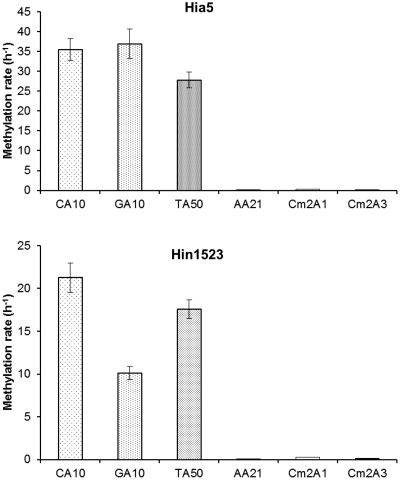
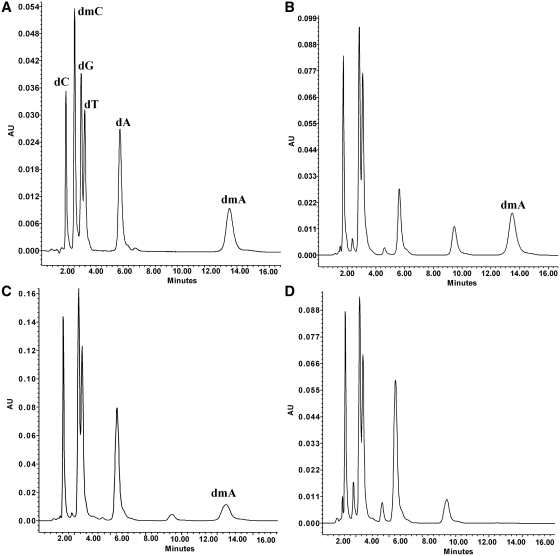
The mom gene of bacteriophage Mu encodes an enzyme that converts adenine to N(6)-(1-acetamido)-adenine in the phage DNA and thereby protects the viral genome from cleavage by a wide variety of restriction endonucleases. Mu-like prophage sequences present in Haemophilus influenzae Rd (FluMu), Neisseria meningitidis type A strain Z2491 (Pnme1) and H. influenzae biotype aegyptius ATCC 11116 do not possess a Mom-encoding gene. Instead, at the position occupied by mom in Mu they carry an unrelated gene that encodes a protein with homology to DNA adenine N(6)-methyltransferases (hin1523, nma1821, hia5, respectively). Products of the hin1523, hia5 and nma1821 genes modify adenine residues to N(6)-methyladenine, both in vitro and in vivo. All of these enzymes catalyzed extensive DNA methylation; most notably the Hia5 protein caused the methylation of 61% of the adenines in λ DNA. Kinetic analysis of oligonucleotide methylation suggests that all adenine residues in DNA, with the possible exception of poly(A)-tracts, constitute substrates for the Hia5 and Hin1523 enzymes. Their potential 'sequence specificity' could be summarized as AB or BA (where B = C, G or T). Plasmid DNA isolated from Escherichia coli cells overexpressing these novel DNA methyltransferases was resistant to cleavage by many restriction enzymes sensitive to adenine methylation.
噬菌体 Mu 的“妈妈”基因编码一种酶,能将噬菌体 DNA 中的腺嘌呤转化为 N(6)-(1-乙酰氨基)-腺嘌呤,从而保护病毒基因组免受各种限制内切酶的切割。流感嗜血杆菌 Rd(FluMu)、A 型脑膜炎奈瑟菌菌株 Z2491(Pnme1)和 H. influenzae biotype aegyptius ATCC 11116 中存在的 Mu 样前噬菌体序列不具有“妈妈”基因编码的基因。相反,在 Mu 中 Mom 占据的位置,它们携带一个不相关的基因,该基因编码与 DNA 腺嘌呤 N(6)-甲基转移酶具有同源性的蛋白质(分别为 hin1523、nma1821、hia5)。hin1523、hia5 和 nma1821 基因的产物在体外和体内均将腺嘌呤残基修饰为 N(6)-甲基腺嘌呤。所有这些酶都能催化广泛的 DNA 甲基化;特别是 Hia5 蛋白导致 λ DNA 中 61%的腺嘌呤被甲基化。寡核苷酸甲基化的动力学分析表明,除了多(A)-链外,DNA 中的所有腺嘌呤残基都是 Hia5 和 Hin1523 酶的底物。它们潜在的“序列特异性”可以概括为 AB 或 BA(其中 B = C、G 或 T)。从过度表达这些新型 DNA 甲基转移酶的大肠杆菌细胞中分离出的质粒 DNA 对许多对腺嘌呤甲基化敏感的限制酶的切割具有抗性。