Harper Diane M, Vierthaler Stephen L
Center of Excellence, Women's Health, University of Missouri-Kansas City School of Medicine, 7900 Lee's Summit Road, Kansas City, MO 64139, USA.
ISRN Obstet Gynecol. 2011;2011:457204. doi: 10.5402/2011/457204. Epub 2011 Nov 2.
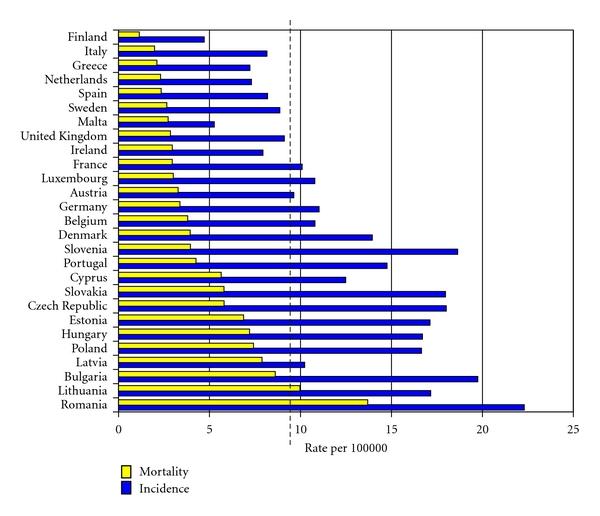
Nearly a half a million women throughout the world develop cervical cancer every year Parkin and Bray ("Chapter 2. The burden of HPVrelated cancers," Vaccine, vol. 24, no. 3, pp. S11-S25, 2006); 80% of these women are in countries without a quality-assured cytology screening program. It is in this setting that Cervarix could reduce the incidence of cervical cancer to about 9.5/100,000 women. New evidence indicates that this might be able to be accomplished with a single dose of Cervarix, a great advantage to public health implementation programs Kreimer et al. ("Proof-of-principle evaluation of the efficacy of fewer than three doses of a bivalent HPV16/18 vaccine, The Journal of the National Cancer Institute, vol. 103, no. 19, pp. 1444-1451, 2011). In countries with screening programs, adenocarcinoma is the most difficult to detect and treat with later-stage presentation and higher mortality Smith et al. ("The rising incidence of adenocarcinoma relative to squamous cell carcinoma of the uterine cervix in the United States-a 24-year population-based study," Gynecologic Oncology, vol. 78, no. 2, pp. 97-105, 2000) and Gunnell et al. ("A longitudinal Swedish study on screening for squamous cell carcinoma and adenocarcinoma: evidence of effectiveness and overtreatment," Cancer Epidemiology Biomarkers and Prevention, vol. 16, no. 12, pp. 2641-2648, 2007). With additional cross-protection to HPV 31, 33, and 45 and protection against HPV 16 and 18 lasting at least 9.4 years, Cervarix may reduce adenocarcinomas in screened populations by more than 90%. This paper will detail the evidence about the efficacy, immunogenicity, and safety of Cervarix in the studied populations contrasting public health goals with individual health options.
全世界每年有近50万女性罹患宫颈癌(帕金和布雷,《第2章.人乳头瘤病毒相关癌症的负担》,《疫苗》,第24卷,第3期,第S11 - S25页,2006年);其中80%的女性所在国家没有质量有保证的细胞学筛查项目。正是在这种情况下,卉妍康(Cervarix)可将宫颈癌发病率降低至约9.5/10万女性。新证据表明,单剂卉妍康或许就能实现这一目标,这对公共卫生实施项目来说是一个巨大优势(克雷默等人,《少于三剂二价人乳头瘤病毒16/18疫苗效力的原理验证评估》,《国家癌症研究所杂志》,第103卷,第19期,第1444 - 1451页,2011年)。在有筛查项目的国家,腺癌最难检测和治疗,其晚期表现和死亡率更高(史密斯等人,《美国子宫颈腺癌相对于鳞状细胞癌发病率上升——一项基于人群的24年研究》,《妇科肿瘤学》,第78卷,第2期,第97 - 105页,2000年;冈内尔等人,《瑞典一项关于鳞状细胞癌和腺癌筛查的纵向研究:有效性和过度治疗的证据》》,《癌症流行病学、生物标志物与预防》,第16卷,第12期,第2641 - 2648页,2007年)。卉妍康对人乳头瘤病毒31、33和45有额外交叉保护作用,对人乳头瘤病毒16和18的保护作用至少持续9.4年,它可能使筛查人群中的腺癌减少90%以上。本文将详细阐述卉妍康在研究人群中的效力、免疫原性和安全性方面的证据,将公共卫生目标与个体健康选择进行对比。