The Mina and Everard Goodman Faculty of Life Science, Bar Ilan University, 1 Keren-Hayesod St, Ramat-Gan, 52900, Israel.
Genome Med. 2011 Nov 28;3(11):77. doi: 10.1186/gm293.
Glioblastoma multiforme (GBM) is the most common, aggressive and malignant primary tumor of the brain and is associated with one of the worst 5-year survival rates among all human cancers. Identification of molecular interactions that associate with disease progression may be key in finding novel treatments.
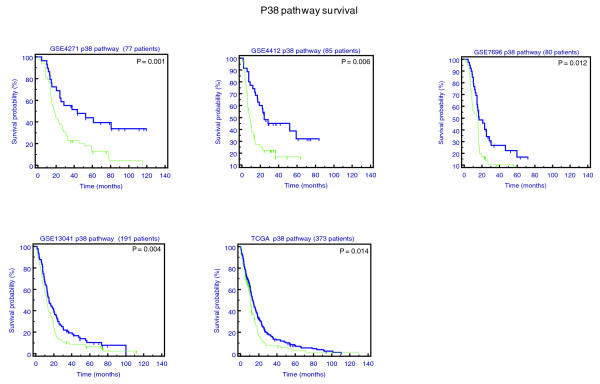
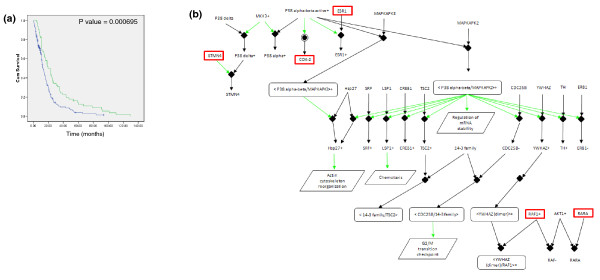
Using five independent molecular and clinical datasets with a set of computational algorithms we were able to identify a gene-gene and gene-microRNA network that significantly stratifies patient prognosis. By combining gene expression microarray data with microRNA expression levels, copy number alterations, drug response and clinical data, combined with network knowledge, we were able to identify a single pathway at the core of glioblastoma.
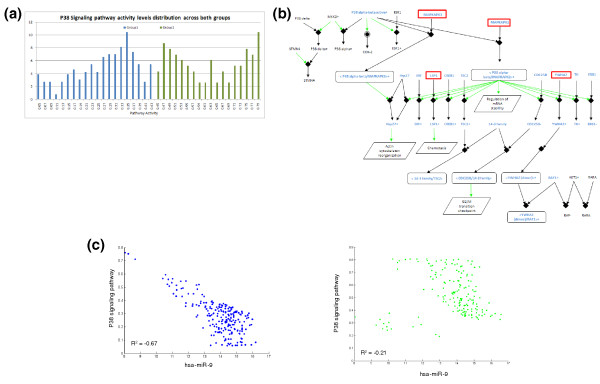
This network, the p38 network, and an associated microRNA, hsa-miR-9, facilitate prognostic stratification. The microRNA hsa-miR-9 correlated with network behavior and presents binding affinities with network members in a manner that suggests control over network behavior. A similar control over network behavior is possible through a set of drugs. These drugs are part of the treatment regimen for a subpopulation of the patients that participated in the TCGA study and for which the study provides clinical information. Interestingly, the patients that were treated with these specific sets of drugs, all of which targeted against p38 network members, demonstrate highly significant stratification of prognosis.
Combined, these results call for attention to p38 network targeted treatment and present the p38 network-hsa-miR-9 control mechanism as critical in GBM progression.
多形性胶质母细胞瘤(GBM)是最常见、侵袭性和恶性的脑原发性肿瘤,其 5 年生存率是所有人类癌症中最差的之一。鉴定与疾病进展相关的分子相互作用可能是寻找新治疗方法的关键。
我们使用五组独立的分子和临床数据集以及一组计算算法,鉴定了一个基因-基因和基因-miRNA 网络,该网络可显著分层患者的预后。通过将基因表达微阵列数据与 miRNA 表达水平、拷贝数改变、药物反应和临床数据相结合,并结合网络知识,我们能够鉴定出胶质母细胞瘤核心的单一途径。
该网络,即 p38 网络,以及相关的 microRNA,hsa-miR-9,有助于预后分层。microRNA hsa-miR-9 与网络行为相关,并以暗示对网络行为控制的方式与网络成员结合。通过一组药物可以实现对网络行为的类似控制。这些药物是 TCGA 研究中参与研究的一部分患者的治疗方案的一部分,并且该研究提供了临床信息。有趣的是,用这些特定药物治疗的患者,所有这些药物都针对 p38 网络成员,表现出预后的高度显著分层。
综合来看,这些结果呼吁关注 p38 网络靶向治疗,并提出 p38 网络-hsa-miR-9 控制机制在 GBM 进展中至关重要。