Epidemiology Service, Public Health Agency of Barcelona, Spain.
BMC Med. 2011 Nov 28;9:127. doi: 10.1186/1741-7015-9-127.
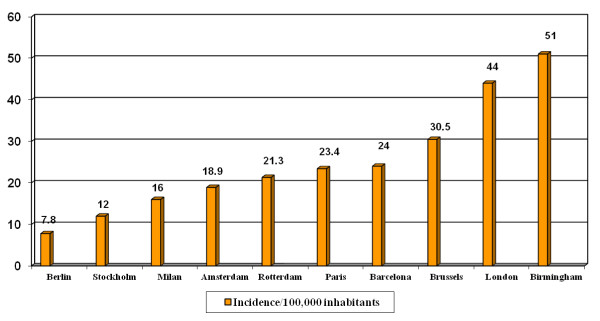
Tuberculosis (TB) is still a serious public health issue, even in large cities in developed countries. Control of this old disease is based on complicated programs that require completion of long treatments and contact tracing. In an accompanying research article published in BMC Public Health, Bothamley and colleagues found that areas with a ratio lower than one nurse per forty notifications had increased rates with respect to TB notifications, smear-positive cases, loss to follow-up and treatment abandonment across the UK. Furthermore, in these areas there was less opportunity for directly observed therapy, assistance with complex needs, educational outreach and new-entrant screening. In this commentary, we discuss the importance of improving organizational aspects and evaluating TB control programs. According to Bothamley and colleagues, a ratio of one nurse per forty notifications is an effective method of reducing the high TB incidences observed in London and in other cities in developed countries, or to maintain the decline in incidence in cities with lower incidences. It is crucial to evaluate TB programs every year to detect gaps early.
结核病(TB)仍然是一个严重的公共卫生问题,即使在发达国家的大城市也是如此。这种古老疾病的控制基于复杂的方案,需要完成长期治疗和接触者追踪。在 BMC 公共卫生杂志上发表的一篇相关研究文章中,Bothamley 及其同事发现,在英国,每四十例通报中护士人数低于一人的地区,结核病通报率、涂片阳性病例、失访和治疗中断率均有所上升。此外,在这些地区,直接观察治疗、复杂需求援助、教育推广和新感染者筛查的机会较少。在这篇评论中,我们讨论了改善组织方面和评估结核病控制计划的重要性。根据 Bothamley 及其同事的研究,每四十例通报中配备一名护士是减少伦敦和其他发达国家城市中观察到的高结核病发病率的有效方法,或者在发病率较低的城市保持发病率下降。每年评估结核病计划以尽早发现差距至关重要。