Bioengineering Technologies Group, The New Zealand Institute for Plant and Food Research Ltd, East Street, Hamilton 3214, New Zealand.
Sensors (Basel). 2010;10(8):7323-46. doi: 10.3390/s100807323. Epub 2010 Aug 4.
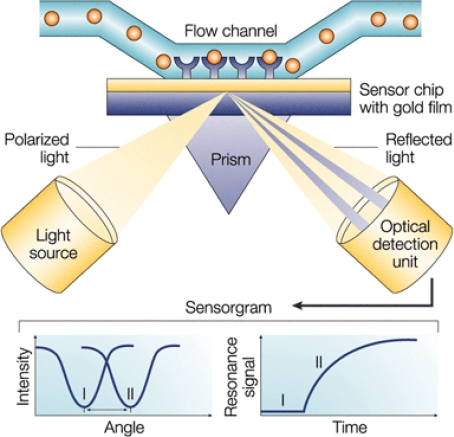
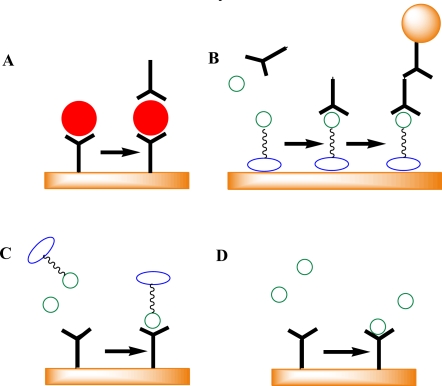
Surface plasmon resonance (SPR) biosensors utilize refractive index changes to sensitively detect mass changes at noble metal sensor surface interfaces. As such, they have been extensively applied to immunoassays of large molecules, where their high mass and use of sandwich immunoassay formats can result in excellent sensitivity. Small molecule immunosensing using SPR is more challenging. It requires antibodies or high-mass or noble metal labels to provide the required signal for ultrasensitive assays. Also, it can suffer from steric hindrance between the small antigen and large antibodies. However, new studies are increasingly meeting these and other challenges to offer highly sensitive small molecule immunosensor technologies through careful consideration of sensor interface design and signal enhancement. This review examines the application of SPR transduction technologies to small molecule immunoassays directed to different classes of small molecule antigens, including the steroid hormones, toxins, drugs and explosives residues. Also considered are the matrix effects resulting from measurement in chemically complex samples, the construction of stable sensor surfaces and the development of multiplexed assays capable of detecting several compounds at once. Assay design approaches are discussed and related to the sensitivities obtained.
表面等离子体共振(SPR)生物传感器利用折射率变化来敏感地检测贵金属传感器表面界面的质量变化。因此,它们已广泛应用于大分子的免疫分析,其高质量和使用三明治免疫分析格式可以产生优异的灵敏度。使用 SPR 的小分子免疫传感更具挑战性。它需要抗体或高质量或贵金属标记物来提供超灵敏分析所需的信号。此外,小分子抗原和大抗体之间的空间位阻也会影响其性能。然而,通过仔细考虑传感器界面设计和信号增强,新的研究越来越多地应对这些和其他挑战,提供高灵敏度的小分子免疫传感器技术。本文综述了 SPR 转换技术在小分子免疫分析中的应用,这些免疫分析针对不同类别的小分子抗原,包括甾体激素、毒素、药物和爆炸物残留。还考虑了在化学复杂样品中测量时的基质效应、稳定传感器表面的构建以及能够同时检测几种化合物的多路复用分析的开发。讨论了分析设计方法,并与获得的灵敏度相关联。