Department of Chemistry, Faculty of Sciences, Gazi University, Ankara 06500, Turkey.
Sensors (Basel). 2011;11(8):8152-63. doi: 10.3390/s110808152. Epub 2011 Aug 22.
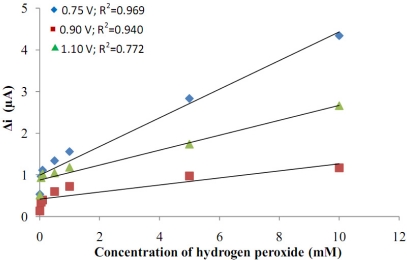
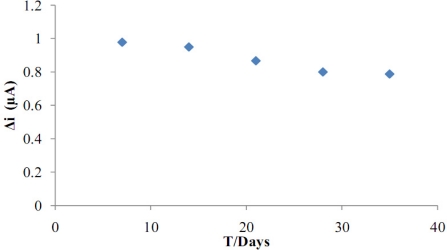
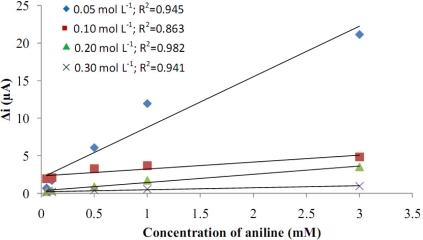
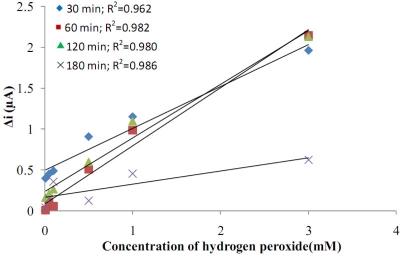
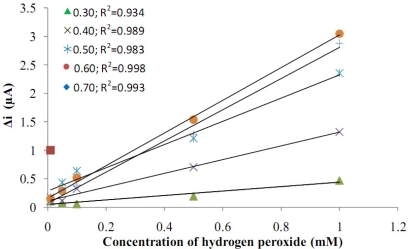
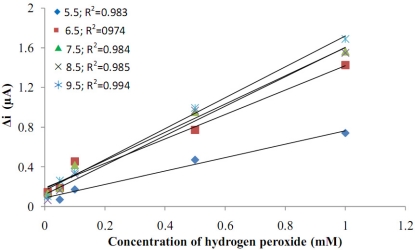
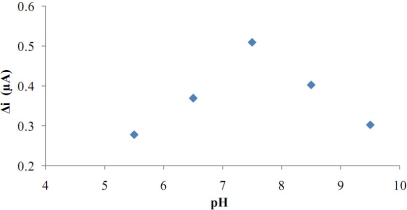
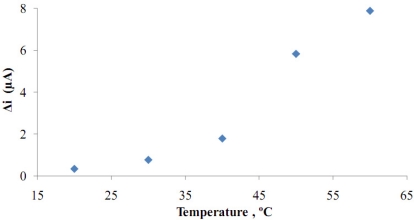
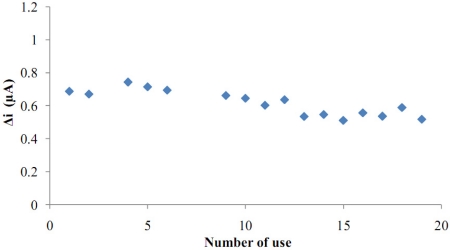
In this study, a novel amperometric glucose biosensor with immobilization of glucose oxidase on electrochemically polymerized polyaniline-polyvinylsulphonate (Pani-Pvs) films has been accomplished via the entrapment technique. Electropolymerization of aniline on the Pt surface of the Pt electrode was carried out at constant potential (0.75 V, vs. Ag/AgCl) using an electrochemical cell containing aniline and polyvinylsulphonate. Firstly, the optimum working conditions for preparing polyaniline-polyvinylsulfonate films were investigated. Determination of glucose was carried out by the oxidation of enzymatically produced H(2)O(2) at 0.4 V vs. Ag/AgCl. The effects of pH and temperature were investigated and the optimum pH value was found to be 7.5. The storage stability and operational stability of the enzyme electrode were also studied. The results show that 75% of the response current was retained after 16 activity assays. The prepared glucose biosensor retained 80.6% of initial activity after 40 days when stored in 0.1 M phosphate buffer solution at 4 °C.
在这项研究中,通过包埋技术,在电化学聚合的聚苯胺-聚砜(Pani-Pvs)膜上固定葡萄糖氧化酶,实现了一种新型的电流型葡萄糖生物传感器。在含有苯胺和聚砜的电化学电池中,通过恒电位(0.75 V,相对于 Ag/AgCl)在 Pt 电极的 Pt 表面上进行苯胺的电聚合。首先,研究了制备聚苯胺-聚砜膜的最佳工作条件。通过在 0.4 V 相对于 Ag/AgCl 下氧化酶促产生的 H(2)O(2)来进行葡萄糖的测定。研究了 pH 值和温度的影响,发现最佳 pH 值为 7.5。还研究了酶电极的储存稳定性和操作稳定性。结果表明,在 16 次活性测定后,响应电流保留了 75%。当在 4°C 的 0.1 M 磷酸盐缓冲溶液中储存时,制备的葡萄糖生物传感器在 40 天后仍保留初始活性的 80.6%。