Murakami Masahiro
Yale Cardiovascular Research Center, Section of Cardiovascular Medicine, Department of Internal Medicine, Yale University School of Medicine, New Haven, CT 06511, USA.
Int J Vasc Med. 2012;2012:293641. doi: 10.1155/2012/293641. Epub 2011 Dec 6.
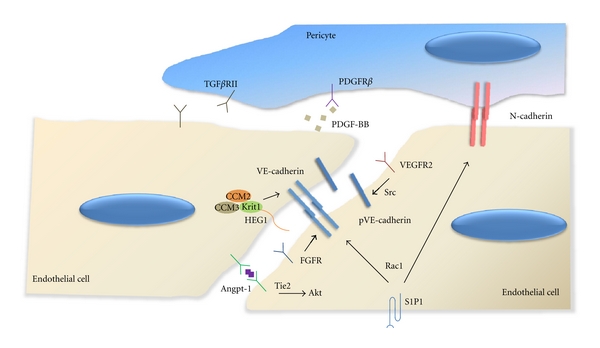
As our understanding of molecular mechanisms leading to vascular formation increases, vessel maintenance including stabilization of new vessels and prevention of vessel regression began to be considered as an active process that requires specific cellular signaling. While signaling pathways such as VEGF, FGF, and angiopoietin-Tie2 are important for endothelial cell survival and junction stabilization, PDGF and TGF-β signaling modify mural cell (vascular smooth muscle cells and pericytes) functions, thus they fortify vessel integrity. Breakdown of these signaling systems results in pathological hyperpermeability and/or genetic vascular abnormalities such as vascular malformations, ultimately progressing to hemorrhage and edema. Hence, blood vessel maintenance is fundamental to controlling vascular homeostasis and tissue functions. This paper discusses signaling pathways essential for vascular maintenance and clinical conditions caused by deterioration of vessel integrity.
随着我们对导致血管形成的分子机制的理解不断加深,血管维持,包括新血管的稳定和防止血管消退,开始被视为一个需要特定细胞信号传导的活跃过程。虽然VEGF、FGF和血管生成素-Tie2等信号通路对内皮细胞存活和连接稳定很重要,但PDGF和TGF-β信号通路会改变壁细胞(血管平滑肌细胞和周细胞)的功能,从而加强血管完整性。这些信号系统的破坏会导致病理性高通透性和/或遗传性血管异常,如血管畸形,最终发展为出血和水肿。因此,血管维持对于控制血管稳态和组织功能至关重要。本文讨论了血管维持所必需的信号通路以及由血管完整性恶化引起的临床病症。