The Faculty of Veterinary Science, The University of Sydney, NSW, Australia, 2570.
Vet Res. 2012 Jan 16;43(1):3. doi: 10.1186/1297-9716-43-3.
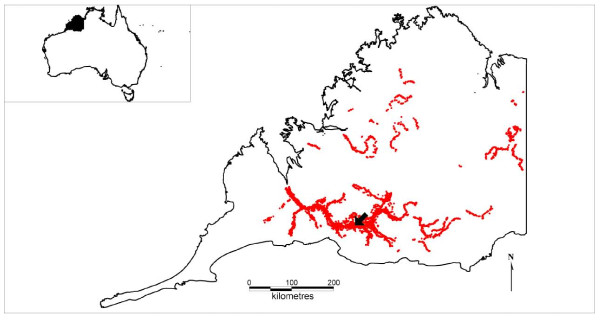
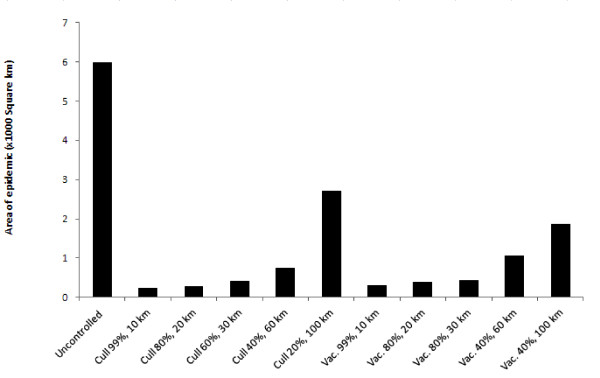
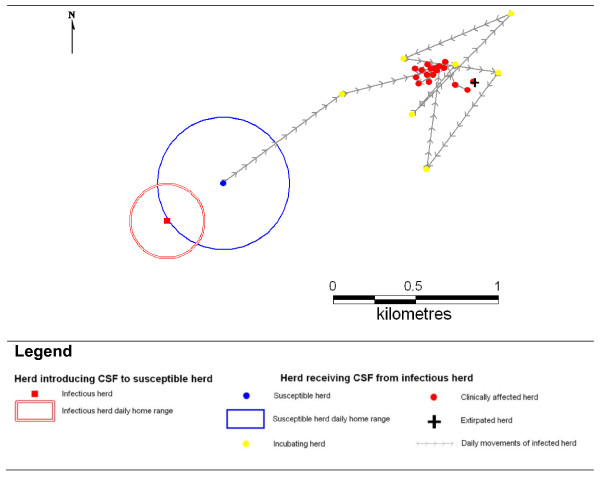
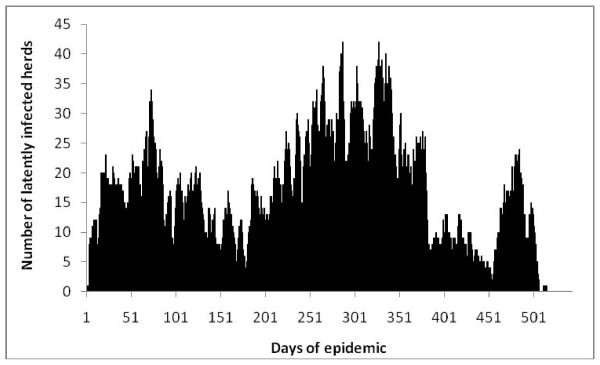
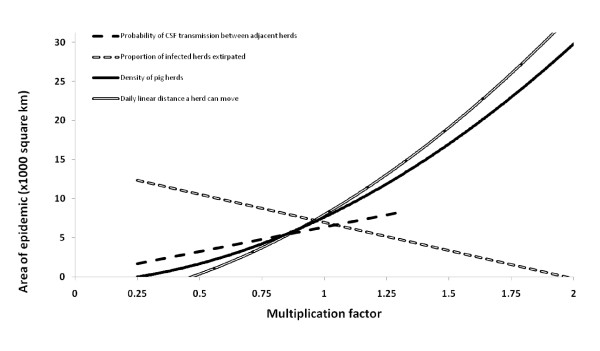
Disease modelling is one approach for providing new insights into wildlife disease epidemiology. This paper describes a spatio-temporal, stochastic, susceptible- exposed-infected-recovered process model that simulates the potential spread of classical swine fever through a documented, large and free living wild pig population following a simulated incursion. The study area (300 000 km2) was in northern Australia. Published data on wild pig ecology from Australia, and international Classical Swine Fever data was used to parameterise the model. Sensitivity analyses revealed that herd density (best estimate 1-3 pigs km-2), daily herd movement distances (best estimate approximately 1 km), probability of infection transmission between herds (best estimate 0.75) and disease related herd mortality (best estimate 42%) were highly influential on epidemic size but that extraordinary movements of pigs and the yearly home range size of a pig herd were not. CSF generally established (98% of simulations) following a single point introduction. CSF spread at approximately 9 km2 per day with low incidence rates (< 2 herds per day) in an epidemic wave along contiguous habitat for several years, before dying out (when the epidemic arrived at the end of a contiguous sub-population or at a low density wild pig area). The low incidence rate indicates that surveillance for wildlife disease epidemics caused by short lived infections will be most efficient when surveillance is based on detection and investigation of clinical events, although this may not always be practical. Epidemics could be contained and eradicated with culling (aerial shooting) or vaccination when these were adequately implemented. It was apparent that the spatial structure, ecology and behaviour of wild populations must be accounted for during disease management in wildlife. An important finding was that it may only be necessary to cull or vaccinate relatively small proportions of a population to successfully contain and eradicate some wildlife disease epidemics.
疾病建模是提供野生动物疾病流行病学新见解的一种方法。本文描述了一种时空随机易感染-暴露-感染-恢复过程模型,用于模拟在模拟入侵后,通过有记录的、大型的自由生活野猪种群传播古典猪瘟的潜在情况。研究区域(300000 平方公里)位于澳大利亚北部。该模型使用了来自澳大利亚和国际的关于野猪生态学的已发表数据以及古典猪瘟数据进行参数化。敏感性分析表明,猪群密度(最佳估计值为 1-3 头猪/平方公里)、每日猪群移动距离(最佳估计值约为 1 公里)、猪群之间感染传播的可能性(最佳估计值为 0.75)和疾病相关的猪群死亡率(最佳估计值为 42%)对疫情规模有很大影响,但猪的异常移动和猪群每年的家域大小则没有影响。CSF 通常在单点引入后建立(98%的模拟)。CSF 以每天约 9 平方公里的速度传播,在连续的栖息地中以低发病率(每天不到 2 个猪群)形成多年的疫情波,然后逐渐消失(当疫情到达连续的亚种群末端或野猪密度较低的地区时)。低发病率表明,基于对临床事件的检测和调查进行野生动物疾病疫情监测将是最有效的,尽管这在实践中可能并不总是可行。通过适当实施扑杀(空中射击)或接种疫苗,可以控制和消灭疫情。显然,在野生动物疾病管理中,必须考虑到野生动物种群的空间结构、生态和行为。一个重要的发现是,成功控制和消灭一些野生动物疾病疫情,可能只需要对相对较小比例的种群进行扑杀或接种疫苗。