Blagosklonny Mikhail V
Department of Cell Stress Biology, Roswell Park Cancer Institute, Buffalo, NY 14263, USA.
Aging (Albany NY). 2011 Dec;3(12):1130-41. doi: 10.18632/aging.100422.
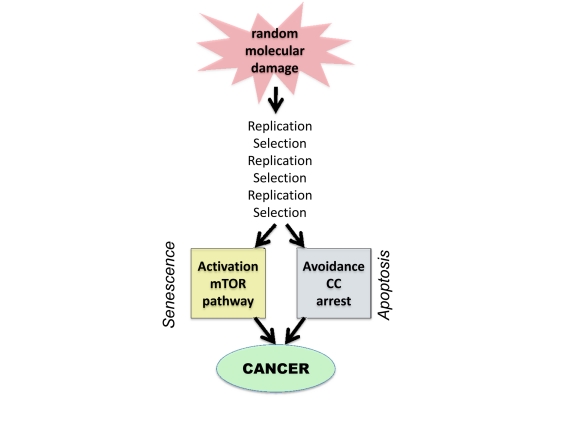
Despite common belief, accumulation of molecular damage does not play a key role in aging. Still, cancer (an age-related disease) is initiated by molecular damage. Cancer and aging share a lot in common including the activation of the TOR pathway. But the role of molecular damage distinguishes cancer and aging. Furthermore, an analysis of the role of both damage and aging in cancer argues against "a decline, caused by accumulation of molecular damage" as a cause of aging. I also discuss how random molecular damage, via rounds of multiplication and selection, brings about non-random hallmarks of cancer.
尽管人们普遍认为,分子损伤的积累在衰老过程中并不起关键作用。然而,癌症(一种与年龄相关的疾病)却是由分子损伤引发的。癌症和衰老有许多共同之处,包括TOR通路的激活。但分子损伤在癌症和衰老中所起的作用有所不同。此外,对损伤和衰老在癌症中的作用进行分析后发现,“由分子损伤积累导致的衰退”作为衰老原因的观点并不成立。我还将探讨随机分子损伤如何通过多轮增殖和选择产生癌症的非随机特征。