Pettis Jeffery S, vanEngelsdorp Dennis, Johnson Josephine, Dively Galen
USDA-ARS Bee Research Laboratory, Beltsville, MD, USA.
Naturwissenschaften. 2012 Feb;99(2):153-8. doi: 10.1007/s00114-011-0881-1. Epub 2012 Jan 13.
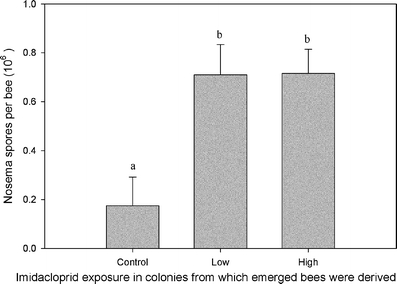
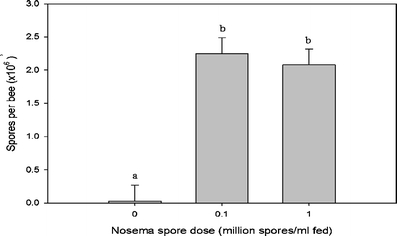
Global pollinator declines have been attributed to habitat destruction, pesticide use, and climate change or some combination of these factors, and managed honey bees, Apis mellifera, are part of worldwide pollinator declines. Here we exposed honey bee colonies during three brood generations to sub-lethal doses of a widely used pesticide, imidacloprid, and then subsequently challenged newly emerged bees with the gut parasite, Nosema spp. The pesticide dosages used were below levels demonstrated to cause effects on longevity or foraging in adult honey bees. Nosema infections increased significantly in the bees from pesticide-treated hives when compared to bees from control hives demonstrating an indirect effect of pesticides on pathogen growth in honey bees. We clearly demonstrate an increase in pathogen growth within individual bees reared in colonies exposed to one of the most widely used pesticides worldwide, imidacloprid, at below levels considered harmful to bees. The finding that individual bees with undetectable levels of the target pesticide, after being reared in a sub-lethal pesticide environment within the colony, had higher Nosema is significant. Interactions between pesticides and pathogens could be a major contributor to increased mortality of honey bee colonies, including colony collapse disorder, and other pollinator declines worldwide.
全球传粉者数量的减少归因于栖息地破坏、农药使用、气候变化或这些因素的某种组合,而人工饲养的蜜蜂(西方蜜蜂)也是全球传粉者数量减少的一部分。在此,我们让蜂群在三个育雏世代中接触亚致死剂量的一种广泛使用的农药吡虫啉,然后用肠道寄生虫微孢子虫属对新羽化出的蜜蜂进行后续挑战。所使用的农药剂量低于已证明会对成年蜜蜂的寿命或觅食产生影响的水平。与来自对照蜂箱的蜜蜂相比,来自经农药处理蜂箱的蜜蜂体内微孢子虫感染显著增加,这表明农药对蜜蜂体内病原体生长有间接影响。我们清楚地证明,在暴露于全球使用最广泛的农药之一吡虫啉的蜂群中饲养的个体蜜蜂,其体内病原体生长增加,且该农药剂量低于被认为对蜜蜂有害的水平。这一发现很重要,即在蜂群内的亚致死农药环境中饲养后,体内目标农药水平检测不到的个体蜜蜂感染微孢子虫的程度更高。农药与病原体之间的相互作用可能是导致蜜蜂蜂群死亡率增加(包括蜂群崩溃失调)以及全球其他传粉者数量减少的一个主要因素。