Infectious Disease Epidemiology Group, Weill Cornell Medical College--Qatar, Cornell University, Qatar Foundation--Education City, Doha, Qatar.
Sex Transm Infect. 2012 Feb;88(1):51-7. doi: 10.1136/sextrans-2011-050114.
To describe patterns of HIV infection among stable sexual partnerships across sub-Saharan Africa (SSA).
The authors defined measures of HIV discordancy and conducted a comprehensive quantitative assessment of discordancy among stable partnerships in 20 countries in SSA through an analysis of the Demographic and Health Survey data.
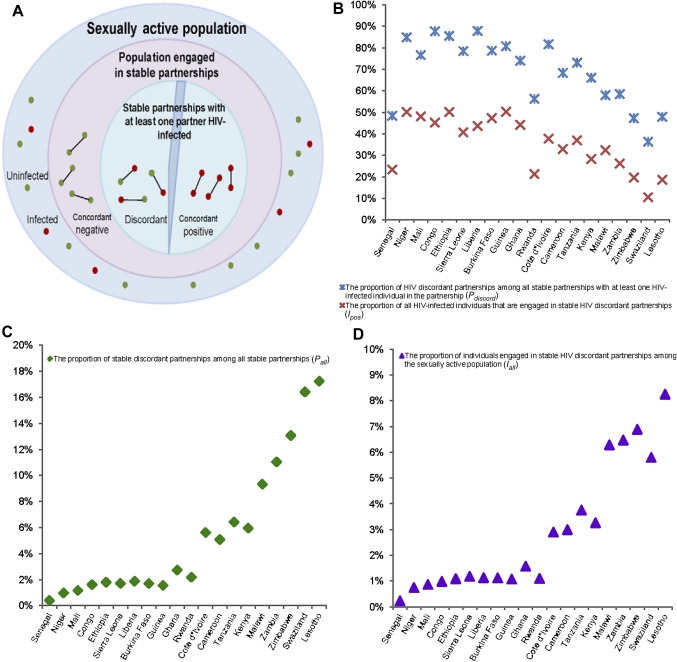
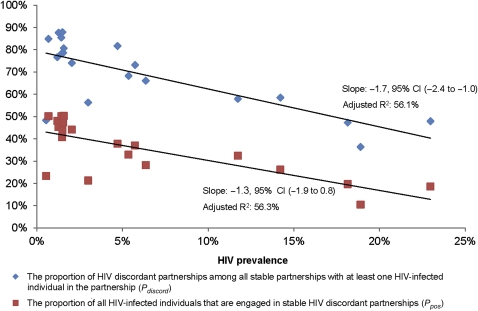
HIV prevalence explained at least 50% of the variation in HIV discordancy, with two distinct patterns of discordancy emerging based on HIV prevalence being roughly smaller or larger than 10%. In low-prevalence countries, approximately 75% of partnerships affected by HIV are discordant, while only about half of these are discordant in high-prevalence countries. Out of each 10 HIV infected persons, two to five are engaged in discordant partnerships in low-prevalence countries compared with one to three in high-prevalence countries. Among every 100 partnerships in the population, one to nine are affected by HIV and zero to six are discordant in low-prevalence countries compared with 16-45 and 9-17, respectively, in high-prevalence countries. Finally, zero to four of every 100 sexually active adults are engaged in a discordant partnership in low-prevalence countries compared with six to eight in high-prevalence countries.
In high-prevalence countries, a large fraction of stable partnerships were affected by HIV and half were discordant, whereas in low-prevalence countries, fewer stable partnerships were affected by HIV but a higher proportion of them were discordant. The findings provide a global view of HIV infection among stable partnerships in SSA but imply complex considerations for rolling out prevention interventions targeting discordant partnerships.
描述撒哈拉以南非洲(SSA)稳定性伴侣中 HIV 感染的模式。
作者定义了 HIV 不一致的衡量标准,并通过对 SSA 20 个国家的人口与健康调查数据进行分析,对稳定伴侣之间的不一致情况进行了全面的定量评估。
HIV 流行率至少解释了 HIV 不一致性变化的 50%,根据 HIV 流行率的大小,出现了两种截然不同的不一致模式,大致分为 HIV 流行率较小或较大的两种模式。在低流行率国家,大约 75%受 HIV 影响的伴侣存在不一致性,而在高流行率国家,只有大约一半的伴侣存在不一致性。每 10 名 HIV 感染者中,有 2 到 5 人处于低流行率国家的不一致伴侣关系中,而在高流行率国家中,有 1 到 3 人处于不一致伴侣关系中。在低流行率国家,每 100 对人群中的伴侣中,有 1 到 9 对受到 HIV 的影响,而零到 6 对存在不一致性,而在高流行率国家,这一比例分别为 16-45 和 9-17。最后,在低流行率国家,每 100 名活跃性伴侣中,有 0 到 4 人处于不一致的伴侣关系中,而在高流行率国家,有 6 到 8 人处于不一致的伴侣关系中。
在高流行率国家,大量稳定的伴侣关系受到 HIV 的影响,其中一半是不一致的,而在低流行率国家,受到 HIV 影响的稳定伴侣关系较少,但其中更多的伴侣关系是不一致的。这些发现提供了撒哈拉以南非洲稳定伴侣中 HIV 感染的全球视角,但意味着为推广针对不一致伴侣关系的预防干预措施需要考虑到复杂因素。