Mancuso Carol A, Choi Tiffany N, Westermann Heidi, Wenderoth Suzanne, Hollenberg James P, Wells Martin T, Isen Alice M, Jobe Jared B, Allegrante John P, Charlson Mary E
Hospital for Special Surgery, New York, NY 10021, USA.
Arch Intern Med. 2012 Feb 27;172(4):337-43. doi: 10.1001/archinternmed.2011.1316. Epub 2012 Jan 23.
Patients with asthma engage in less physical activity than peers without asthma. Protocols are needed to prudently increase physical activity in asthma patients. We evaluated whether an educational intervention enhanced with positive-affect induction and self-affirmation was more effective than the educational protocol alone in increasing physical activity in asthma patients.
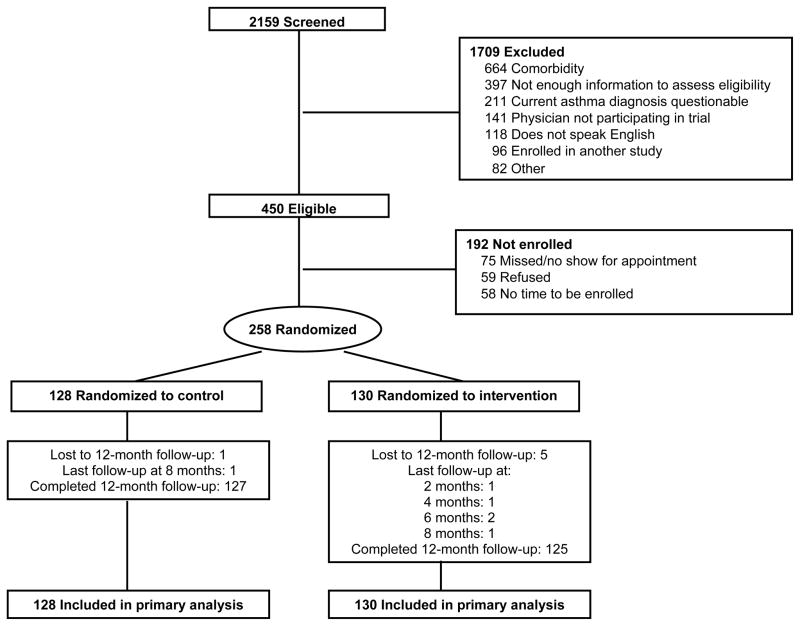
We conducted a randomized trial in New York City from September 28, 2004, through July 5, 2007; of 258 asthma patients, 252 completed the trial. At enrollment, control subjects completed a survey measuring energy expenditure, made a contract to increase physical activity, received a pedometer and an asthma workbook, and then underwent bimonthly follow-up telephone calls. Intervention patients received this protocol plus small gifts and instructions in fostering positive affect and self-affirmation. The main outcome was the within-patient change in energy expenditure in kilocalories per week from enrollment to 12 months with an intent-to-treat analysis.
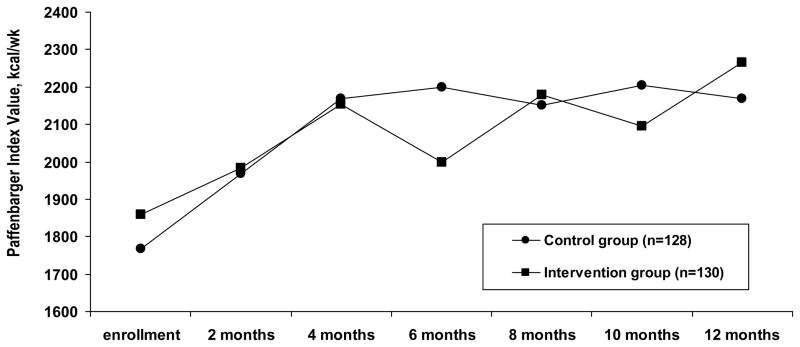
Mean (SD) energy expenditure at enrollment was 1767 (1686) kcal/wk among controls and 1860 (1633) kcal/wk among intervention patients (P = .65) and increased by 415 (95% CI, 76-754; P = .02) and 398 (95% CI, 145-652; P = .002) kcal/wk, respectively, with no difference between groups (P = .94). For both groups, energy expenditure was sustained through 12 months. No adverse events were attributed to the trial. In multivariate analysis, increased energy expenditure was associated with less social support, decreased depressive symptoms, more follow-up calls, use of the pedometer, fulfillment of the contract, and the intervention among patients who required urgent asthma care (all P < .10, 2-sided test).
A multiple-component protocol was effective in increasing physical activity in asthma patients, but an intervention to increase positive affect and self-affirmation was not effective within this protocol. The intervention may have had some benefit, however, in the subgroup of patients who required urgent asthma care during the trial. Trial Registration clinicaltrials.gov Identifier: NCT00195117.
哮喘患者的体力活动比无哮喘的同龄人少。需要制定方案以谨慎地增加哮喘患者的体力活动。我们评估了一种通过积极情感诱导和自我肯定强化的教育干预措施,在增加哮喘患者体力活动方面是否比单纯的教育方案更有效。
我们于2004年9月28日至2007年7月5日在纽约市进行了一项随机试验;258例哮喘患者中,252例完成了试验。入组时,对照组完成一项测量能量消耗的调查,签订增加体力活动的合同,收到一个计步器和一本哮喘工作手册,然后每两个月接受一次随访电话。干预组患者接受该方案,外加小礼物以及培养积极情感和自我肯定的指导。主要结局是从入组到12个月时,患者每周以千卡为单位的能量消耗的自身变化,并进行意向性分析。
入组时,对照组的平均(标准差)能量消耗为1767(1686)千卡/周,干预组患者为1860(1633)千卡/周(P = 0.65),分别增加了415(95%CI,76 - 754;P = 0.02)和398(95%CI,145 - 652;P = 0.002)千卡/周,两组之间无差异(P = 0.94)。两组的能量消耗在12个月内均持续保持。没有不良事件归因于该试验。在多变量分析中,能量消耗增加与社会支持较少、抑郁症状减轻、随访电话次数增多、使用计步器、履行合同以及对需要紧急哮喘护理的患者进行干预有关(所有P < 0.10,双侧检验)。
一个多成分方案在增加哮喘患者的体力活动方面是有效的,但在该方案中增加积极情感和自我肯定的干预措施无效。然而,在试验期间需要紧急哮喘护理的患者亚组中,该干预措施可能有一些益处。试验注册 clinicaltrials.gov标识符:NCT00195117。