Mancini Antonio, Festa Roberto, Raimondo Sebastiano, Pontecorvi Alfredo, Littarru Gian Paolo
Department of Internal Medicine, Division of Endocrinology, Catholic University of the Sacred Heart, Largo Gemelli, 1-00168 Rome, Italy.
Int J Mol Sci. 2011;12(12):9216-25. doi: 10.3390/ijms12129216. Epub 2011 Dec 9.
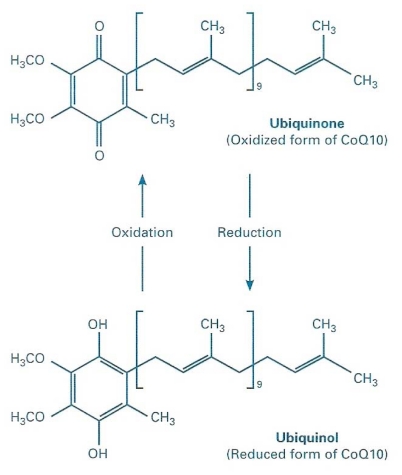
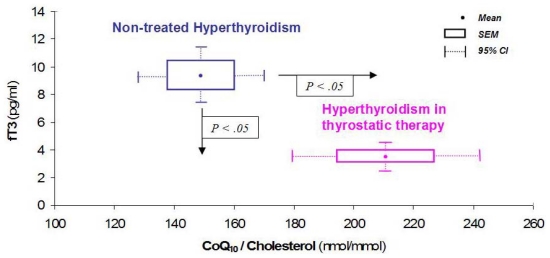
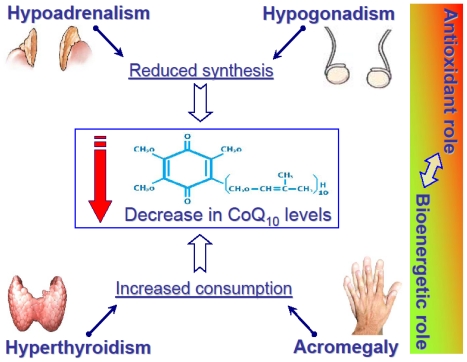
Coenzyme Q(10) (CoQ(10)), also known as ubiquinone for its presence in all body cells, is an essential part of the cell energy-producing system. However, it is also a powerful lipophilic antioxidant protecting lipoproteins and cell membranes. Due to these two actions, CoQ(10) is commonly used in clinical practice in chronic heart failure, male infertility, and neurodegenerative disease. However, it is also taken as an anti-aging substance by healthy people aiming for long-term neuroprotection and by sportsmen to improve endurance. Many hormones are known to be involved in body energy regulation, in terms of production, consumption and dissipation, and their influence on CoQ(10) body content or blood values may represent an important pathophysiological mechanism. We summarize the main findings of the literature about the link between hormonal systems and circulating CoQ(10) levels. In particular the role of thyroid hormones, directly involved in the regulation of energy homeostasis, is discussed. There is also a link with gonadal and adrenal hormones, partially due to the common biosynthetic pathway with CoQ(10), but also to the increased oxidative stress found in hypogonadism and hypoadrenalism.
辅酶Q(10)(CoQ(10)),因其存在于所有人体细胞中也被称为泛醌,是细胞能量产生系统的重要组成部分。然而,它也是一种强大的亲脂性抗氧化剂,可保护脂蛋白和细胞膜。由于这两种作用,CoQ(10)常用于慢性心力衰竭、男性不育症和神经退行性疾病的临床治疗。此外,健康人群为了长期的神经保护作用将其作为抗衰老物质服用,运动员也会服用以提高耐力。已知许多激素参与身体能量的产生、消耗和消散的调节,它们对CoQ(10)体内含量或血液值的影响可能代表一种重要的病理生理机制。我们总结了关于激素系统与循环CoQ(10)水平之间联系的文献主要研究结果。特别讨论了直接参与能量稳态调节的甲状腺激素的作用。与性腺和肾上腺激素也存在联系,部分原因是它们与CoQ(10)有共同的生物合成途径,还因为性腺功能减退和肾上腺功能减退中存在氧化应激增加的情况。