Department of Psychiatry, Oregon Health & Science University, Portland, Oregon, United States of America.
PLoS One. 2012;7(1):e30468. doi: 10.1371/journal.pone.0030468. Epub 2012 Jan 20.
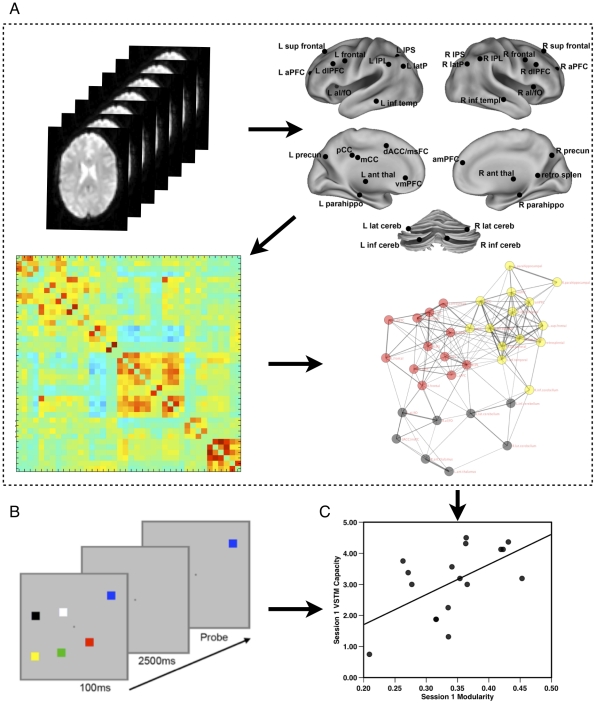
Cognitive abilities, such as working memory, differ among people; however, individuals also vary in their own day-to-day cognitive performance. One potential source of cognitive variability may be fluctuations in the functional organization of neural systems. The degree to which the organization of these functional networks is optimized may relate to the effective cognitive functioning of the individual. Here we specifically examine how changes in the organization of large-scale networks measured via resting state functional connectivity MRI and graph theory track changes in working memory capacity.
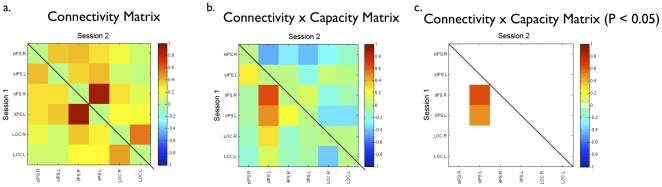
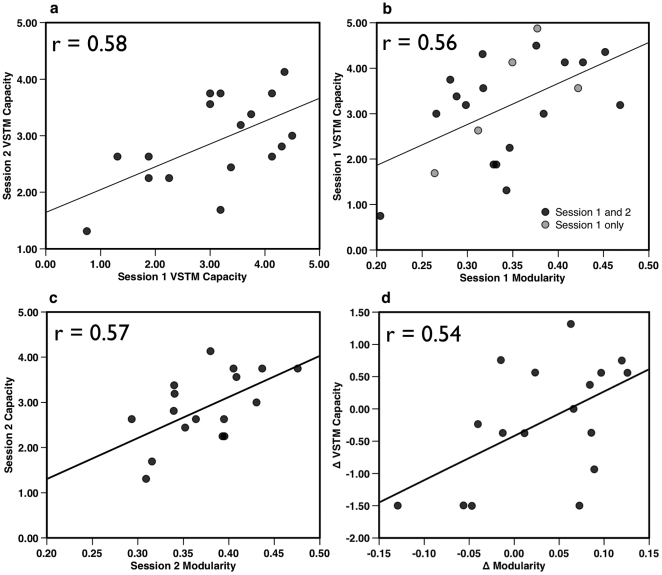
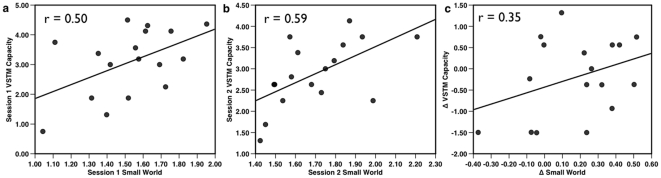
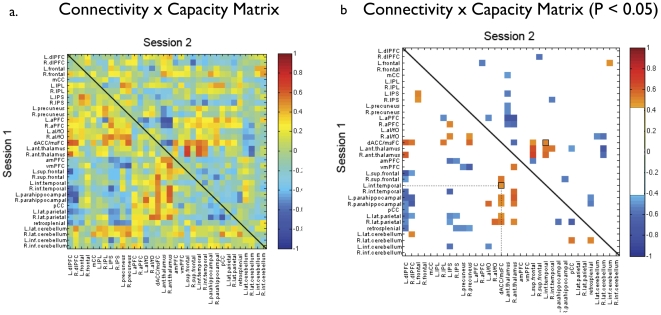
METHODOLOGY/PRINCIPAL FINDINGS: Twenty-two participants performed a test of working memory capacity and then underwent resting-state fMRI. Seventeen subjects repeated the protocol three weeks later. We applied graph theoretic techniques to measure network organization on 34 brain regions of interest (ROI). Network modularity, which measures the level of integration and segregation across sub-networks, and small-worldness, which measures global network connection efficiency, both predicted individual differences in memory capacity; however, only modularity predicted intra-individual variation across the two sessions. Partial correlations controlling for the component of working memory that was stable across sessions revealed that modularity was almost entirely associated with the variability of working memory at each session. Analyses of specific sub-networks and individual circuits were unable to consistently account for working memory capacity variability.
CONCLUSIONS/SIGNIFICANCE: The results suggest that the intrinsic functional organization of an a priori defined cognitive control network measured at rest provides substantial information about actual cognitive performance. The association of network modularity to the variability in an individual's working memory capacity suggests that the organization of this network into high connectivity within modules and sparse connections between modules may reflect effective signaling across brain regions, perhaps through the modulation of signal or the suppression of the propagation of noise.
认知能力,如工作记忆,在人与人之间存在差异;然而,个体在自己的日常认知表现中也存在差异。认知变异性的一个潜在来源可能是神经系统功能组织的波动。这些功能网络的组织程度优化的程度可能与个体的有效认知功能有关。在这里,我们特别研究了通过静息状态功能连接磁共振成像和图论测量的大规模网络组织的变化如何跟踪工作记忆能力的变化。
方法/主要发现:22 名参与者进行了工作记忆能力测试,然后进行了静息状态 fMRI。17 名受试者在三周后重复了该方案。我们应用图论技术测量 34 个感兴趣脑区(ROI)的网络组织。网络模块性,用于衡量子网络之间的整合和隔离程度,以及小世界性,用于衡量全局网络连接效率,都预测了记忆能力的个体差异;然而,只有模块性预测了两次会议之间的个体内变异。控制跨会议稳定的工作记忆成分的偏相关表明,模块性几乎完全与每次会议的工作记忆变异性相关。对特定子网络和个体电路的分析无法一致解释工作记忆容量的可变性。
结论/意义:结果表明,在休息时测量的预先定义的认知控制网络的内在功能组织提供了关于实际认知表现的大量信息。网络模块性与个体工作记忆能力变异性的关联表明,该网络的组织成模块内高连接性和模块间稀疏连接可能反映了大脑区域之间有效的信号传递,可能通过信号的调制或噪声传播的抑制。