Institute of Biochemical and Biomedical Engineering, Chang-Gung University, Tao-Yuan, Taiwan.
PLoS One. 2012;7(2):e31200. doi: 10.1371/journal.pone.0031200. Epub 2012 Feb 2.
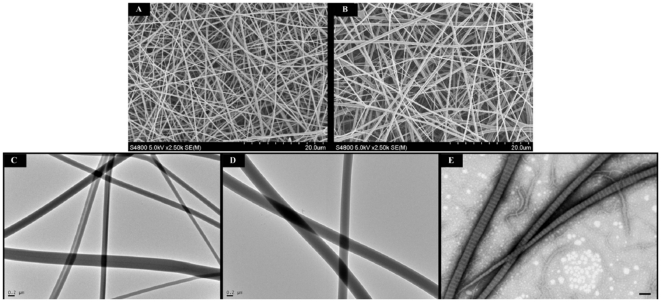
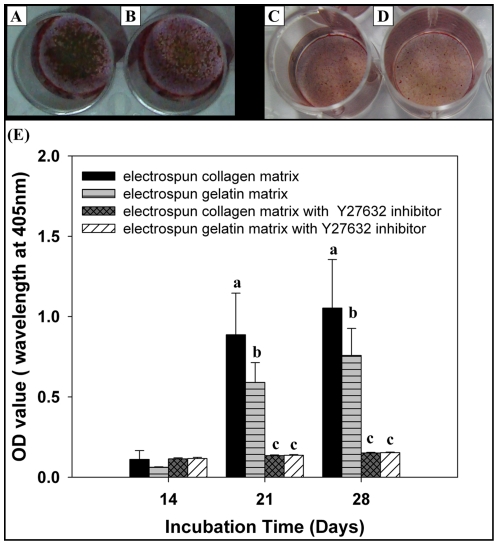
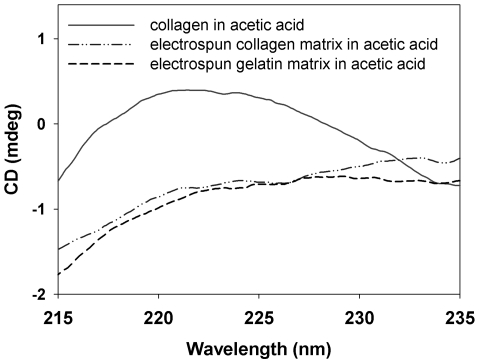
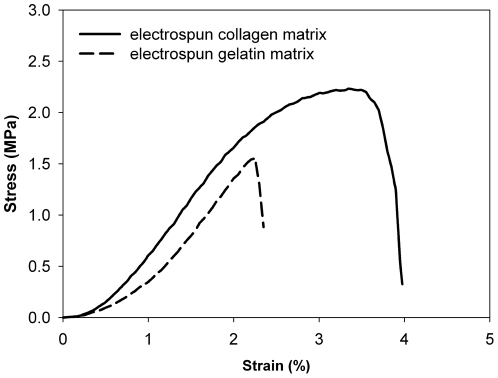
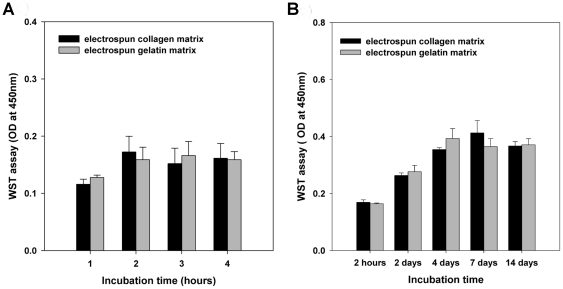
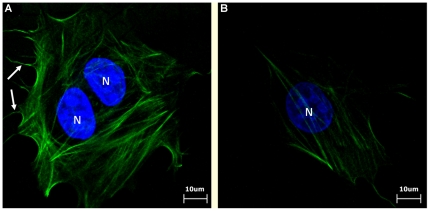
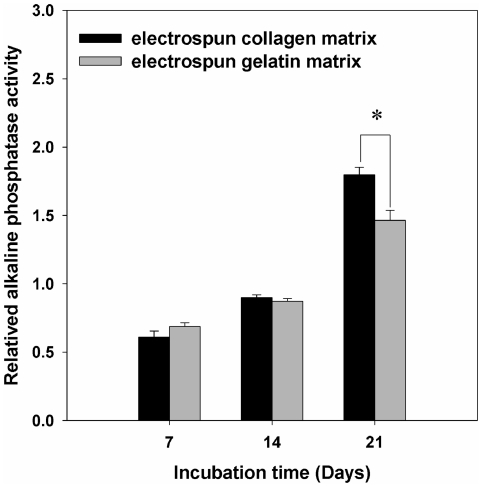
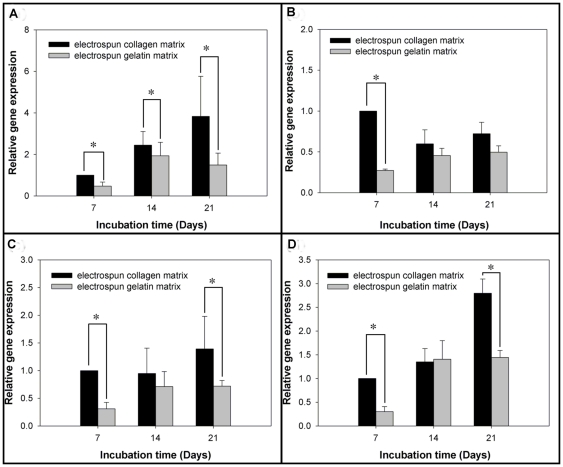
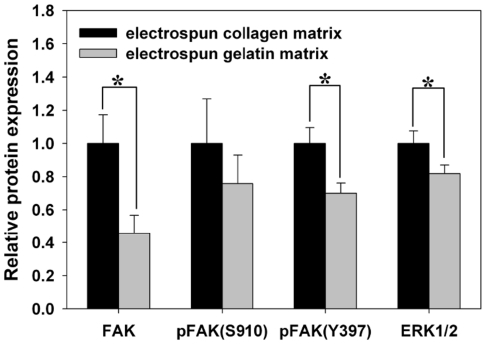
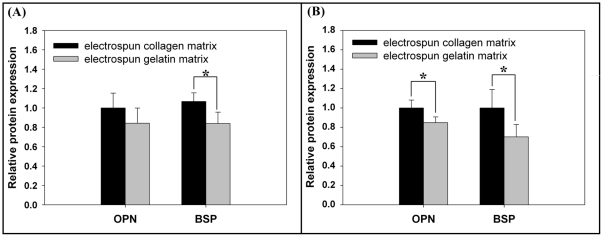
Electrospinning is a simple and efficient method of fabricating a non-woven polymeric nanofiber matrix. However, using fluorinated alcohols as a solvent for the electrospinning of proteins often results in protein denaturation. TEM and circular dichroism analysis indicated a massive loss of triple-helical collagen from an electrospun collagen (EC) matrix, and the random coils were similar to those found in gelatin. Nevertheless, from mechanical testing we found the Young's modulus and ultimate tensile stresses of EC matrices were significantly higher than electrospun gelatin (EG) matrices because matrix stiffness can affect many cell behaviors such as cell adhesion, proliferation and differentiation. We hypothesize that the difference of matrix stiffness between EC and EG will affect intracellular signaling through the mechano-transducers Rho kinase (ROCK) and focal adhesion kinase (FAK) and subsequently regulates the osteogenic phenotype of MG63 osteoblast-like cells. From the results, we found there was no significant difference between the EC and EG matrices with respect to either cell attachment or proliferation rate. However, the gene expression levels of OPN, type I collagen, ALP, and OCN were significantly higher in MG63 osteoblast-like cells grown on the EC than in those grown on the EG. In addition, the phosphorylation levels of Y397-FAK, ERK1/2, BSP, and OPN proteins, as well as ALP activity, were also higher on the EC than on the EG. We further inhibited ROCK activation with Y27632 during differentiation to investigate its effects on matrix-mediated osteogenic differentiation. Results showed the extent of mineralization was decreased with inhibition after induction. Moreover, there is no significant difference between EC and EG. From the results of the protein levels of phosphorylated Y397-FAK, ERK1/2, BSP and OPN, ALP activity and mineral deposition, we speculate that the mechanism that influences the osteogenic differentiation of MG63 osteoblast-like cells on EC and EG is matrix stiffness and via ROCK-FAK-ERK1/2.
静电纺丝是一种制造无纺聚合物纳米纤维基质的简单而有效的方法。然而,使用含氟醇作为蛋白质静电纺丝的溶剂通常会导致蛋白质变性。TEM 和圆二色性分析表明,胶原蛋白(EC)基质中的三螺旋胶原蛋白大量丢失,而无规卷曲与明胶中的相似。然而,从力学测试中我们发现,EC 基质的杨氏模量和极限拉伸应力明显高于静电纺丝明胶(EG)基质,因为基质的刚度会影响许多细胞行为,如细胞黏附、增殖和分化。我们假设,EC 和 EG 基质之间的基质刚度差异会通过机械转导 Rho 激酶(ROCK)和粘着斑激酶(FAK)影响细胞内信号,从而调节 MG63 成骨样细胞的成骨表型。从结果来看,我们发现 EC 和 EG 基质在细胞黏附或增殖率方面没有显著差异。然而,在 MG63 成骨样细胞中,OPN、I 型胶原蛋白、ALP 和 OCN 的基因表达水平在生长于 EC 上的细胞中明显高于生长于 EG 上的细胞。此外,在 EC 上,FAK 的 Y397 磷酸化、ERK1/2、BSP 和 OPN 蛋白的磷酸化水平以及 ALP 活性也高于 EG。我们进一步用 Y27632 抑制 ROCK 的激活,以研究其对基质介导的成骨分化的影响。结果表明,在诱导后抑制 ROCK 的激活会降低矿化程度。此外,EC 和 EG 之间没有显著差异。从磷酸化 Y397-FAK、ERK1/2、BSP 和 OPN 的蛋白水平、ALP 活性和矿物质沉积的结果来看,我们推测影响 MG63 成骨样细胞在 EC 和 EG 上成骨分化的机制是基质刚度和 ROCK-FAK-ERK1/2。