Public Health Sciences Department, Karolinska Institute, Stockholm, Sweden.
BMC Public Health. 2012 Feb 21;12:138. doi: 10.1186/1471-2458-12-138.
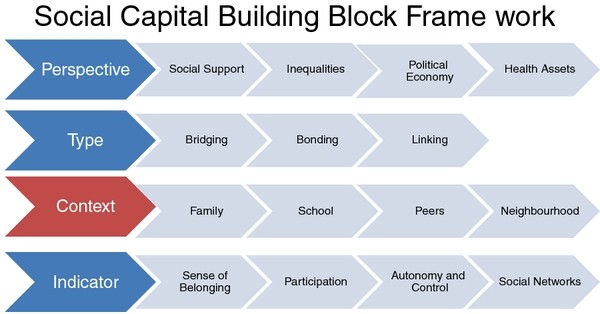
This study used a social capital framework to examine the relationship between a set of potential protective ('health assets') factors and the wellbeing of 15 year adolescents living in Spain and England. The overall purpose of the study was to compare the consistency of these relationships between countries and to investigate their respective relative importance.
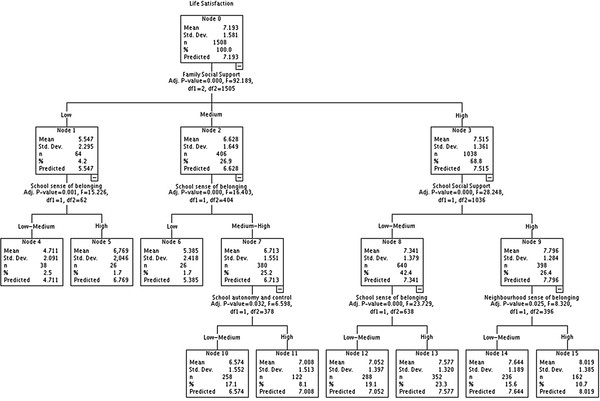
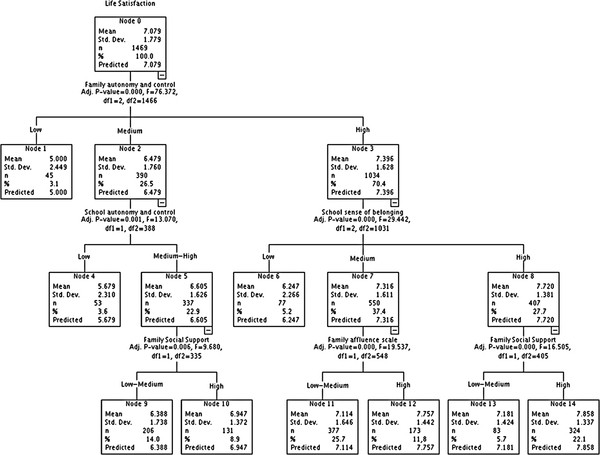
Data were drawn from the 2002, English and Spanish components of the WHO Health Behaviour in School-Aged Children (HBSC) survey A total of 3,591 respondents (1884, Spain; 1707, England) aged 15, drawn from random samples of students in 215 and 80 schools respectively were included in the study. A series of univariate, bivariate and multivariate (general linear modelling and decision tree) analyses were used to establish the relationships.
Results showed that the wellbeing of Spanish and English adolescents is similar and good. Three measures of social capital and 2 measures of social support were found to be important factors in the general linear model. Namely, family autonomy and control; family and school sense of belonging; and social support at home and school. However, there were differences in how the sub components of social capital manifest themselves in each country--feelings of autonomy of control, were more important in England and social support factors in Spain.
There is some evidence to suggest that social capital (and its related concept of social support) do travel and are applicable to young people living in Spain and England. Given the different constellation of assets found in each country, it is not possible to define exactly the precise formula for applying social capital across cultures. This should more appropriately be defined at the programme planning stage.
本研究使用社会资本框架来检验一组潜在的保护因素(“健康资产”)与生活在西班牙和英国的 15 岁青少年健康状况之间的关系。该研究的总体目的是比较这些关系在两国之间的一致性,并探讨它们各自的相对重要性。
数据来自世界卫生组织 2002 年的青少年健康行为调查的西班牙和英国部分,共有来自 215 所和 80 所学校的随机样本的 3591 名 15 岁学生(西班牙 1884 名,英国 1707 名)参与了这项研究。采用单变量、双变量和多变量(一般线性模型和决策树)分析来确定这些关系。
结果表明,西班牙和英国青少年的幸福感相似且良好。三种社会资本衡量指标和两种社会支持衡量指标被发现是一般线性模型中的重要因素。即家庭自治和控制、家庭和学校归属感以及家庭和学校的社会支持。然而,社会资本的子成分在两国的表现方式存在差异——自治和控制感在英国更为重要,而社会支持因素在西班牙更为重要。
有一些证据表明,社会资本(及其相关概念社会支持)可以在生活在西班牙和英国的年轻人中传播和适用。鉴于每个国家都有不同的资产组合,不可能在跨文化层面上定义适用于社会资本的确切公式。这应该在规划阶段更恰当地进行定义。