CNRS-Institut des Sciences de l'Evolution de Montpellier, Université de Montpellier II, Montpellier, France.
PLoS One. 2012;7(2):e31290. doi: 10.1371/journal.pone.0031290. Epub 2012 Feb 20.
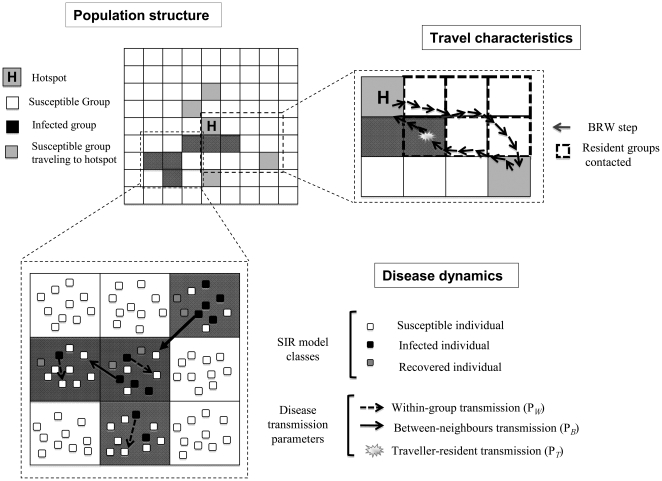
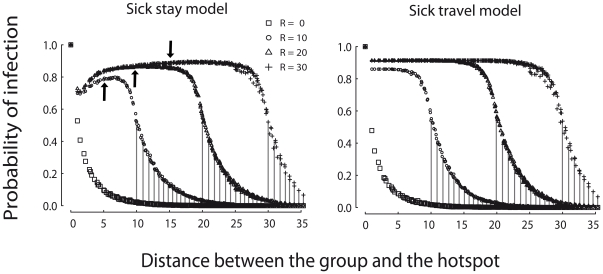
The spread of infectious diseases in wildlife populations is influenced by patterns of between-host contacts. Habitat "hotspots"--places attracting a large numbers of individuals or social groups--can significantly alter contact patterns and, hence, disease propagation. Research on the importance of habitat hotspots in wildlife epidemiology has primarily focused on how inter-individual contacts occurring at the hotspot itself increase disease transmission. However, in territorial animals, epidemiologically important contacts may primarily occur as animals cross through territories of conspecifics en route to habitat hotspots. So far, the phenomenon has received little attention. Here, we investigate the importance of these contacts in the case where infectious individuals keep visiting the hotspots and in the case where these individuals are not able to travel to the hotspot any more.
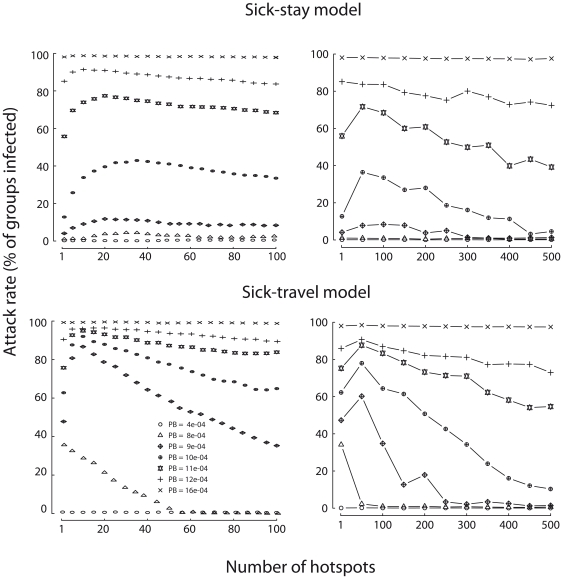
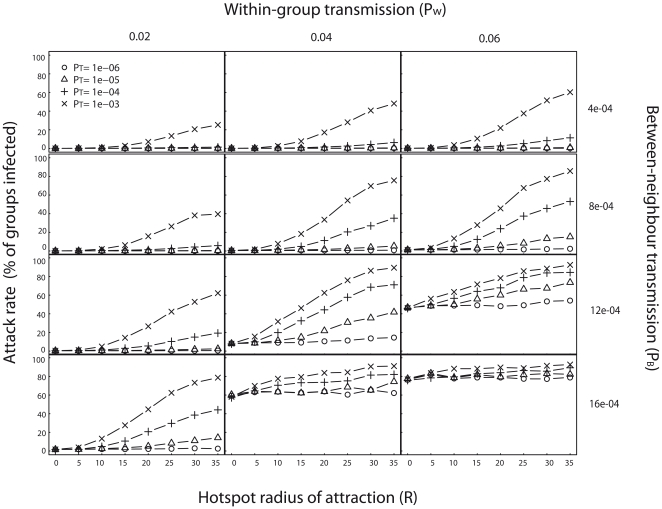
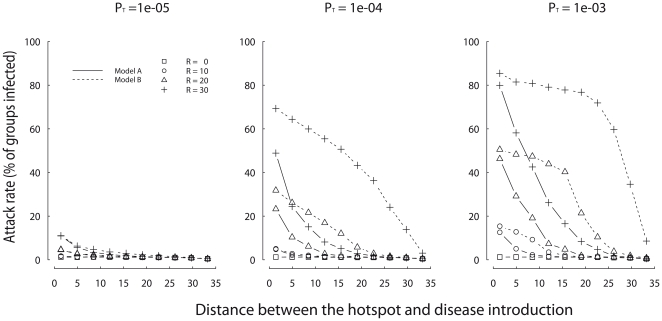
We developed a simulation epidemiological model to investigate both cases in a scenario when transmission at the hotspot does not occur. We find that (i) hotspots still exacerbate epidemics, (ii) when infectious individuals do not travel to the hotspot, the most vulnerable individuals are those residing at intermediate distances from the hotspot rather than nearby, and (iii) the epidemiological vulnerability of a population is the highest when the number of hotspots is intermediate.
By altering animal movements in their vicinity, habitat hotspots can thus strongly increase the spread of infectious diseases, even when disease transmission does not occur at the hotspot itself. Interestingly, when animals only visit the nearest hotspot, creating additional artificial hotspots, rather than reducing their number, may be an efficient disease control measure.
野生动物种群中传染病的传播受到宿主间接触模式的影响。“热点栖息地”——吸引大量个体或社会群体的地方——可以显著改变接触模式,从而影响疾病的传播。关于热点栖息地在野生动物流行病学中的重要性的研究主要集中在热点本身发生的个体间接触如何增加疾病传播。然而,在有领地的动物中,具有流行病学意义的接触主要发生在动物穿越同种个体的领地前往热点栖息地的过程中。到目前为止,这一现象还没有得到太多关注。在这里,我们研究了在感染个体继续访问热点的情况下以及这些个体无法再前往热点的情况下,这些接触的重要性。
我们开发了一个模拟流行病学模型,在热点处不发生传播的情况下,研究了这两种情况。我们发现:(i)热点仍然会加剧疫情;(ii)当感染个体不再前往热点时,最脆弱的个体是那些居住在离热点中等距离而不是附近的个体;(iii)当热点数量中等时,种群的流行病学脆弱性最高。
通过改变其附近动物的运动,热点栖息地可以强烈地增加传染病的传播,即使疾病本身不在热点处传播。有趣的是,当动物只访问最近的热点,而不是减少它们的数量,创建额外的人工热点可能是一种有效的疾病控制措施。