State Key Laboratory of Loess and Quaternary Geology, Institute of Earth Environment, Chinese Academy of Sciences, Xi'an, China.
Environ Health Perspect. 2012 Mar;120(3):373-8. doi: 10.1289/ehp.1103671.
Although ambient fine particulate matter (PM(2.5); particulate matter ≤ 2.5 µm in aerodynamic diameter) has been linked to adverse human health effects, the chemical constituents that cause harm are unknown. To our knowledge, the health effects of PM(2.5) constituents have not been reported for a developing country.
We examined the short-term association between PM(2.5) constituents and daily mortality in Xi'an, a heavily polluted Chinese city.
We obtained daily mortality data and daily concentrations of PM(2.5), organic carbon (OC), elemental carbon (EC), and 10 water-soluble ions for 1 January 2004 through 31 December 2008. We also measured concentrations of fifteen elements 1 January 2006 through 31 December 2008. We analyzed the data using overdispersed generalized linear Poisson models.
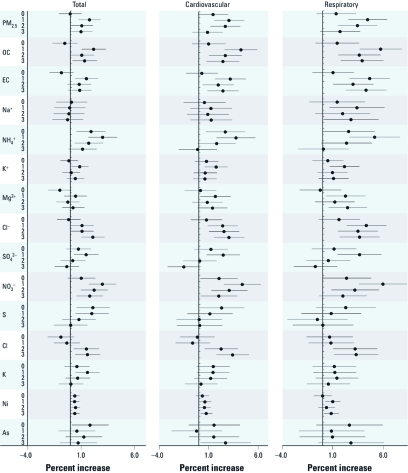
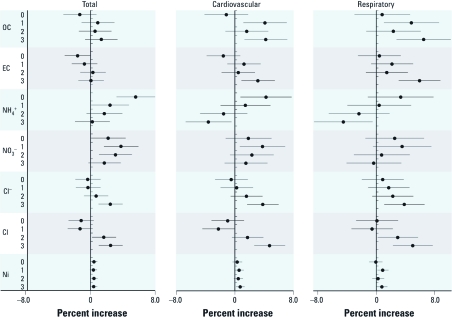
During the study period, the mean daily average concentration of PM(2.5) in Xi'an was 182.2 µg/m³. Major contributors to PM(2.5) mass included OC, EC, sulfate, nitrate, and ammonium. After adjustment for PM(2.5) mass, we found significant positive associations of total, cardiovascular, or respiratory mortality with OC, EC, ammonium, nitrate, chlorine ion, chlorine, and nickel for at least one lag period. Nitrate demonstrated stronger associations with total and cardiovascular mortality than PM(2.5) mass. For a 1-day lag, interquartile range increases in PM(2.5) mass and nitrate (114.9 and 15.4 µg/m³, respectively) were associated with 1.8% [95% confidence interval (CI): 0.8%, 2.8%] and 3.8% (95% CI: 1.7%, 5.9%) increases in total mortality.
Our findings suggest that PM(2.5) constituents from the combustion of fossil fuel may have an appreciable influence on the health effects attributable to PM(2.5) in Xi'an.
尽管环境细颗粒物(PM(2.5);空气动力学直径≤2.5 µm 的颗粒物)与人类健康的不良影响有关,但造成危害的化学成分尚不清楚。据我们所知,PM(2.5)成分对发展中国家的健康影响尚未有报道。
我们研究了西安这个中国重度污染城市中 PM(2.5)成分与每日死亡率之间的短期关联。
我们获取了 2004 年 1 月 1 日至 2008 年 12 月 31 日期间的每日死亡率数据和 PM(2.5)、有机碳(OC)、元素碳(EC)和 10 种水溶性离子的日浓度,还测量了 2006 年 1 月 1 日至 2008 年 12 月 31 日期间的 15 种元素浓度。我们采用过度分散的广义线性泊松模型对数据进行分析。
在研究期间,西安的 PM(2.5)日平均浓度为 182.2 µg/m³。PM(2.5)质量的主要贡献者包括 OC、EC、硫酸盐、硝酸盐和铵盐。在调整 PM(2.5)质量后,我们发现 OC、EC、铵盐、硝酸盐、氯离子、氯和镍与总死亡率、心血管死亡率或呼吸系统死亡率之间存在至少一个滞后期的显著正关联。硝酸盐与总死亡率和心血管死亡率的关联比 PM(2.5)质量更强。对于 1 天的滞后期,PM(2.5)质量和硝酸盐(分别为 114.9 和 15.4 µg/m³)的四分位间距增加分别与总死亡率增加 1.8%(95%置信区间:0.8%,2.8%)和 3.8%(95%置信区间:1.7%,5.9%)相关。
我们的研究结果表明,化石燃料燃烧产生的 PM(2.5)成分可能对西安归因于 PM(2.5)的健康影响产生相当大的影响。