Department of Psychology, University of Graz, Austria.
Int J Psychophysiol. 2012 May;84(2):219-25. doi: 10.1016/j.ijpsycho.2012.02.012. Epub 2012 Mar 3.
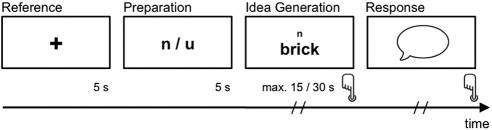
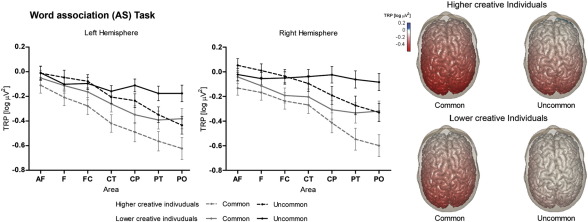
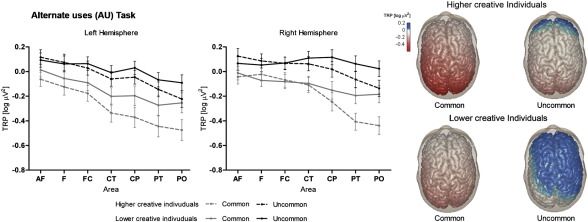
The distinction between convergent and divergent cognitive processes given by Guilford (1956) had a strong influence on the empirical research on creative thinking. Neuroscientific studies typically find higher event-related synchronization in the EEG alpha rhythm for individuals engaged in creative ideation tasks compared to intelligence-related tasks. This study examined, whether these neurophysiological effects can also be found when both cognitive processing modes (convergent vs. divergent) are assessed by means of the same task employing a simple variation of instruction. A sample of 55 participants performed the alternate uses task as well as a more basic word association task while EEG was recorded. On a trial-by-trial basis, participants were either instructed to find a most common solution (convergent condition) or a most uncommon solution (divergent condition). The answers given in the divergent condition were in both tasks significantly more original than those in the convergent condition. Moreover, divergent processing was found to involve higher task-related EEG alpha power than convergent processing in both the alternate uses task and the word association task. EEG alpha synchronization can hence explicitly be associated with divergent cognitive processing rather than with general task characteristics of creative ideation tasks. Further results point to a differential involvement of frontal and parietal cortical areas by individuals of lower versus higher trait creativity.
Guilford(1956)提出的聚合与发散认知过程的区别对创造性思维的实证研究产生了强烈影响。神经科学研究通常发现,与智力相关任务相比,从事创造性思维任务的个体的脑电图 alpha 节律中存在更高的事件相关同步。本研究通过采用相同任务的简单变化的指令来评估这两种认知加工模式(聚合与发散),考察了这些神经生理效应是否也可以找到。一个由 55 名参与者组成的样本在记录脑电图的同时执行了替代用途任务和更基本的单词联想任务。在逐个试验的基础上,参与者被指示要么找到最常见的解决方案(聚合条件),要么找到最不常见的解决方案(发散条件)。发散条件下的答案在两个任务中都明显比聚合条件下的答案更具原创性。此外,在替代用途任务和单词联想任务中,发散处理比聚合处理都涉及更高的与任务相关的 EEG alpha 功率。因此,脑电图 alpha 同步可以明确地与发散认知处理相关,而不是与创造性思维任务的一般任务特征相关。进一步的结果表明,个体的特质创造力较低与较高时,额皮质和顶叶皮质区域的参与程度存在差异。