Chen Jyh-Ping, Chen Shih-Hsien, Lai Guo-Jyun
Department of Chemical and Materials Engineering, Chang Gung University, Kwei-Shan, Tao-Yuan, Taiwan, 333, Republic of China.
Nanoscale Res Lett. 2012 Mar 6;7(1):170. doi: 10.1186/1556-276X-7-170.
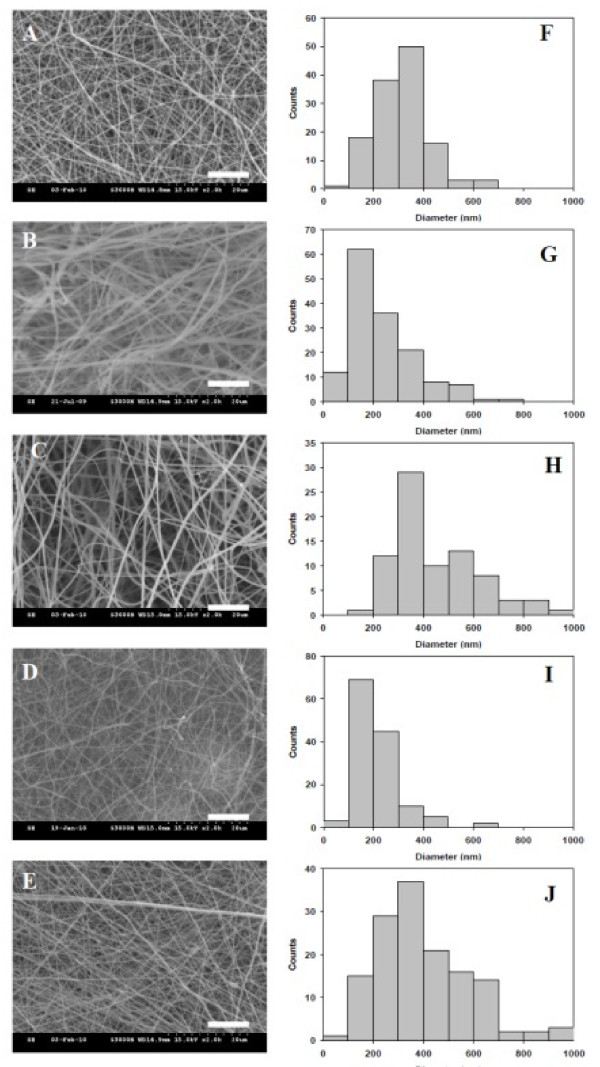
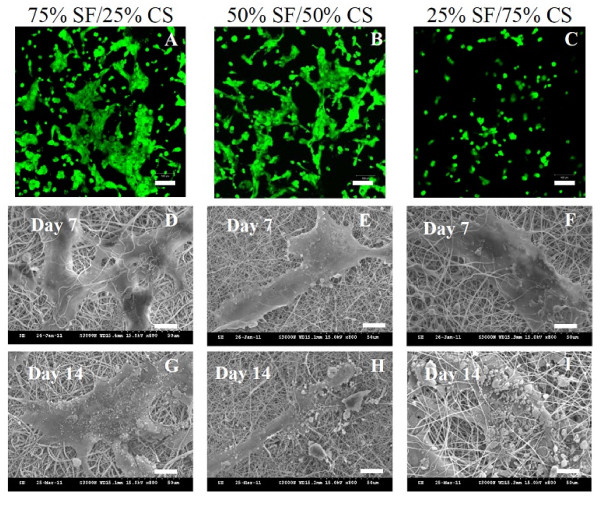
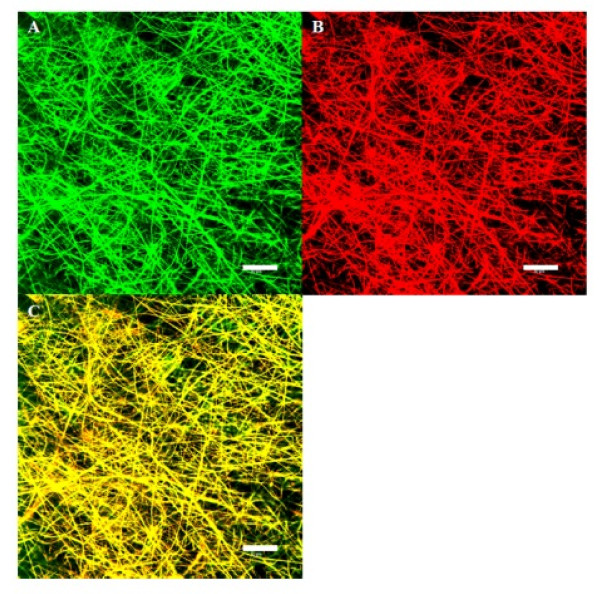
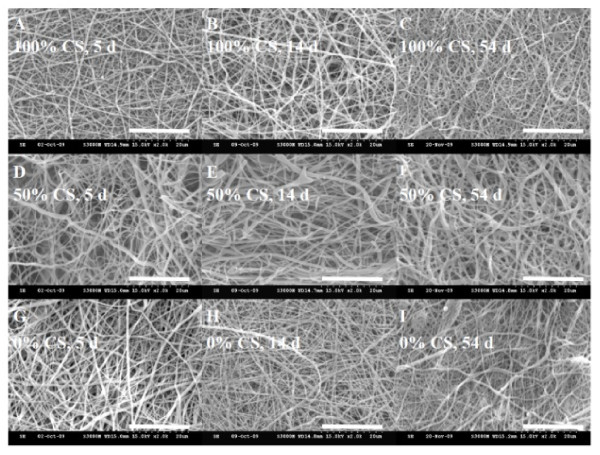
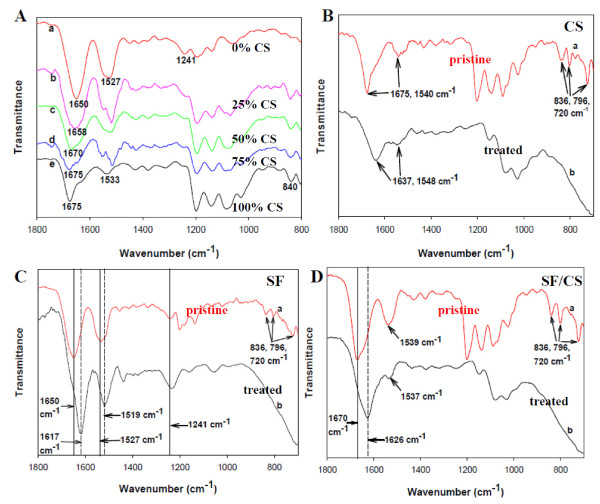
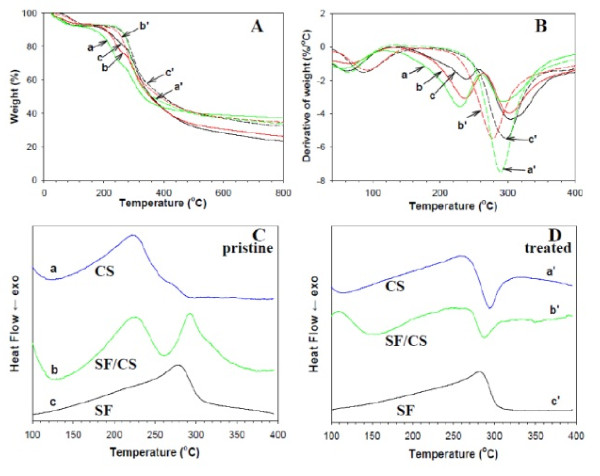
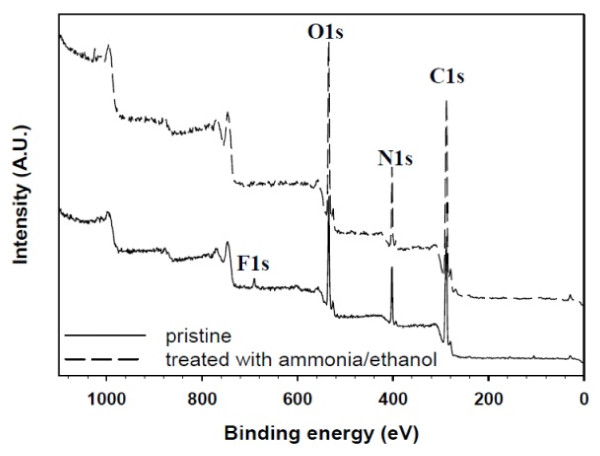
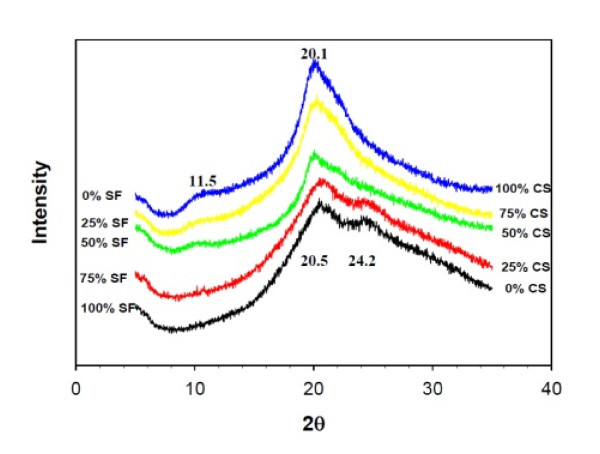
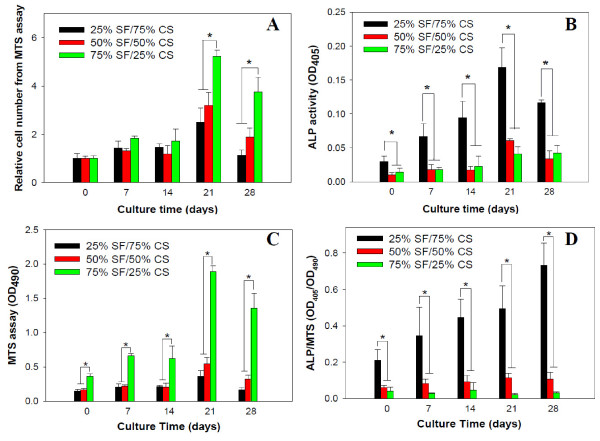
In this study, we have successfully fabricated electrospun bead-free silk fibroin [SF]/chitosan [CS] composite nanofibers [NFs] covering the whole range of CS content (0%, 25%, 50%, 75%, and 100%). SF/CS spinning solutions were prepared in a mixed solvent system of trifluoroacetic acid [TFA] and dichloromethane. The morphology of the NFs was observed by scanning electron microscope, and the average fiber diameter ranges from 215 to 478 nm. Confocal laser scanning microscopy confirms the uniform distribution of SF and CS within the composite NFs. To increase biocompatibility and preserve nanostructure when seeded with cells in culture medium, NFs were treated with an ethanol/ammonia aqueous solution to remove residual TFA and to change SF protein conformation. After the chemical treatment, SF/CS NFs could maintain the original structure for up to 54 days in culture medium. Properties of pristine and chemically treated SF/CS NFs were investigated by Fourier transform infrared spectroscopy [FT-IR], X-ray diffraction [XRD], and thermogravimetry/differential scanning calorimetry [TG/DSC]. Shift of absorption peaks in FT-IR spectra confirms the conformation change of SF from random coil to β-sheet by the action of ethanol, which is also consistent with the SF crystalline diffraction patterns measured by XRD. From TG/DSC analysis, the decomposition temperature peaks due to salt formation from TFA and protonated amines disappeared after chemical treatment, indicating complete removal of TFA by binding with ammonium ions during the treatment. This was also confirmed with the disappearance of F1s peak in X-ray photoelectron spectroscopy spectra and disappearance of TFA salt peaks in FT-IR spectra. The composite NFs could support the growth and osteogenic differentiation of human fetal osteoblastic [hFOB] cells, but each component in the composite NF shows distinct effect on cell behavior. SF promotes hFOB proliferation while CS enhances hFOB differentiation. The composite SF/CS NFs will be suitable for bone tissue engineering applications by choosing a suitable blend composition.PACS: 87.85.jf; 87.85.Rs; 68.37.Hk.
在本研究中,我们成功制备了覆盖壳聚糖(CS)全含量范围(0%、25%、50%、75%和100%)的无珠电纺丝素蛋白[SF]/壳聚糖[CS]复合纳米纤维[NFs]。SF/CS纺丝溶液在三氟乙酸[TFA]和二氯甲烷的混合溶剂体系中制备。通过扫描电子显微镜观察纳米纤维的形态,其平均纤维直径范围为215至478纳米。共聚焦激光扫描显微镜证实了SF和CS在复合纳米纤维中的均匀分布。为了在将细胞接种于培养基中时提高生物相容性并保留纳米结构,纳米纤维用乙醇/氨水溶液处理以去除残留的TFA并改变丝素蛋白的构象。化学处理后,SF/CS纳米纤维在培养基中最多可维持原始结构54天。通过傅里叶变换红外光谱[FT-IR]、X射线衍射[XRD]和热重分析/差示扫描量热法[TG/DSC]研究了原始和化学处理后的SF/CS纳米纤维的性能。FT-IR光谱中吸收峰的位移证实了乙醇作用下SF从无规卷曲构象转变为β-折叠构象,这也与XRD测量的丝素蛋白晶体衍射图谱一致。从TG/DSC分析可知,化学处理后由于TFA与质子化胺形成盐而产生的分解温度峰消失,表明处理过程中TFA通过与铵离子结合而被完全去除。这也通过X射线光电子能谱中F1s峰的消失以及FT-IR光谱中TFA盐峰的消失得到证实。复合纳米纤维能够支持人胎儿成骨细胞[hFOB]的生长和成骨分化,但复合纳米纤维中的每种成分对细胞行为都有不同的影响。SF促进hFOB增殖,而CS增强hFOB分化。通过选择合适的共混物组成,复合SF/CS纳米纤维将适用于骨组织工程应用。
87.85.jf;87.85.Rs;68.37.Hk。