Department of Virology II, National Institute of Infectious Diseases, Tokyo, Japan.
PLoS Pathog. 2012;8(3):e1002561. doi: 10.1371/journal.ppat.1002561. Epub 2012 Mar 1.
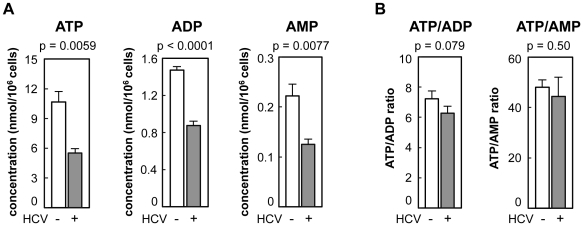
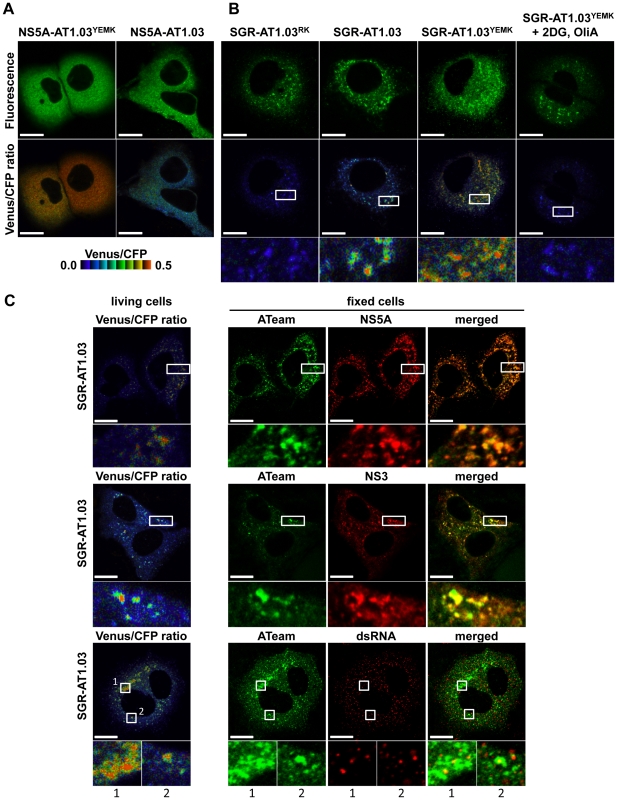
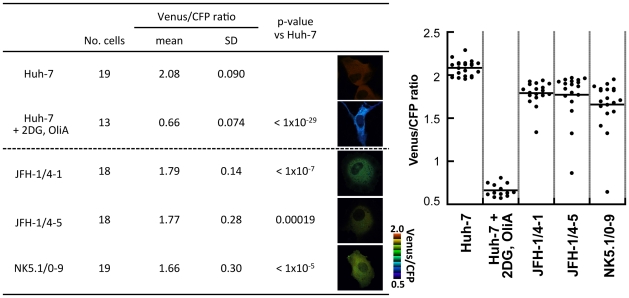
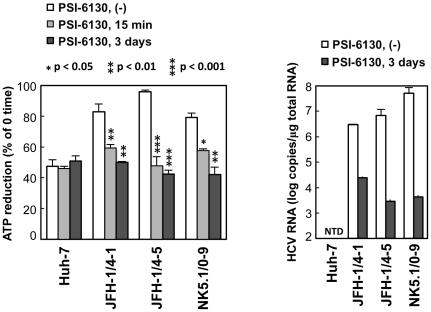
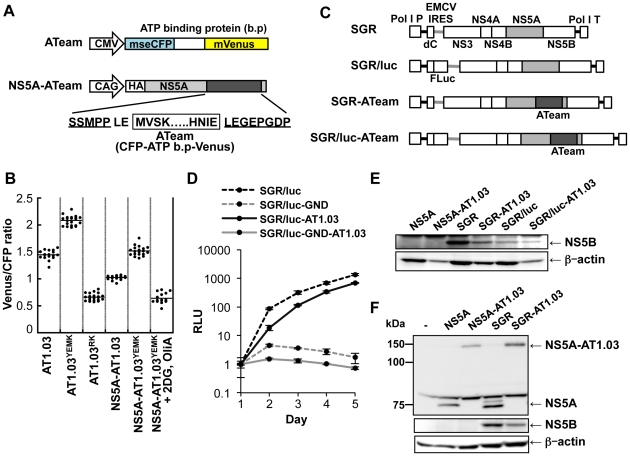
Adenosine 5'-triphosphate (ATP) is the primary energy currency of all living organisms and participates in a variety of cellular processes. Although ATP requirements during viral lifecycles have been examined in a number of studies, a method by which ATP production can be monitored in real-time, and by which ATP can be quantified in individual cells and subcellular compartments, is lacking, thereby hindering studies aimed at elucidating the precise mechanisms by which viral replication energized by ATP is controlled. In this study, we investigated the fluctuation and distribution of ATP in cells during RNA replication of the hepatitis C virus (HCV), a member of the Flaviviridae family. We demonstrated that cells involved in viral RNA replication actively consumed ATP, thereby reducing cytoplasmic ATP levels. Subsequently, a method to measure ATP levels at putative subcellular sites of HCV RNA replication in living cells was developed by introducing a recently-established Förster resonance energy transfer (FRET)-based ATP indicator, called ATeam, into the NS5A coding region of the HCV replicon. Using this method, we were able to observe the formation of ATP-enriched dot-like structures, which co-localize with non-structural viral proteins, within the cytoplasm of HCV-replicating cells but not in non-replicating cells. The obtained FRET signals allowed us to estimate ATP concentrations within HCV replicating cells as ∼5 mM at possible replicating sites and ∼1 mM at peripheral sites that did not appear to be involved in HCV replication. In contrast, cytoplasmic ATP levels in non-replicating Huh-7 cells were estimated as ∼2 mM. To our knowledge, this is the first study to demonstrate changes in ATP concentration within cells during replication of the HCV genome and increased ATP levels at distinct sites within replicating cells. ATeam may be a powerful tool for the study of energy metabolism during replication of the viral genome.
三磷酸腺苷 (ATP) 是所有生物的主要能量货币,参与多种细胞过程。尽管在许多研究中已经检查了病毒生命周期中 ATP 的需求,但缺乏实时监测 ATP 产生的方法,以及在单个细胞和亚细胞隔室中定量 ATP 的方法,从而阻碍了旨在阐明由 ATP 驱动的病毒复制的确切机制的研究。在这项研究中,我们研究了丙型肝炎病毒 (HCV) 复制期间细胞中 ATP 的波动和分布,HCV 是黄病毒科的成员。我们证明了参与病毒 RNA 复制的细胞积极消耗 ATP,从而降低细胞质 ATP 水平。随后,通过将最近建立的基于Förster 共振能量转移 (FRET) 的 ATP 指示剂 ATeam 引入 HCV 复制子的 NS5A 编码区,开发了一种在活细胞中测量 HCV RNA 复制潜在亚细胞部位 ATP 水平的方法。使用这种方法,我们能够观察到富含 ATP 的点状结构在 HCV 复制细胞的细胞质中形成,但在非复制细胞中则没有。获得的 FRET 信号使我们能够估计 HCV 复制细胞内的 ATP 浓度在可能的复制部位约为 5 mM,在不参与 HCV 复制的外围部位约为 1 mM。相比之下,非复制 Huh-7 细胞中的细胞质 ATP 水平估计为约 2 mM。据我们所知,这是第一项研究表明 HCV 基因组复制过程中细胞内 ATP 浓度的变化以及复制细胞内特定部位 ATP 水平的增加。ATeam 可能是研究病毒基因组复制期间能量代谢的有力工具。