Danish Ramazzini Centre, Department of Occupational Medicine, Aarhus University Hospital, Aarhus, Denmark.
Environ Health Perspect. 2012 Jun;120(6):897-903. doi: 10.1289/ehp.1104522. Epub 2012 Mar 7.
Measures of prenatal environmental exposures are important, and amniotic fluid levels may directly reflect fetal exposures during hypothesized windows of vulnerability.
We aimed to detect various phthalate metabolites and perfluorooctanesulfonic acid (PFOS) in human amniotic fluid, to study temporal exposure trends, and to estimate potential associations with gestational week of amniocentesis and maternal age and parity at amniocentesis.
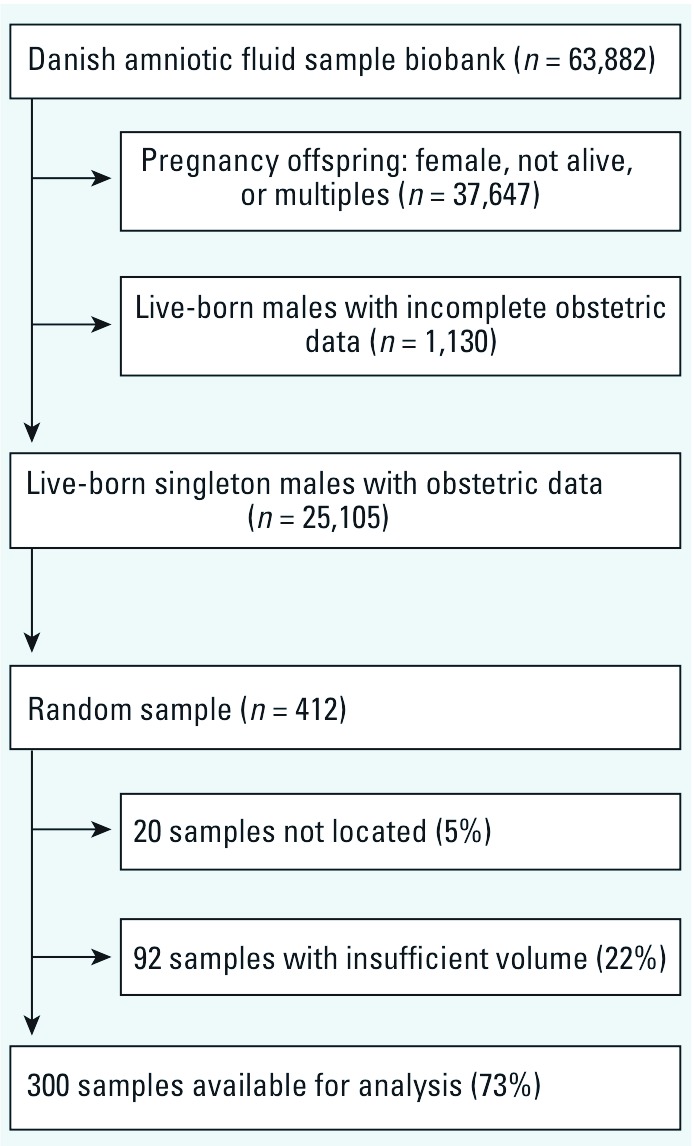
We studied 300 randomly selected second-trimester amniotic fluid samples from a Danish pregnancy-screening biobank covering 1980 through 1996. We used only samples from male offspring pregnancies. We assayed the environmental pollutants by liquid chromatography/triple quadrupole mass spectrometry and analyzed data using generalized linear regression models.
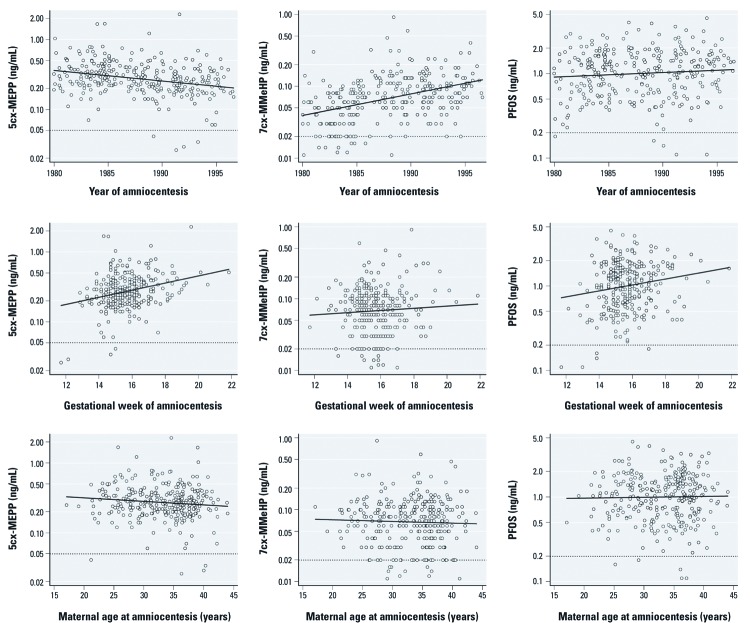
We detected the di(2-ethylhexyl) phthalate (DEHP) metabolite mono(2-ethyl-5-carboxypentyl) phthalate (5cx-MEPP) at a median concentration of 0.27 ng/mL [interquartile range (IQR): 0.20-0.37 ng/mL], the diisononyl phthalate (DiNP) metabolite mono(4-methyl-7-carboxyheptyl) phthalate (7cx-MMeHP) at 0.07 ng/mL (IQR: 0.05-0.11 ng/mL), and PFOS at 1.1 ng/mL (IQR: 0.66-1.60 ng/mL). An increase of 1 calendar year was associated with 3.5% lower [95% confidence interval (CI): -4.8%, -2.1%] 5cx-MEPP levels and with 7.1% higher (95% CI: 5.3%, 9.0%) 7cx-MMeHP levels. For each later gestational week of amniocentesis, 5cx-MEPP was 9.9% higher (95% CI: 4.8%, 15.2%), 7cx-MMeHP was 8.6% higher (95: CI: 2.7%, 14.9%), and PFOS was 9.4% higher (95: CI: 3.3%, 15.9%). We observed no associations with maternal age or parity.
Measured metabolite levels appeared to parallel decreasing DEHP exposure and increasing DiNP exposure during the study period. The environmental pollutant levels were positively associated with later gestational age at amniocentesis during pregnancy weeks 12-22.
产前环境暴露的衡量指标很重要,羊水水平可能直接反映胎儿在假设的易损期内的暴露情况。
我们旨在检测人羊水中的各种邻苯二甲酸酯代谢物和全氟辛烷磺酸 (PFOS),研究时间暴露趋势,并估计与羊膜穿刺术的妊娠周数以及羊膜穿刺术时的母亲年龄和产次的潜在关联。
我们研究了来自丹麦妊娠筛查生物库的 300 个随机选择的中期羊水样本,该生物库涵盖了 1980 年至 1996 年。我们仅使用男性后代妊娠的样本。我们通过液相色谱/三重四极杆质谱法检测环境污染物,并使用广义线性回归模型分析数据。
我们检测到邻苯二甲酸二(2-乙基己基)酯(DEHP)代谢物单(2-乙基-5-羧基戊基)邻苯二甲酸酯(5cx-MEPP)的中位数浓度为 0.27 ng/mL[四分位距 (IQR):0.20-0.37 ng/mL],邻苯二甲酸二异壬酯(DiNP)代谢物单(4-甲基-7-羧基庚基)邻苯二甲酸酯(7cx-MMeHP)为 0.07 ng/mL(IQR:0.05-0.11 ng/mL),全氟辛烷磺酸(PFOS)为 1.1 ng/mL(IQR:0.66-1.60 ng/mL)。每增加 1 个日历年,5cx-MEPP 水平降低 3.5%[95%置信区间 (CI):-4.8%,-2.1%],7cx-MMeHP 水平升高 7.1%(95%CI:5.3%,9.0%)。对于羊膜穿刺术的每个较晚妊娠周数,5cx-MEPP 升高 9.9%(95%CI:4.8%,15.2%),7cx-MMeHP 升高 8.6%(95%CI:2.7%,14.9%),PFOS 升高 9.4%(95%CI:3.3%,15.9%)。我们没有观察到与母亲年龄或产次的关联。
测量的代谢物水平似乎与研究期间 DEHP 暴露的减少和 DiNP 暴露的增加呈平行关系。在妊娠 12-22 周期间,环境污染物水平与羊膜穿刺术时妊娠周数的较晚妊娠年龄呈正相关。