Department of Pharmaceutical Botany, Jagiellonian University, Collegium Medicum, Kraków, Poland.
Appl Biochem Biotechnol. 2012 Apr;166(8):1941-8. doi: 10.1007/s12010-012-9622-y. Epub 2012 Mar 8.
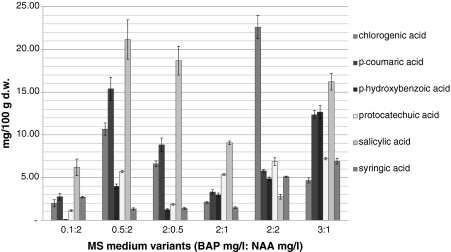
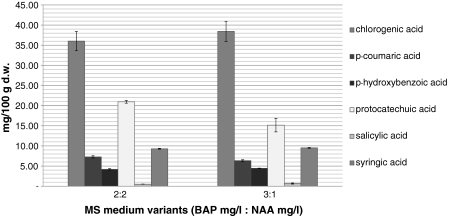
The contents of free phenolic acids and cinnamic acid were determined using an HPLC method in methanolic extracts from biomass of Schisandra chinensis (Turcz.) Baill. (Chinese magnolia vine) at different stages of organogenesis, cultured in vitro on a few variants of Murashige and Skoog (MS) medium, containing different concentrations of plant growth regulators 6-benzylaminopurine (BAP) and 1-naphthaleneacetic acid (NAA) (from 0.1 to 3.0 mg/l) and in extracts from overground parts of plants growing in vivo. Six of 12 analysed compounds were detected in all extracts: chlorogenic, p-coumaric, p-hydroxybenzoic, protocatechuic, salicylic and syringic acids. Total contents of the examined metabolites in biomass of shoot-differentiating callus culture cultivated on six MS medium variants were dependent on concentrations of growth regulators in the media and ranged from 14.90 to 60.05 mg/100 g d.w. Total contents of the compounds in biomass extracts from undifferentiating callus culture maintained only on two of six MS medium variants were higher and amounted to 74.54 and 78.24 mg/100 g d.w. Maximum total contents of phenolic acids in both types of in vitro cultures were greater than in fruits (55.73 mg/100 g d.w.) and leaves (4.55 mg/100 g d.w.) of plants gowning in vivo. Chlorogenic acid and salicylic acid were the main compounds identified in biomass extracts of shoot-differentiating callus cultures (max 22.60 and 21.17 mg/100 g d.w., respectively), while chlorogenic acid (max 38.43 mg/100 g d.w.) and protocatechuic acid (max 20.95 mg/100 g d.w.) prevailed in the extracts from undifferentiating callus cultures. Other compounds dominated in fruits, namely p-coumaric acid (23.36 mg/100 g d.w.) and syringic acid (14.96 mg/100 g d.w.). This is the first report on biochemical potential of cells from S. chinensis in vitro cultures to produce the biologically active phenolic acids. These are the first results on the analysis of this group of metabolites in overground parts of plants growing in vivo, too.
采用高效液相色谱法测定了不同器官发生阶段的五味子(Turcz.)Baill。(中华木兰藤)在含有不同浓度植物生长调节剂 6-苄基氨基嘌呤(BAP)和 1-萘乙酸(NAA)(0.1-3.0 mg/L)的几种 Murashige 和 Skoog(MS)培养基中体外培养的生物质以及体内生长的地上部分提取物中的游离酚酸和肉桂酸的含量。在所有提取物中均检测到 12 种分析化合物中的 6 种:绿原酸、对香豆酸、对羟基苯甲酸、原儿茶酸、水杨酸和丁香酸。在六种 MS 培养基变体上培养的芽分化愈伤组织培养物的生物质中,所研究代谢物的总含量取决于培养基中生长调节剂的浓度,范围为 14.90-60.05 mg/100 g DW。仅在六种 MS 培养基变体中的两种上维持的未分化愈伤组织培养物生物质提取物中的化合物总含量较高,分别为 74.54 和 78.24 mg/100 g DW。两种体外培养物中总酚酸含量均高于体内生长的植物果实(55.73 mg/100 g DW)和叶片(4.55 mg/100 g DW)。在芽分化愈伤组织培养物生物质提取物中,绿原酸和水杨酸是主要化合物(分别为 22.60 和 21.17 mg/100 g DW),而在未分化愈伤组织培养物提取物中,绿原酸(38.43 mg/100 g DW)和原儿茶酸(20.95 mg/100 g DW)占主导地位。其他化合物在果实中占主导地位,即对香豆酸(23.36 mg/100 g DW)和丁香酸(14.96 mg/100 g DW)。这是首次报道五味子体外培养细胞产生生物活性酚酸的生化潜力。这也是首次对体内生长的植物地上部分分析这一组代谢物的结果。