Centre National de la Recherche Scientifique (CNRS), Unité mixte de recherche (UMR) 8161, Institut de Biologie de Lille, Institut Pasteur de Lille, Université Lille-Nord de France, Institut fédératif de recherche (IFR) 142, Lille, France.
Cell Death Dis. 2012 Mar 8;3(3):e277. doi: 10.1038/cddis.2012.18.
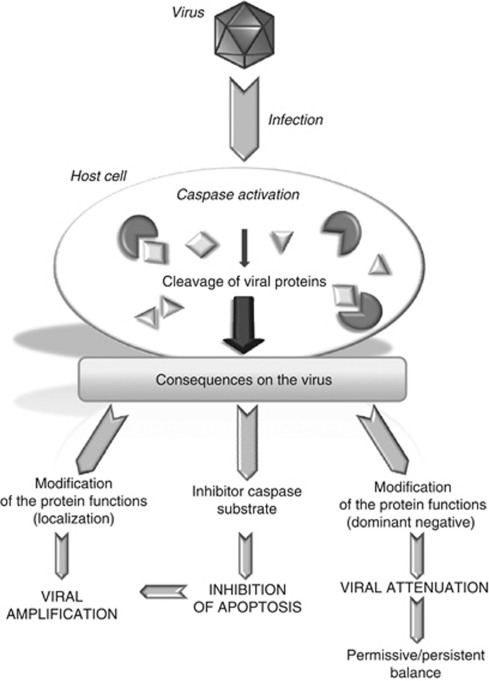
Viral infection constitutes an unwanted intrusion that needs to be eradicated by host cells. On one hand, one of the first protective barriers set up to prevent viral replication, spread or persistence involves the induction of apoptotic cell death that aims to limit the availability of the cellular components for viral amplification. On the other hand, while they completely depend on the host molecular machinery, viruses also need to evade the cellular responses that are meant to destroy them. The existence of numerous antiapoptotic products within the viral kingdom proves that apoptosis constitutes a major threat that should better be bypassed. Among the different strategies developed to deal with apoptosis, one is based on what viruses do best: backfiring the cell on itself. Several unrelated viruses have been described to take advantage of apoptosis induction by expressing proteins targeted by caspases, the key effectors of apoptotic cell death. Caspase cleavage of these proteins results in various consequences, from logical apoptosis inhibition to more surprising enhancement or attenuation of viral replication. The present review aims at discussing the characterization and relevance of this post-translational modification that adds a new complexity in the already intricate host-apoptosis-virus triangle.
病毒感染是一种不受欢迎的入侵,宿主细胞需要将其清除。一方面,为了防止病毒复制、传播或持续存在,宿主细胞会建立第一道保护屏障,其中包括诱导细胞凋亡,以限制病毒扩增所需的细胞成分。另一方面,虽然病毒完全依赖于宿主的分子机制,但它们也需要逃避旨在消灭它们的细胞反应。病毒界中存在大量的抗凋亡产物证明,凋亡是一种主要的威胁,最好是避开它。在为应对细胞凋亡而开发的不同策略中,有一种策略基于病毒最擅长的事情:反噬宿主细胞。已经描述了几种不相关的病毒利用细胞凋亡诱导来表达被半胱天冬酶靶向的蛋白,这些蛋白是细胞凋亡的关键效应因子。这些蛋白的半胱天冬酶切割会导致各种后果,从逻辑上抑制细胞凋亡到更令人惊讶的增强或减弱病毒复制。本综述旨在讨论这种翻译后修饰的特征和相关性,它为已经复杂的宿主凋亡-病毒三角关系增加了新的复杂性。