Division of Cell and Molecular Biology, Department of Life Sciences, Imperial College, London, UK.
PLoS Negl Trop Dis. 2012;6(3):e1565. doi: 10.1371/journal.pntd.0001565. Epub 2012 Mar 13.
Mosquito-borne viral diseases cause significant burden in much of the developing world. Although host-virus interactions have been studied extensively in the vertebrate host, little is known about mosquito responses to viral infection. In contrast to mosquitoes of the Aedes and Culex genera, Anopheles gambiae, the principal vector of human malaria, naturally transmits very few arboviruses, the most important of which is O'nyong-nyong virus (ONNV). Here we have investigated the A. gambiae immune response to systemic ONNV infection using forward and reverse genetic approaches.
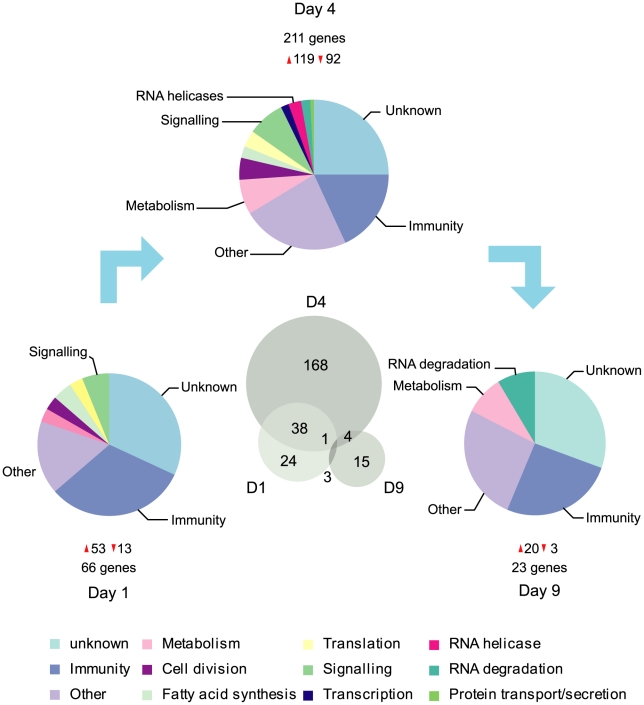
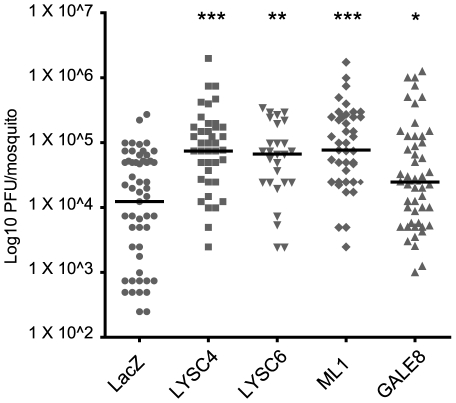
METHODOLOGY/PRINCIPAL FINDINGS: We have used DNA microarrays to profile the transcriptional response of A. gambiae inoculated with ONNV and investigate the antiviral function of candidate genes through RNAi gene silencing assays. Our results demonstrate that A. gambiae responses to systemic viral infection involve genes covering all aspects of innate immunity including pathogen recognition, modulation of immune signalling, complement-mediated lysis/opsonisation and other immune effector mechanisms. Patterns of transcriptional regulation and co-infections of A. gambiae with ONNV and the rodent malaria parasite Plasmodium berghei suggest that hemolymph immune responses to viral infection are diverted away from melanisation. We show that four viral responsive genes encoding two putative recognition receptors, a galectin and an MD2-like receptor, and two effector lysozymes, function in limiting viral load.
CONCLUSIONS/SIGNIFICANCE: This study is the first step in elucidating the antiviral mechanisms of A. gambiae mosquitoes, and has revealed interesting differences between A. gambiae and other invertebrates. Our data suggest that mechanisms employed by A. gambiae are distinct from described invertebrate antiviral immunity to date, and involve the complement-like branch of the humoral immune response, supressing the melanisation response that is prominent in anti-parasitic immunity. The antiviral immune response in A. gambiae is thus composed of some key conserved mechanisms to target viral infection such as RNAi but includes other diverse and possibly species-specific mechanisms.
蚊媒病毒病在发展中国家造成了巨大的负担。尽管脊椎动物宿主中的宿主-病毒相互作用已得到广泛研究,但对蚊子对病毒感染的反应知之甚少。与埃及伊蚊和库蚊属的蚊子不同,冈比亚按蚊是人类疟疾的主要传播媒介,自然传播的虫媒病毒很少,其中最重要的是奥尼永永病毒(ONNV)。在这里,我们使用正向和反向遗传学方法研究了冈比亚按蚊对系统性 ONNV 感染的免疫反应。
方法/主要发现:我们使用 DNA 微阵列来分析接种 ONNV 的冈比亚按蚊的转录反应,并通过 RNAi 基因沉默测定研究候选基因的抗病毒功能。我们的结果表明,冈比亚按蚊对系统性病毒感染的反应涉及涵盖先天免疫各个方面的基因,包括病原体识别、免疫信号调节、补体介导的裂解/调理作用和其他免疫效应机制。冈比亚按蚊对系统性病毒感染的转录调节模式和与 ONNV 和啮齿动物疟原虫寄生虫 Plasmodium berghei 的共感染表明,血液免疫反应对病毒感染的黑化作用被转移。我们表明,四个病毒反应性基因编码两个假定的识别受体、一个半乳糖凝集素和一个 MD2 样受体,以及两个效应溶菌酶,在限制病毒载量方面发挥作用。
结论/意义:这项研究是阐明冈比亚按蚊抗病毒机制的第一步,并且揭示了冈比亚按蚊与其他无脊椎动物之间的有趣差异。我们的数据表明,冈比亚按蚊所采用的机制与迄今为止描述的无脊椎动物抗病毒免疫不同,涉及体液免疫反应的补体样分支,抑制在抗寄生虫免疫中突出的黑化反应。因此,冈比亚按蚊的抗病毒免疫反应由一些针对病毒感染的关键保守机制组成,如 RNAi,但也包括其他不同且可能是特定于物种的机制。