Biology Department, University of Ottawa, 30 Marie Curie, Ottawa, ON K1N 6N5, Canada.
BMC Microbiol. 2012 Mar 22;12:40. doi: 10.1186/1471-2180-12-40.
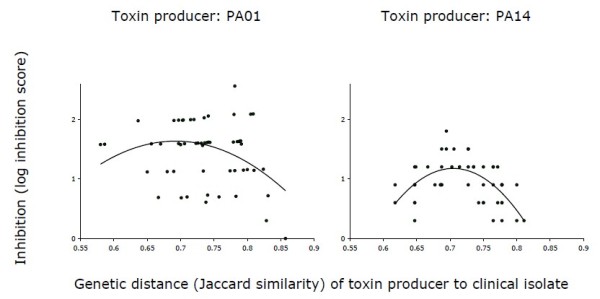
Bacteria excrete costly toxins to defend their ecological niche. The evolution of such antagonistic interactions between individuals is expected to depend on both the social environment and the strength of resource competition. Antagonism is expected to be weak among highly similar genotypes because most individuals are immune to antagonistic agents and among dissimilar genotypes because these are unlikely to be competing for the same resources and antagonism should not yield much benefit. The strength of antagonism is therefore expected to peak at intermediate genetic distance.
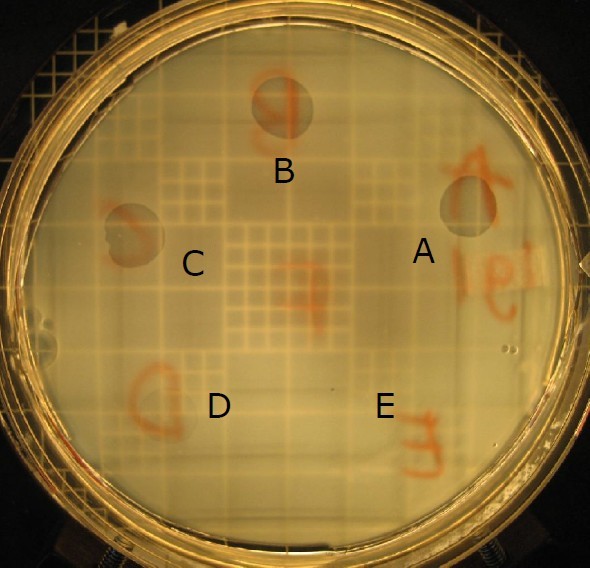
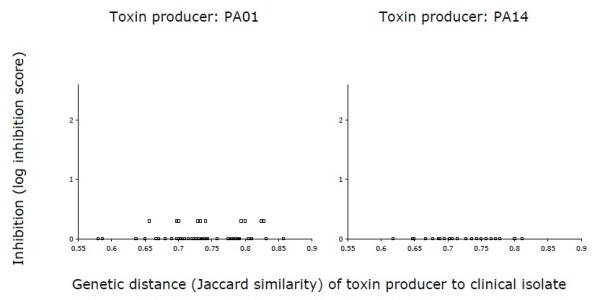
We studied the ability of laboratory strains of Pseudomonas aeruginosa to prevent growth of 55 different clinical P. aeruginosa isolates derived from cystic fibrosis patients. Genetic distance was determined using genetic fingerprints. We found that the strength of antagonism was maximal among genotypes of intermediate genetic distance and we show that genetic distance and resource use are linked.
Our results suggest that the importance of social interactions like antagonism may be modulated by the strength of resource competition.
细菌会分泌昂贵的毒素来保护其生态位。个体之间这种对抗性相互作用的进化预计取决于社会环境和资源竞争的强度。由于大多数个体对拮抗剂有免疫力,因此高度相似的基因型之间的拮抗作用预计较弱;由于这些基因型不太可能争夺相同的资源,而且拮抗作用不会带来太多好处,因此不同的基因型之间的拮抗作用预计也较弱。因此,拮抗作用的强度预计在中间遗传距离时达到峰值。
我们研究了来自囊性纤维化患者的 55 种不同临床铜绿假单胞菌分离株的实验室菌株抑制 55 种不同临床铜绿假单胞菌分离株生长的能力。遗传距离是用遗传指纹确定的。我们发现,中间遗传距离的基因型之间的拮抗作用最强,并且我们表明遗传距离和资源利用是相关的。
我们的研究结果表明,像拮抗作用这样的社会相互作用的重要性可能受到资源竞争强度的调节。