Lab of Biotechnology, Beijing Institute of Radiation Medicine, Beijing, China.
J Cell Mol Med. 2012 Oct;16(10):2539-46. doi: 10.1111/j.1582-4934.2012.01572.x.
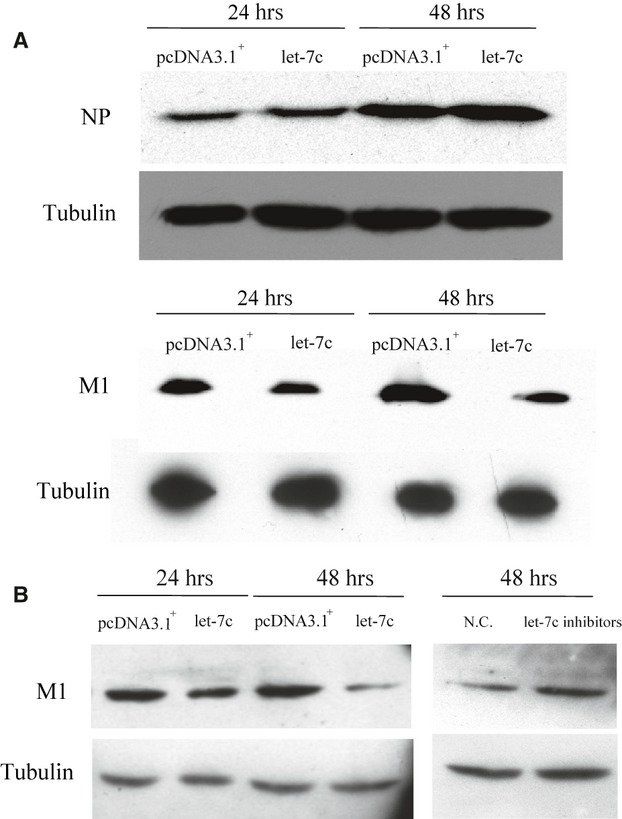
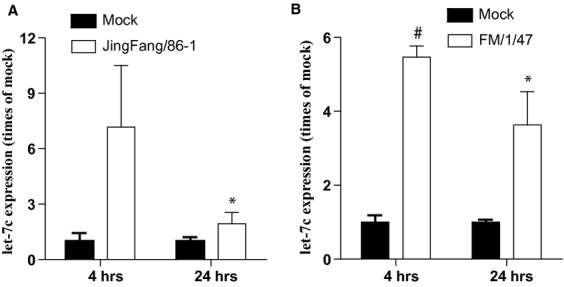
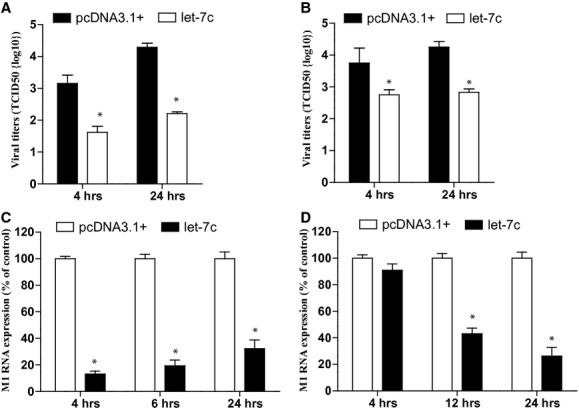
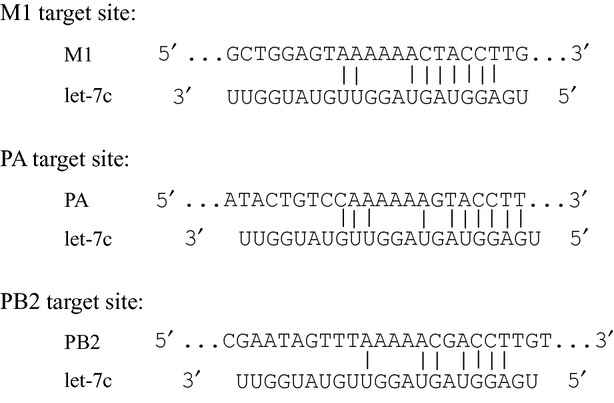
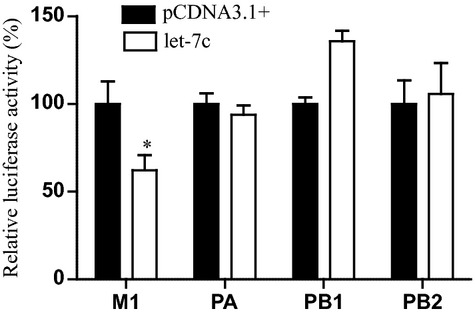
The influenza virus (IV) triggers a series of signalling events inside host cells and induces complex cellular responses. Studies have suggested that host factors play an essential role in IV replication. MicroRNAs (miRNAs) represent a class of small non-coding RNAs that target mRNAs, triggering either translation repression or RNA degradation. Emerging research suggests that host-derived cellular miRNAs are involved in mediating the host-IV interaction. Using miRNA microarrays, we identified several miRNAs aberrantly expressed in IV-infected human lung epithelial cells (A549). Specifically, miR-let-7c was highly up-regulated in IV-infected A549 cells. PITA and miRanda database screening indicated that the let-7c seed sequence is a perfect complementary sequence match to the 3' untranslated region (UTR) of viral gene M1 (+) cRNA, but not to PB2 and PA. As detected by a luciferase reporter system, let-7c directly targeted the 3'-UTR of M1 (+) cRNA, but not PB2 and PA. To experimentally identify the function of cellular let-7c, precursor let-7c was transfected into A549 cells. Let-7c down-regulated IV M1 expression at both the (+) cRNA and protein levels. Furthermore, transfection with a let-7c inhibitor enhanced the expression of M1. Therefore, let-7c may reduce IV replication by degrading M1 (+) cRNA. This is the first report indicating that cellular miRNA regulates IV replication through the degradation of viral gene (+) cRNA by matching the 3'-UTR of the viral cRNA. These findings suggest that let-7c plays a role in protecting host cells from the virus in addition to its known cellular functions.
流感病毒 (IV) 在宿主细胞内引发一系列信号事件,并诱导复杂的细胞反应。研究表明,宿主因素在 IV 复制中起着至关重要的作用。microRNAs (miRNAs) 是一类靶向 mRNA 的小非编码 RNA,可触发翻译抑制或 RNA 降解。新兴研究表明,宿主来源的细胞 miRNAs 参与介导宿主-IV 相互作用。使用 miRNA 微阵列,我们鉴定出在 IV 感染的人肺上皮细胞 (A549) 中异常表达的几种 miRNAs。具体而言,miR-let-7c 在 IV 感染的 A549 细胞中高度上调。PITA 和 miRanda 数据库筛选表明,let-7c 的种子序列与病毒基因 M1 (+) cRNA 的 3'非翻译区 (UTR) 完全互补匹配,但不与 PB2 和 PA 匹配。如荧光素酶报告系统检测所示,let-7c 直接靶向 M1 (+) cRNA 的 3'-UTR,但不靶向 PB2 和 PA。为了实验鉴定细胞 let-7c 的功能,将前体 let-7c 转染到 A549 细胞中。Let-7c 下调了 IV M1 在 (+) cRNA 和蛋白水平的表达。此外,转染 let-7c 抑制剂增强了 M1 的表达。因此,let-7c 可能通过降解 M1 (+) cRNA 来降低 IV 复制。这是第一项表明细胞 miRNA 通过匹配病毒 cRNA 的 3'-UTR 降解病毒基因 (+) cRNA 来调节 IV 复制的报告。这些发现表明,let-7c 在发挥其已知的细胞功能之外,还在保护宿主细胞免受病毒侵害方面发挥作用。