Cancer Research Institute, University of South China, Hunan, 421001, People's Republic of China.
Virol J. 2012 Mar 30;9:77. doi: 10.1186/1743-422X-9-77.
Epstain-Barr virus (EBV) can transform human B lymphocytes making them immortalized and inducing tumorigenic ability in vitro, but the molecular mechanisms remain unclear. The aim of the present study is to detect and analyze differentially expressed genes in two types of host cells, normal human lymphocytes and coupled EBV-transformed lymphoblasts in vitro using gene chips, and to screen the key regulatory genes of lymphocyte transformation induced by EB virus.
Fresh peripheral blood samples from seven healthy donors were collected. EBV was used to transform lymphocytes in vitro. Total RNA was extracted from 7 cases of the normal lymphocytes and transformed lymphoblasts respectively, marked with dihydroxyfluorane after reverse transcription, then hybridized with 4 × 44 K Agilent human whole genome microarray. LIMMA, String, Cytoscape and other softwares were used to screen and analyze differentially expressed genes. Real-time PCR was applied to verify the result of gene expression microarrays.
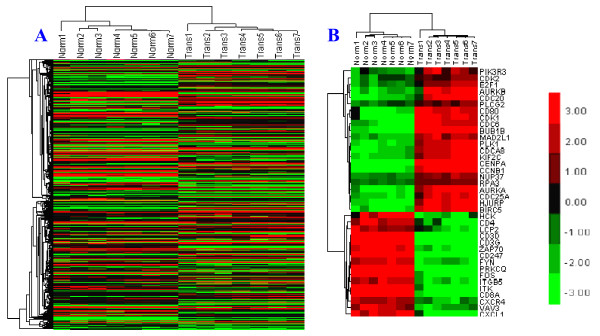
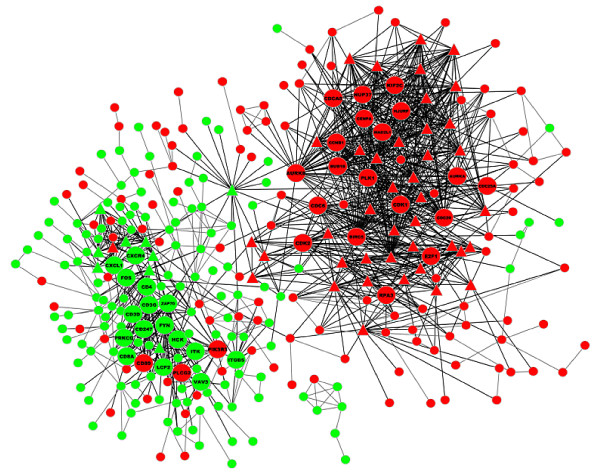
There were 1745 differentially expressed genes that had been screened, including 917 up-regulated genes and 828 down-regulated genes. According to the results of Generank, String and Cytoscape analyses, 38 genes may be key controlled genes related to EBV-transformed lymphocytes, including 22 up-regulated genes(PLK1, E2F1, AURKB, CDK2, PLCG2, CD80, PIK3R3, CDC20, CDC6, AURKA, CENPA, BUB1B, NUP37, MAD2L1, BIRC5, CDC25A, CCNB1, RPA3, HJURP, KIF2C, CDK1, CDCA8) and 16 down-regulated genes(FYN, CD3D, CD4, CD3G, ZAP70, FOS, HCK, CD247, PRKCQ, ITK, LCP2, CXCL1, CD8A, ITGB5, VAV3, CXCR4), which primarily control biological processes such as cell cycle, mitosis, cytokine-cytokine pathway, immunity response and so on.
Human lymphocyte transformation induced by EB virus is a complicated process, involving multiple-genes and -pathways in virus-host interactions. Global gene expression profile analysis showed that EBV may transform human B lymphocytes by promoting cell cycle and mitosis, inhibiting cell apoptosis, hindering host immune function and secretion of cytokines.
Epstain-Barr 病毒(EBV)可使人类 B 淋巴细胞永生化,并在体外诱导肿瘤形成能力,但分子机制尚不清楚。本研究旨在使用基因芯片检测和分析两种宿主细胞(正常人外周血淋巴细胞和 EBV 体外转化的淋巴母细胞)中的差异表达基因,筛选 EBV 诱导淋巴细胞转化的关键调控基因。
收集 7 例健康供者的新鲜外周血样本,用 EBV 体外转化淋巴细胞,分别提取 7 例正常人外周血淋巴细胞和转化的淋巴母细胞总 RNA,反转录后用二羟基氟烷标记,与 4×44K Agilent 人类全基因组微阵列杂交。采用 LIMMA、String、Cytoscape 等软件进行筛选和分析差异表达基因。实时 PCR 验证基因表达微阵列的结果。
筛选出差异表达基因 1745 个,其中上调基因 917 个,下调基因 828 个。根据 Generank、String 和 Cytoscape 分析结果,38 个基因可能是与 EBV 转化淋巴细胞相关的关键调控基因,包括 22 个上调基因(PLK1、E2F1、AURKB、CDK2、PLCG2、CD80、PIK3R3、CDC20、CDC6、AURKA、CENPA、BUB1B、NUP37、MAD2L1、BIRC5、CDC25A、CCNB1、RPA3、HJURP、KIF2C、CDK1、CDCA8)和 16 个下调基因(FYN、CD3D、CD4、CD3G、ZAP70、FOS、HCK、CD247、PRKCQ、ITK、LCP2、CXCL1、CD8A、ITGB5、VAV3、CXCR4),主要调控细胞周期、有丝分裂、细胞因子-细胞因子通路、免疫反应等生物学过程。
EB 病毒诱导的人淋巴细胞转化是一个复杂的过程,涉及病毒-宿主相互作用中的多个基因和途径。全基因表达谱分析表明,EBV 可能通过促进细胞周期和有丝分裂、抑制细胞凋亡、阻碍宿主免疫功能和细胞因子分泌来转化人 B 淋巴细胞。