Environmental Chemistry and Toxicology Laboratory, Department of Environmental Science, Policy and Management, University of California, Berkeley, California 94720, USA.
Environ Health Perspect. 2012 Apr;120(4):487-93. doi: 10.1289/ehp.1104405. Epub 2012 Jan 18.
Pesticide-environment interactions are bidirectional. The environment alters pesticides by metabolism and photodegradation, and pesticides in turn change the environment through nontarget or secondary effects.
Approximately 900 currently used commercial pesticides of widely diverse structures act by nearly a hundred mechanisms to control insects, weeds, and fungi, usually with minimal disruption of nature's equilibrium. Here I consider some aspects of the discovery, development, and use of ecofriendly or green pesticides (i.e., pesticides that are safe, effective, and biodegradable with minimal adverse secondary effects on the environment). Emphasis is given to research in my laboratory.
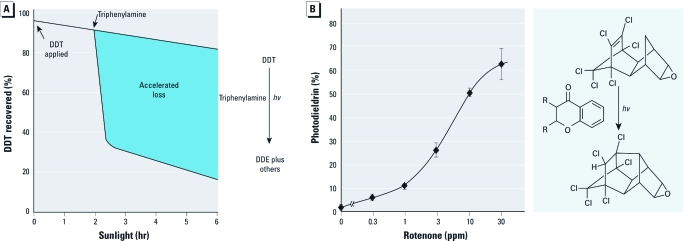
The need for understanding and improving pesticide-environment interactions began with production of the first major insecticide approximately 150 years ago: The arsenical poison Paris Green was green in color but definitely not ecofriendly. Development and use of other pesticides has led to a variety of problems. Topics considered here include the need for high purity [e.g., hexachlorocyclohexane and polychloroborane isomers and 2,4,5-trichlorophenoxyacetic acid (2,4,5-T)], environmental degradation and the bioactivity of resulting photoproducts and metabolites, pesticide photochemistry (including the use of structural optimization, photostabilizers, and photosensitizers to achieve suitable persistence), the presence of multiple active ingredients in botanical insecticides, the need to consider compounds with common mechanisms of action, issues related to primary and secondary targets, and chemically induced or genetically modified changes in plant biochemistry. Many insecticides are bird, fish, and honeybee toxicants, whereas herbicides and fungicides pose fewer environmental problems.
Six factors have contributed to the greening of pesticide-environment interactions: advances in pesticide chemistry and toxicology, banning of many chlorinated hydrocarbons, the development of new biochemical targets, increased reliance on genetically modified crops that reduce the amount and variety of pesticides applied, emphasis on biodegradability and environmental protection, and integrated pest- and pesticide-management systems.
农药-环境相互作用是双向的。环境通过代谢和光降解改变农药,而农药则通过非靶标或次生效应改变环境。
目前约有 900 种商业用途的不同结构的农药,通过近 100 种机制来控制昆虫、杂草和真菌,通常对自然平衡的破坏最小。在这里,我考虑了一些发现、开发和使用环保或绿色农药(即安全、有效且可生物降解,对环境的不利次生影响最小)的方面。重点放在我的实验室的研究上。
对农药-环境相互作用的理解和改进的需求始于大约 150 年前生产的第一种主要杀虫剂:砷毒巴黎绿是绿色的,但绝对不是环保的。其他农药的开发和使用导致了各种问题。这里考虑的主题包括对高纯度的需求[例如,六氯环己烷和多氯硼烷异构体以及 2,4,5-三氯苯氧乙酸(2,4,5-T)]、环境降解和由此产生的光产物和代谢物的生物活性、农药光化学(包括使用结构优化、光稳定剂和光敏剂来实现适当的持久性)、植物杀虫剂中多种有效成分的存在、需要考虑具有共同作用机制的化合物、与主要和次要靶标相关的问题以及化学诱导或遗传修饰改变植物生物化学。许多杀虫剂对鸟类、鱼类和蜜蜂有毒,而除草剂和杀菌剂对环境造成的问题较少。
有六个因素促成了农药-环境相互作用的绿色化:农药化学和毒理学的进步、许多氯化烃的禁用、新生化靶标的开发、对减少施用量和种类的转基因作物的日益依赖、对生物降解性和环境保护的重视以及综合病虫害和农药管理系统。