Biodiversity and Conservation Research Center.-UAEM, Av. Universidad 1001, Col. Chamilpa, Cuernavaca 62209, Morelos, Mexico.
Molecules. 2012 Apr 10;17(4):4292-9. doi: 10.3390/molecules17044292.
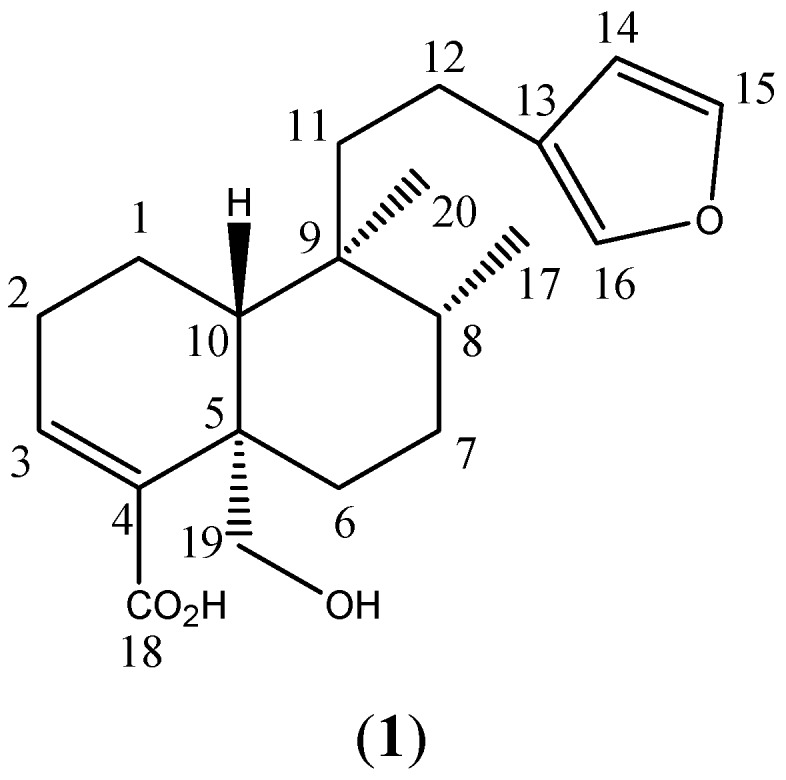
The aim of this study was to identify an anti-inflammatory compound from D. viscosa leaves. The structure of this bioactive substance was elucidated by IR and NMR studies, which indicated that this natural product corresponds to hautriwaic acid (HA). This diterpene exhibited good anti-inflammatory activity in 12-O-tetradecanoylphorbol 13-acetate (TPA) mice ear edema models by applications at doses of 0.25, 0.5 and 1.0 mg/ear (60.2, 70.2 and 87.1% inhibition, respectively); additionally Dodonaea viscosa dichloro-methane extract (DvDE) displays a 97.8% anti-inflammatory effect at 3 mg/kg. Multiple applications of DvDE at doses of 100 mg/kg on TPA mice ear edema inhibited the edema-associated inflammation by 71.8%, while HA at doses of 15 mg/kg, reduced edema to 64% and indomethacin 40%.
本研究旨在从大戟属植物叶片中寻找一种抗炎化合物。通过红外和核磁共振研究阐明了这种生物活性物质的结构,表明该天然产物对应于哈渥酸(HA)。该二萜在 12-O-十四烷酰佛波醇 13-醋酸酯(TPA)小鼠耳肿胀模型中具有良好的抗炎活性,应用剂量为 0.25、0.5 和 1.0mg/耳时,抑制率分别为 60.2%、70.2%和 87.1%;此外,大戟属二氯甲烷提取物(DvDE)在 3mg/kg 时显示出 97.8%的抗炎效果。在 TPA 小鼠耳肿胀模型中,DvDE 以 100mg/kg 的剂量多次应用可抑制炎症相关水肿,抑制率为 71.8%,而 HA 以 15mg/kg 的剂量应用可将水肿减少至 64%,吲哚美辛则减少 40%。