Harvard UniversityThe NIH Clinical CenterDepartment of Bioethics, National Institutes of HealthDepartment of Bioethics, National Institutes of Health, USA and The University of Vermont.
Bioethics. 2013 Nov;27(9):500-7. doi: 10.1111/j.1467-8519.2012.01972.x. Epub 2012 Apr 12.
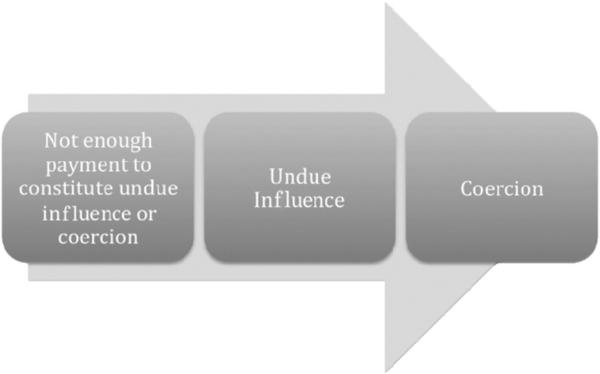
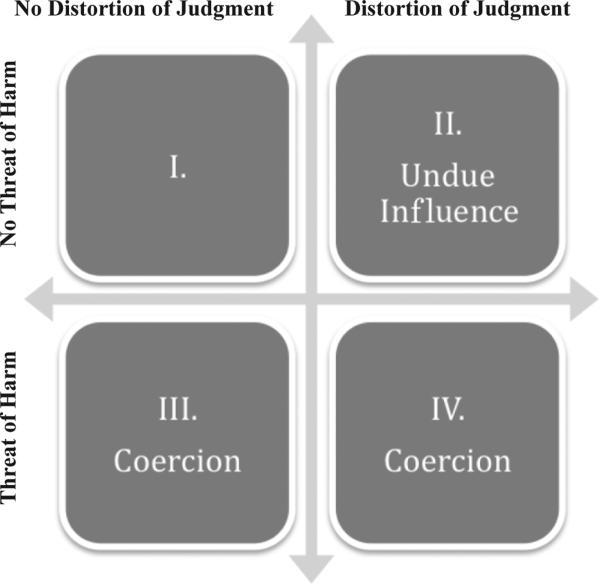
Payment to recruit research subjects is a common practice but raises ethical concerns relating to the potential for coercion or undue influence. We conducted the first national study of IRB members and human subjects protection professionals to explore attitudes as to whether and why payment of research participants constitutes coercion or undue influence. Upon critical evaluation of the cogency of ethical concerns regarding payment, as reflected in our survey results, we found expansive or inconsistent views about coercion and undue influence that may interfere with valuable research. In particular, respondents appear to believe that coercion and undue influence lie on a continuum; by contrast, we argue that they are wholly distinct: whereas undue influence is a cognitive distortion relating to assessment of risks and benefits, coercion is a threat of harm. Because payment is an offer, rather than a threat, payment is never coercive.
支付招募研究对象是一种常见的做法,但引起了与潜在的胁迫或不当影响有关的伦理问题。我们对 IRB 成员和人体研究保护专业人员进行了首次全国性研究,以探讨他们对支付研究参与者是否构成胁迫或不当影响以及原因的态度。通过对我们的调查结果所反映的支付相关伦理问题的说服力进行批判性评估,我们发现关于胁迫和不当影响的观点广泛而不一致,这可能会干扰有价值的研究。特别是,受访者似乎认为胁迫和不当影响是连续的;相比之下,我们认为它们是完全不同的:虽然不当影响是一种与风险和收益评估有关的认知扭曲,但胁迫是一种伤害的威胁。因为支付是一种要约,而不是威胁,所以支付永远不会是胁迫性的。