George Mason University, The Krasnow Institute for Advanced Study, MS 2A1, Fairfax, Virginia, United States of America.
PLoS Comput Biol. 2012;8(4):e1002493. doi: 10.1371/journal.pcbi.1002493. Epub 2012 Apr 19.
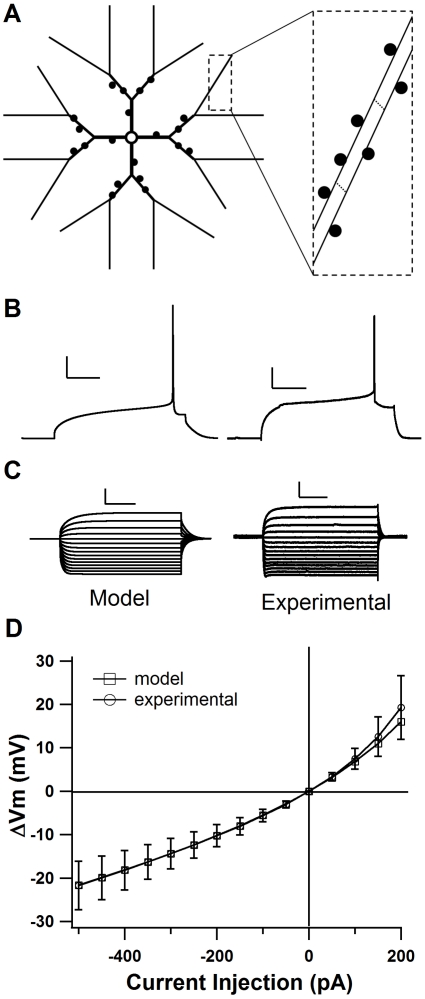
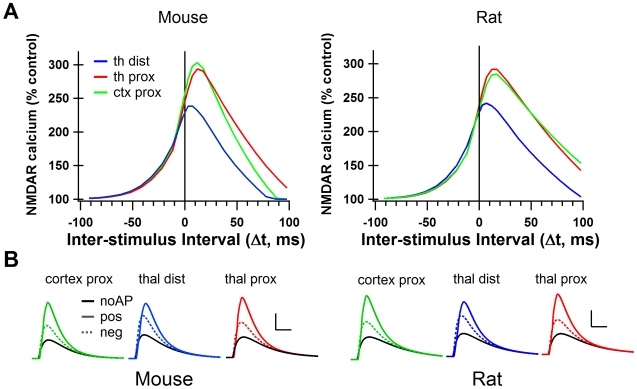
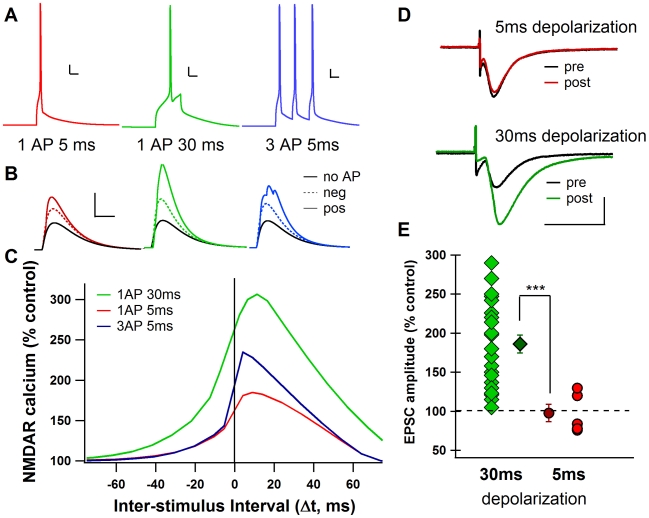
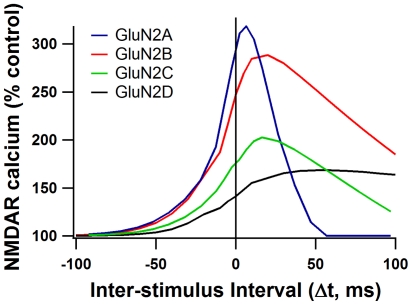
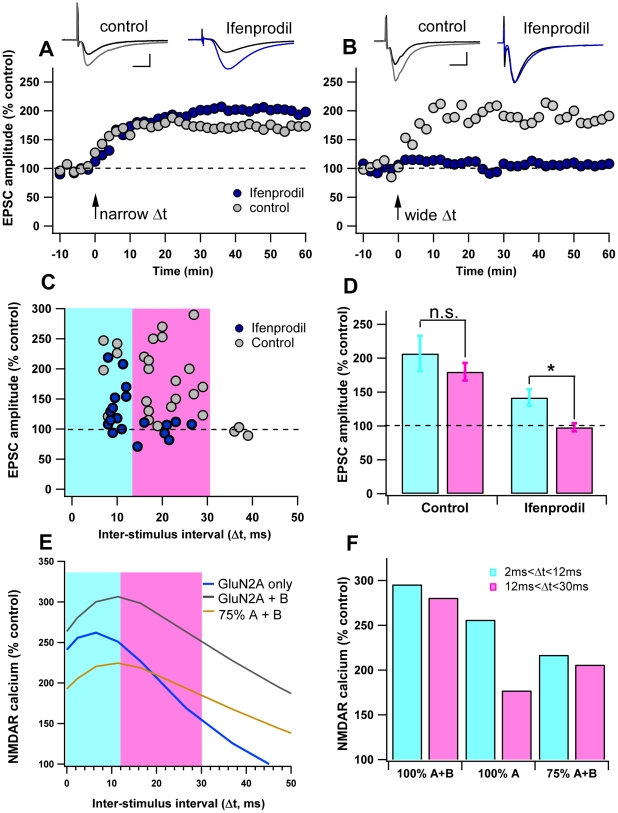
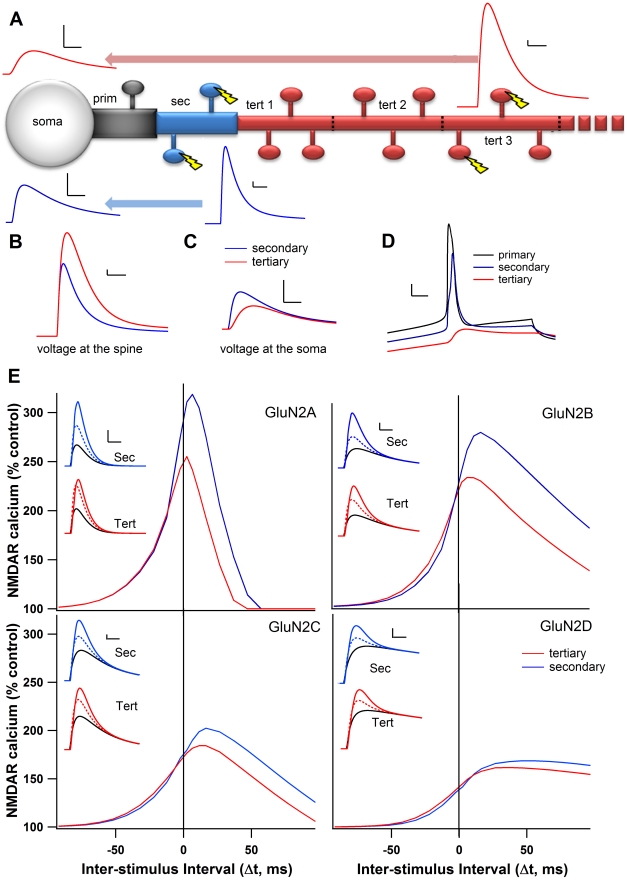
Calcium through NMDA receptors (NMDARs) is necessary for the long-term potentiation (LTP) of synaptic strength; however, NMDARs differ in several properties that can influence the amount of calcium influx into the spine. These properties, such as sensitivity to magnesium block and conductance decay kinetics, change the receptor's response to spike timing dependent plasticity (STDP) protocols, and thereby shape synaptic integration and information processing. This study investigates the role of GluN2 subunit differences on spine calcium concentration during several STDP protocols in a model of a striatal medium spiny projection neuron (MSPN). The multi-compartment, multi-channel model exhibits firing frequency, spike width, and latency to first spike similar to current clamp data from mouse dorsal striatum MSPN. We find that NMDAR-mediated calcium is dependent on GluN2 subunit type, action potential timing, duration of somatic depolarization, and number of action potentials. Furthermore, the model demonstrates that in MSPNs, GluN2A and GluN2B control which STDP intervals allow for substantial calcium elevation in spines. The model predicts that blocking GluN2B subunits would modulate the range of intervals that cause long term potentiation. We confirmed this prediction experimentally, demonstrating that blocking GluN2B in the striatum, narrows the range of STDP intervals that cause long term potentiation. This ability of the GluN2 subunit to modulate the shape of the STDP curve could underlie the role that GluN2 subunits play in learning and development.
钙通过 NMDA 受体(NMDARs)对于突触强度的长期增强(LTP)是必要的;然而,NMDARs 在几个特性上存在差异,这些特性会影响钙流入脊柱的量。这些特性,如对镁阻断的敏感性和电导衰减动力学,改变了受体对依赖于尖峰时间的可塑性(STDP)协议的反应,从而影响了突触整合和信息处理。本研究在纹状体中型棘突投射神经元(MSPN)的模型中,研究了 GluN2 亚基差异在几种 STDP 协议期间对脊柱钙浓度的作用。多隔间、多通道模型表现出与来自小鼠背侧纹状体 MSPN 的电流钳数据相似的放电频率、尖峰宽度和首次尖峰潜伏期。我们发现,NMDAR 介导的钙依赖于 GluN2 亚基类型、动作电位时间、体细胞去极化持续时间和动作电位数量。此外,该模型表明,在 MSPNs 中,GluN2A 和 GluN2B 控制哪些 STDP 间隔允许脊柱中大量钙升高。该模型预测,阻断 GluN2B 亚基会调节导致长期增强的间隔范围。我们通过实验证实了这一预测,证明在纹状体中阻断 GluN2B 会缩小导致长期增强的 STDP 间隔范围。GluN2 亚基调节 STDP 曲线形状的这种能力可能是 GluN2 亚基在学习和发育中发挥作用的基础。