Centre for Virology, Burnet Institute, Melbourne, Australia.
Virol J. 2012 May 2;9:84. doi: 10.1186/1743-422X-9-84.
The visualization of viral proteins has been hindered by the resolution limit of conventional fluorescent microscopes, as the dimension of any single fluorescent signal is often greater than most virion particles. Super-resolution microscopy has the potential to unveil the distribution of proteins at the resolution approaching electron microscopy without relying on morphological features of existing characteristics of the biological specimen that are needed in EM.
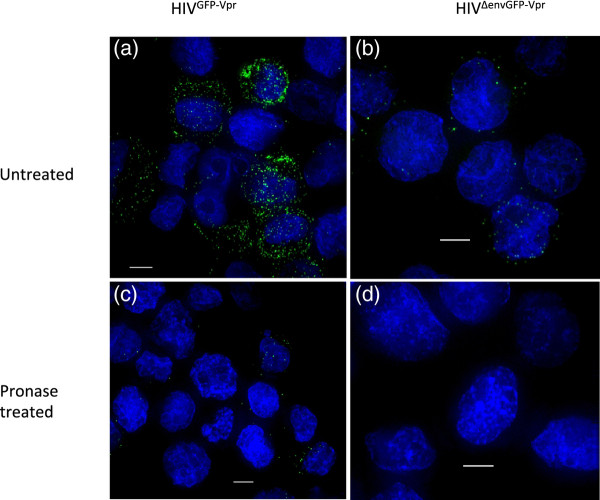
Using direct stochastic optical reconstruction microscopy (dSTORM) to achieve a lateral resolution of 15-20 nm, we quantified the 2-D molecular distribution of the major structural proteins of the infectious human immunodeficiency virus type 1 (HIV-1) before and after infection of lymphoid cells. We determined that the HIV-1 matrix and capsid proteins undergo restructuring soon after HIV-1 infection.
This study provides the proof-of-concept for the use of dSTORM to visualize the changes in the molecular distribution of viral proteins during an infection.
由于常规荧光显微镜的分辨率限制,病毒蛋白的可视化受到阻碍,因为任何单个荧光信号的尺寸通常都大于大多数病毒粒子。超分辨率显微镜有可能揭示蛋白质的分布,其分辨率接近电子显微镜,而无需依赖于电子显微镜中所需的生物样本的现有特征的形态特征。
我们使用直接随机光学重建显微镜(dSTORM)实现了 15-20nm 的横向分辨率,在感染淋巴细胞前后,我们定量分析了感染性人类免疫缺陷病毒 1 型(HIV-1)的主要结构蛋白的 2-D 分子分布。我们确定 HIV-1 基质和衣壳蛋白在感染 HIV-1 后很快发生重组。
本研究为使用 dSTORM 可视化感染过程中病毒蛋白的分子分布变化提供了概念验证。