School of Health Policy & Management, York University, Toronto, Canada.
BMJ Qual Saf. 2012 Aug;21(8):676-84. doi: 10.1136/bmjqs-2011-000601. Epub 2012 May 5.
Enhancing competency in patient safety at entry to practice requires introduction and integration of patient safety into health professional education. As efforts to include patient safety in health professional education increase, it is important to capture new health professionals' perspectives of their own patient safety competence at entry to practice. Existing instruments to measure patient safety knowledge, skills and attitudes have been developed largely to examine the impact of specific patient safety curricular initiatives and the psychometric analyses of the instruments used thus far have been exploratory in nature.
Confirmatory factor analytic approaches are used to extensively test the Health Professional Education in Patient Safety Survey (H-PEPSS), a newly designed survey rooted in a patient safety competency framework and designed to measure health professionals' self-reported patient safety competence around the time of entry to practice. The H-PEPSS focuses primarily on the socio-cultural aspects of patient safety including culture, teamwork, communication, managing risk and understanding human factors.
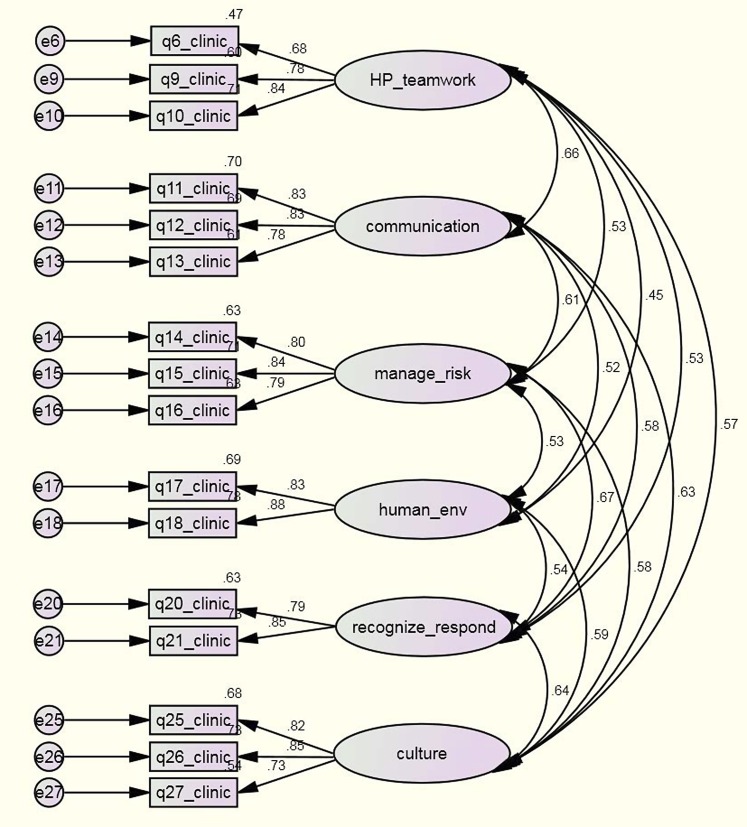
Results support a parsimonious six-factor measurement model of health professionals' perceptions of patient safety competency. These results support the validity of a reduced version of the H-PEPSS and suggest it can be appropriately used at or near training completion with a variety of health professional groups.
Given increased demands for patient safety competency among health professionals at entry to practice and slow, but emerging changes in health professional education, ongoing research to understand the extent of patient safety competency among health professionals around the time of entry to practice will be important.
在实践初期增强患者安全方面的能力需要将患者安全纳入卫生专业教育并进行整合。随着将患者安全纳入卫生专业教育的努力不断增加,了解新的卫生专业人员在实践初期对自身患者安全能力的看法非常重要。现有的衡量患者安全知识、技能和态度的工具主要是为了检验特定的患者安全课程计划的影响,而迄今为止对这些工具的心理测量分析本质上是探索性的。
采用验证性因子分析方法对新设计的患者安全专业教育调查(H-PEPSS)进行了广泛测试。该调查基于患者安全能力框架,旨在衡量卫生专业人员在实践初期自我报告的患者安全能力。H-PEPSS 主要关注患者安全的社会文化方面,包括文化、团队合作、沟通、风险管理和理解人为因素。
结果支持健康专业人员对患者安全能力的六因素简约测量模型。这些结果支持 H-PEPSS 简化版的有效性,并表明它可以在各种卫生专业群体的培训完成时或接近培训完成时适当使用。
鉴于实践初期卫生专业人员对患者安全能力的需求增加,以及卫生专业教育的缓慢但新兴变化,了解卫生专业人员在实践初期患者安全能力的程度的持续研究将非常重要。