Institute of Health and Biomedical Innovation, Queensland University of Technology, Brisbane, QLD, Australia.
BMC Public Health. 2012 May 25;12:380. doi: 10.1186/1471-2458-12-380.
Diabetes mellitus has reached epidemic proportions worldwide. South Asians are known to have an increased predisposition for diabetes which has become an important health concern in the region. We discuss the prevalence of pre-diabetes and diabetes in South Asia and explore the differential risk factors reported.
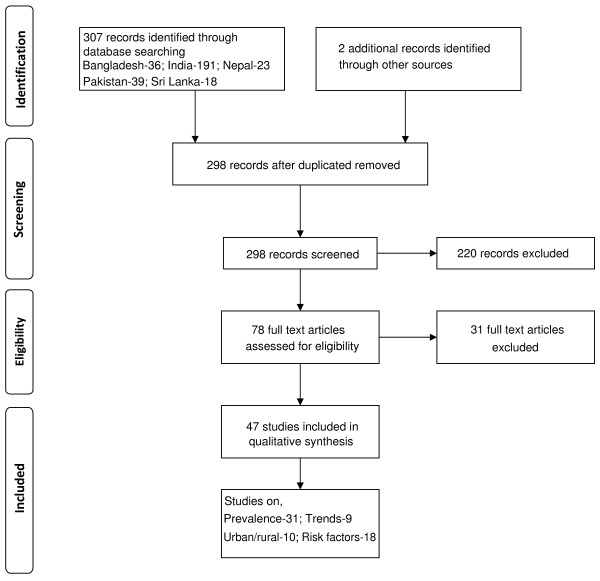
Prevalence data were obtained by searching the Medline® database with; 'prediabetes' and 'diabetes mellitus' (MeSH major topic) and 'Epidemology/EP' (MeSH subheading). Search limits were articles in English, between 01/01/1980-31/12/2011, on human adults (≥19 years). The conjunction of the above results was narrowed down with country names.
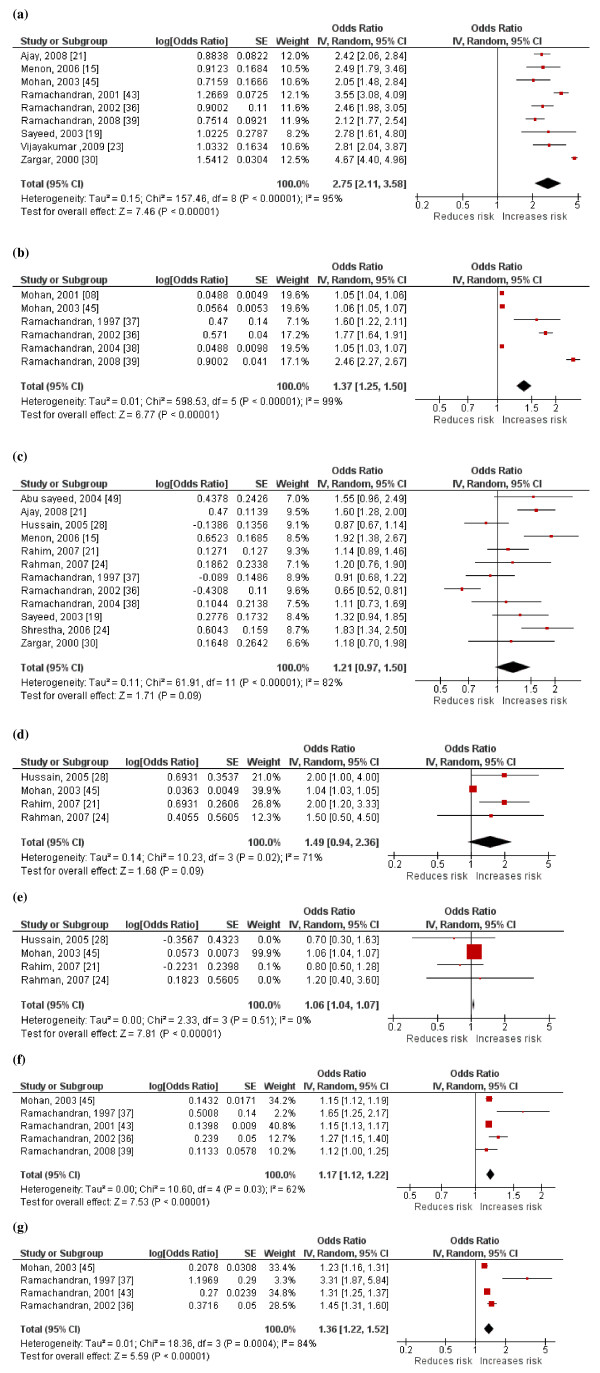
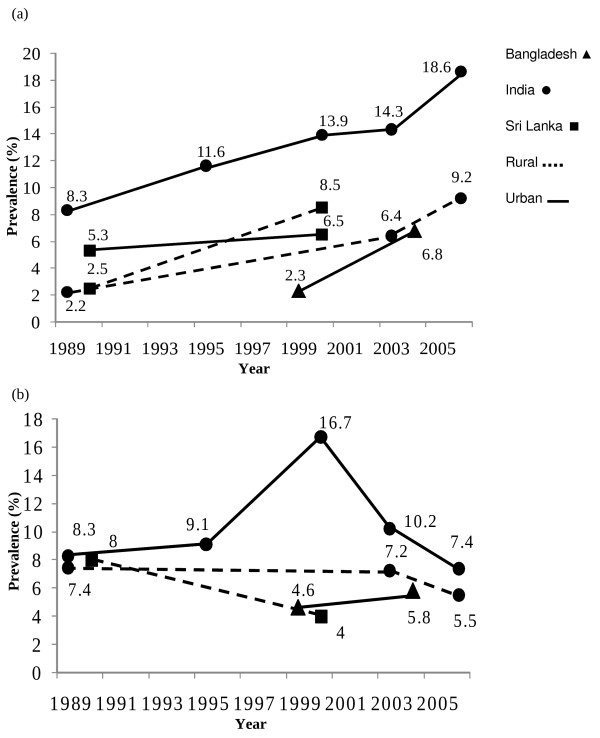
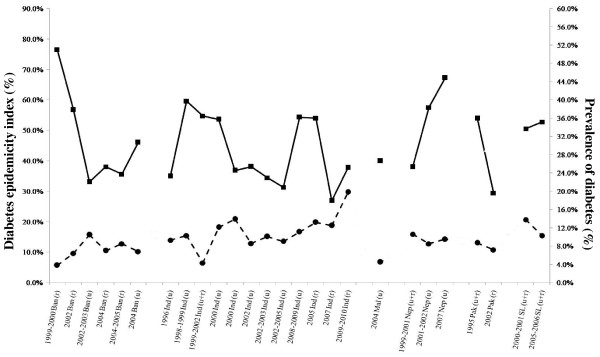
The most recent reported prevalence of pre-diabetes:diabetes in regional countries were; Bangladesh-4.7%:8.5% (2004-2005;Rural), India-4.6%:12.5% (2007;Rural); Maldives-3.0%:3.7% (2004;National), Nepal-19.5%:9.5% (2007;Urban), Pakistan-3.0%:7.2% (2002;Rural), Sri Lanka-11.5%:10.3% (2005-2006;National). Urban populations demonstrated a higher prevalence of diabetes. An increasing trend in prevalence of diabetes was observed in urban/rural India and rural Sri Lanka. The diabetes epidemicity index decreased with the increasing prevalence of diabetes in respective countries. A high epidemicity index was seen in Sri Lanka (2005/2006-52.8%), while for other countries, the epidemicity index was comparatively low (rural India 2007-26.9%; urban India 2002/2005-31.3%, and urban Bangladesh-33.1%). Family history, urban residency, age, higher BMI, sedentary lifestyle, hypertension and waist-hip ratio were associated with an increased risks of diabetes.
A significant epidemic of diabetes is present in the South Asian region with a rapid increase in prevalence over the last two decades. Hence there is a need for urgent preventive and curative strategies.
糖尿病在全球范围内已达到流行程度。众所周知,南亚人更容易患糖尿病,这已成为该地区的一个重要健康问题。我们讨论了南亚地区糖尿病前期和糖尿病的流行情况,并探讨了报告的不同危险因素。
通过在 Medline®数据库中搜索“prediabetes”和“diabetes mellitus”(MeSH 主要主题)和“Epidemology/EP”(MeSH 副标题),获得患病率数据。搜索限制为英语文章,时间范围为 1980 年 1 月 1 日至 2011 年 12 月 31 日,研究对象为成人(≥19 岁)。将上述结果与国家名称结合起来进行缩小。
最近报告的区域国家糖尿病前期患病率为:孟加拉国 4.7%:8.5%(2004-2005 年;农村);印度 4.6%:12.5%(2007 年;农村);马尔代夫 3.0%:3.7%(2004 年;全国);尼泊尔 19.5%:9.5%(2007 年;城市);巴基斯坦 3.0%:7.2%(2002 年;农村);斯里兰卡 11.5%:10.3%(2005-2006 年;全国)。城市人口的糖尿病患病率较高。印度城乡地区和斯里兰卡农村地区的糖尿病患病率呈上升趋势。随着各国糖尿病患病率的升高,糖尿病流行指数下降。斯里兰卡的流行指数较高(2005/2006 年为 52.8%),而其他国家的流行指数相对较低(2007 年农村印度为 26.9%;2002/2005 年城市印度为 31.3%,城市孟加拉国为 33.1%)。家族史、城市居住、年龄、较高的 BMI、久坐的生活方式、高血压和腰臀比与糖尿病风险增加相关。
南亚地区存在着显著的糖尿病流行,过去二十年来,糖尿病的患病率迅速上升。因此,迫切需要采取预防和治疗策略。