Department of Kinesiology and Community Health, University of Illinois at Urbana-Champaign, Urbana, IL, USA.
Health Qual Life Outcomes. 2012 May 29;10:57. doi: 10.1186/1477-7525-10-57.
Physical activity has been established as an important determinant of quality of life, particularly among older adults. Previous research has suggested that physical activity's influence on quality of life perceptions is mediated by changes in self-efficacy and health status. In the same vein, spirituality may be a salient quality of life determinant for many individuals.
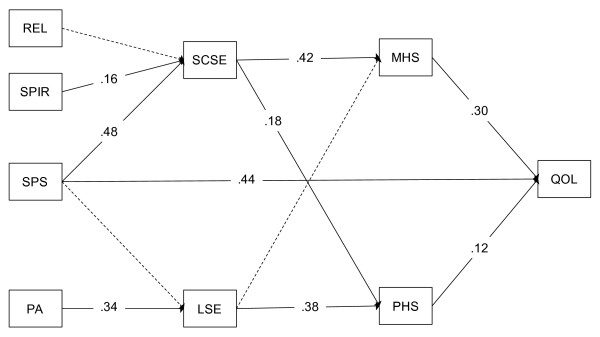
In the current study, we used path analysis to test a model in which physical activity, spirituality, and social support were hypothesized to influence global quality of life in paths mediated by self-efficacy and health status. Cross-sectional data were collected from a sample of 215 adults (male, n = 51; female, n = 164) over the age of 50 (M age = 66.55 years).
The analysis resulted in a model that provided acceptable fit to the data (χ2 = 33.10, df = 16, p < .01; RMSEA = .07; SRMR = .05; CFI = .94).
These results support previous findings of an efficacy-mediated relationship between physical activity and quality of life, with the exception that self-efficacy in the current study was moderately associated with physical health status (.38) but not mental health status. Our results further suggest that spirituality may influence health and well-being via a similar, efficacy-mediated path, with strongest effects on mental health status. These results suggest that those who are more spiritual and physically active report greater quality of life, and the effects of these factors on quality of life may be partially mediated by perceptions of self-efficacy.
身体活动已被确立为生活质量的一个重要决定因素,尤其是在老年人中。先前的研究表明,身体活动对生活质量感知的影响是通过自我效能感和健康状况的变化来介导的。同样,灵性可能是许多人生活质量的一个显著决定因素。
在当前的研究中,我们使用路径分析来测试一个模型,其中身体活动、灵性和社会支持被假设通过自我效能感和健康状况的中介路径来影响整体生活质量。横断面数据来自 215 名年龄在 50 岁以上的成年人(男性,n = 51;女性,n = 164)的样本(M 年龄= 66.55 岁)。
该分析得出的模型为数据提供了可接受的拟合(χ2 = 33.10,df = 16,p <.01;RMSEA =.07;SRMR =.05;CFI =.94)。
这些结果支持了先前关于身体活动与生活质量之间存在效能中介关系的发现,除了当前研究中的自我效能与身体健康状况(.38)中度相关但与心理健康状况无关。我们的结果进一步表明,灵性可能通过类似的效能中介途径影响健康和幸福感,对心理健康状况的影响最大。这些结果表明,那些更有灵性和更积极参加身体活动的人报告了更高的生活质量,这些因素对生活质量的影响可能部分通过自我效能感来介导。