Söder Birgitta, Yakob Maha, Meurman Jukka H, Andersson Leif C, Söder Per-Östen
Department of Dental Medicine, Karolinska Institutet, Huddinge, Sweden.
BMJ Open. 2012 Jun 11;2(3). doi: 10.1136/bmjopen-2012-001083. Print 2012.
To study whether the amount of dental plaque, which indicates poor oral hygiene and is potential source of oral infections, associates with premature death from cancer.
Prospective cohort study.
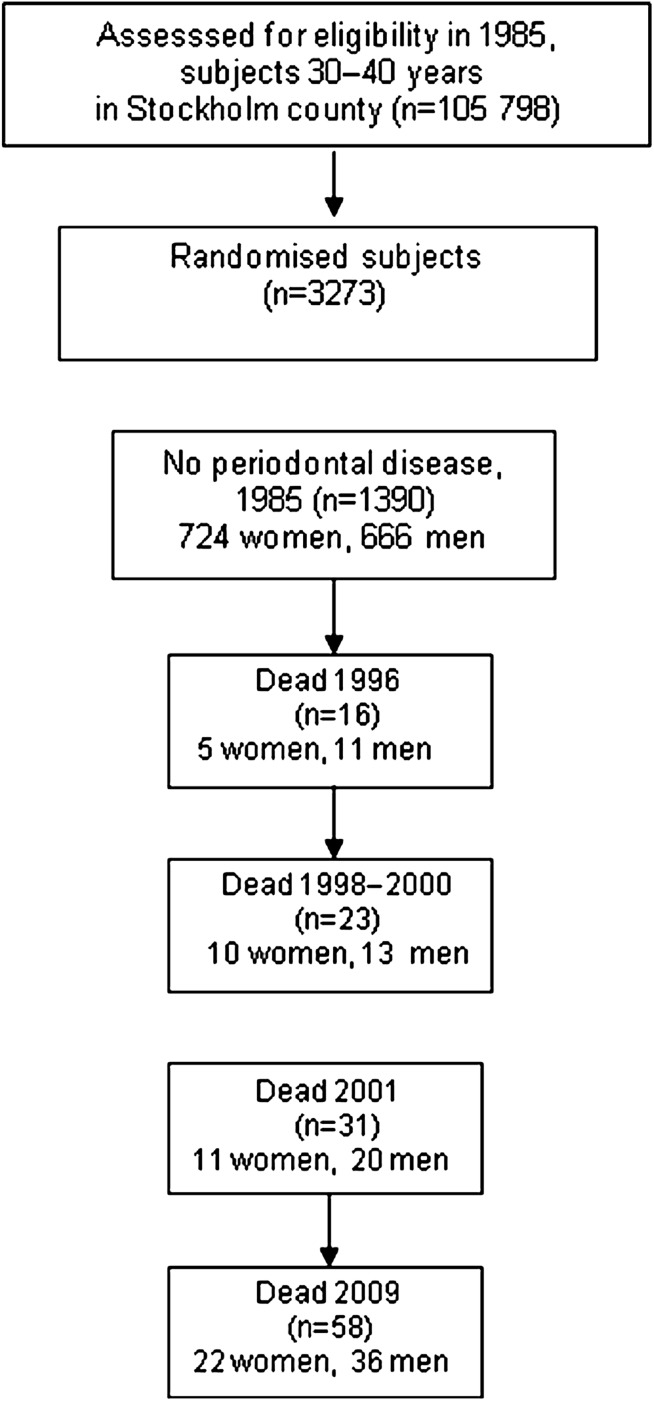
1390 randomly selected healthy young Swedes followed up from 1985 to 2009. All subjects underwent oral clinical examination and answered a questionnaire assessing background variables such as socioeconomic status and smoking.
Causes of death were recorded from national statistics and classified according to the WHO International Classification of Diseases. Unpaired t test, χ(2) tests and multiple logistic regressions were used.
Of the 1390 participants, 4.2% had died during the follow-up. Women had died at a mean age of 61.0 (±2.6 SD) years and men at the age of 60.2 (±2.9 SD) years. The amount of dental plaque between those who had died versus survived was statistically significant (p<0.001). In multiple logistic regression analysis, dental plaque appeared to be a significant independent predictor associated with 1.79 times the OR of death (p<0.05). Age increased the risk with an OR of 1.98 (p<0.05) and gender (men) with an OR of 1.91 (p<0.05). The malignancies were more widely scattered in men, while breast cancer was the most frequent cause of death in women.
This study hypothesis was confirmed by showing that poor oral hygiene, as reflected in the amount of dental plaque, was associated with increased cancer mortality.
研究表明口腔卫生不良且是口腔感染潜在来源的牙菌斑量是否与癌症过早死亡相关。
前瞻性队列研究。
1390名随机选取的健康瑞典年轻人,从1985年至2009年进行随访。所有受试者均接受口腔临床检查,并回答一份评估社会经济地位和吸烟等背景变量的问卷。
从国家统计数据中记录死亡原因,并根据世界卫生组织国际疾病分类进行分类。使用了非配对t检验、χ²检验和多元逻辑回归分析。
在1390名参与者中,4.2%在随访期间死亡。女性死亡的平均年龄为61.0(±2.6标准差)岁,男性为60.2(±2.9标准差)岁。死亡者与存活者之间的牙菌斑量在统计学上有显著差异(p<0.001)。在多元逻辑回归分析中,牙菌斑似乎是一个显著的独立预测因素,与死亡风险比为1.79倍相关(p<0.05)。年龄使风险增加,风险比为1.98(p<0.05),性别(男性)使风险比为1.91(p<0.05)。男性的恶性肿瘤分布更广泛,而乳腺癌是女性最常见的死亡原因。
本研究假设得到证实,即牙菌斑量所反映的口腔卫生不良与癌症死亡率增加相关。