Söder Birgitta, Meurman Jukka H, Söder Per-Östen
Department of Dental Medicine, Karolinska Institutet, Huddinge, Sweden.
Department of Oral and Maxillofacial Diseases, University of Helsinki and Helsinki University Hospital, Helsinki, Finland.
PLoS One. 2016 Jun 23;11(6):e0157797. doi: 10.1371/journal.pone.0157797. eCollection 2016.
Dental infections, such as periodontitis, associate with atherosclerosis and its complications. We studied a cohort followed-up since 1985 for incidence of angina pectoris with the hypothesis that calculus accumulation, proxy for poor oral hygiene, links to this symptom.
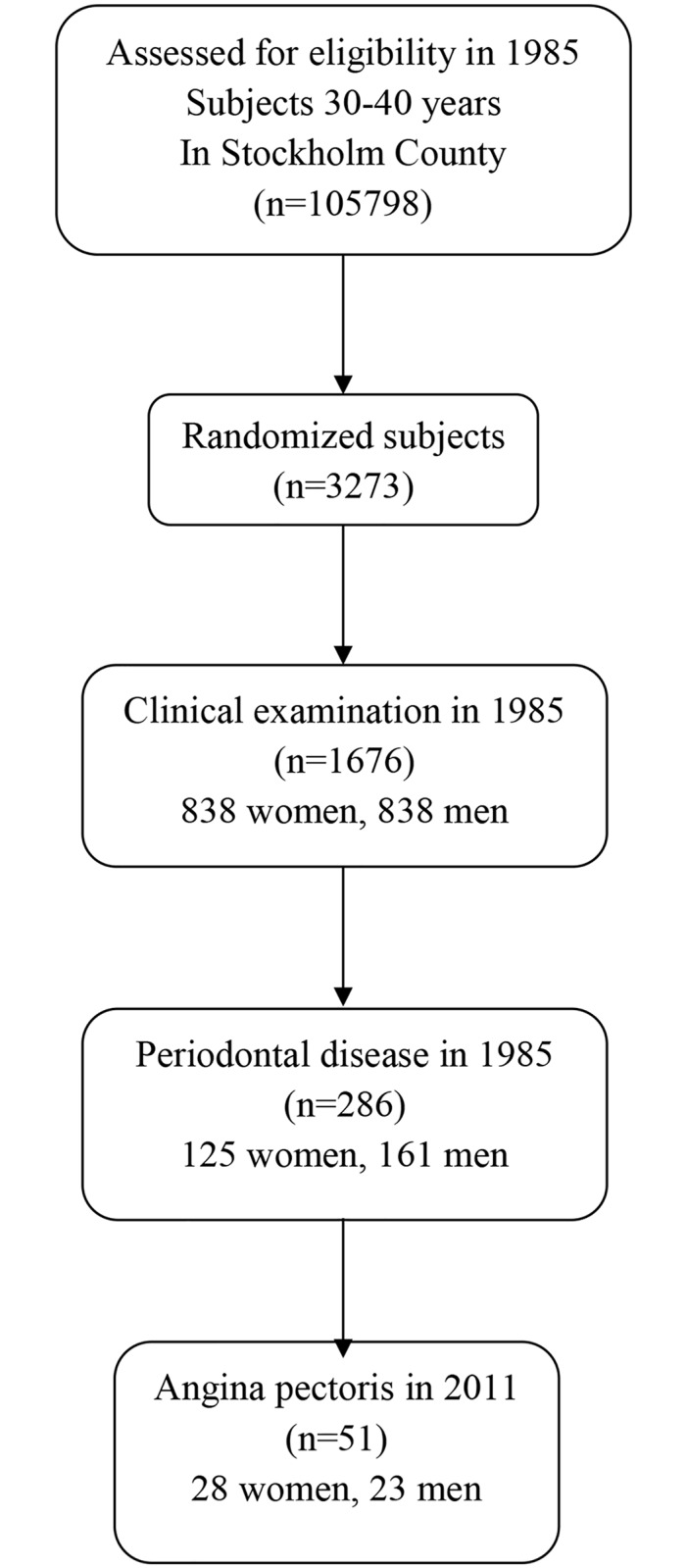
In our Swedish prospective cohort study of 1676 randomly selected subjects followed-up for 26 years. In 1985 all subjects underwent clinical oral examination and answered a questionnaire assessing background variables such as socio-economic status and pack-years of smoking. By using data from the Center of Epidemiology, Swedish National Board of Health and Welfare, Sweden we analyzed the association of oral health parameters with the prevalence of in-hospital verified angina pectoris classified according to the WHO International Classification of Diseases, using descriptive statistics and logistic regression analysis.
Of the 1676 subjects, 51 (28 women/23 men) had been diagnosed with angina pectoris at a mean age of 59.8 ± 2.9 years. No difference was observed in age and gender between patients with angina pectoris and subjects without. Neither was there any difference in education level and smoking habits (in pack years), Gingival index and Plaque index between the groups. Angina pectoris patients had significantly more often their first maxillary molar tooth extracted (d. 16) than the other subjects (p = 0.02). Patients also showed significantly higher dental calculus index values than the subjects without angina pectoris (p = 0.01). Multiple regression analysis showed odds ratio 2.21 (95% confidence interval 1.17-4.17) in the association between high calculus index and angina pectoris (p = 0.015).
Our study hypothesis was confirmed by showing for the first time that high dental calculus score indeed associated with the incidence of angina pectoris in this cohort study.
牙周炎等牙齿感染与动脉粥样硬化及其并发症相关。我们对一个自1985年起随访的队列进行研究,以探讨心绞痛发病率,假设牙结石堆积(口腔卫生差的指标)与该症状有关。
在我们对1676名随机选取的受试者进行的瑞典前瞻性队列研究中,随访26年。1985年,所有受试者接受临床口腔检查,并回答一份评估社会经济状况和吸烟包年数等背景变量的问卷。通过使用瑞典国家卫生和福利委员会流行病学中心的数据,我们采用描述性统计和逻辑回归分析,分析口腔健康参数与根据世界卫生组织国际疾病分类分类的住院确诊心绞痛患病率之间的关联。
在1676名受试者中,51人(28名女性/23名男性)被诊断为心绞痛,平均年龄为59.8±2.9岁。心绞痛患者与未患心绞痛的受试者在年龄和性别上无差异。两组在教育水平和吸烟习惯(吸烟包年数)、牙龈指数和菌斑指数方面也无差异。心绞痛患者拔除第一上颌磨牙(d.16)的频率明显高于其他受试者(p = 0.02)。患者的牙结石指数值也明显高于无心绞痛的受试者(p = 0.01)。多元回归分析显示,高牙结石指数与心绞痛之间的关联的比值比为2.21(95%置信区间1.17 - 4.17)(p = 0.015)。
我们的研究假设得到证实,首次表明在该队列研究中,牙结石高分确实与心绞痛发病率相关。