University of California at Berkeley, School of Public Health, 239 University Hall, #7360, Berkeley, CA, 94720-7360, USA.
Popul Health Metr. 2012 Jun 13;10(1):11. doi: 10.1186/1478-7954-10-11.
Little is known about adult health and mortality relationships outside high-income nations, partly because few datasets have contained biomarker data in representative populations. Our objective is to determine the prognostic value of biomarkers with respect to total and cardiovascular mortality in an elderly population of a middle-income country, as well as the extent to which they mediate the effects of age and sex on mortality.
This is a prospective population-based study in a nationally representative sample of elderly Costa Ricans. Baseline interviews occurred mostly in 2005 and mortality follow-up went through December 2010. Sample size after excluding observations with missing values: 2,313 individuals and 564 deaths.
prospective death rate ratios for 22 baseline biomarkers, which were estimated with hazard regression models.
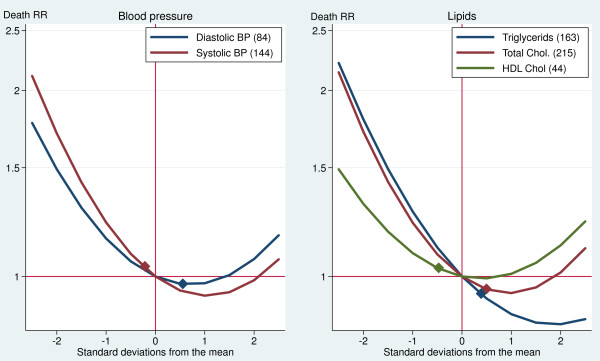
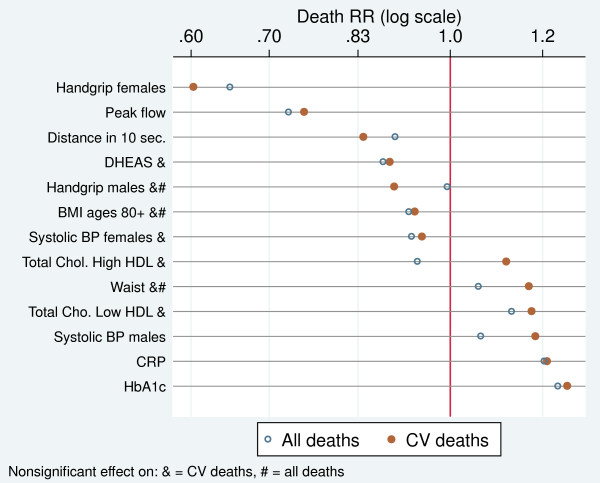
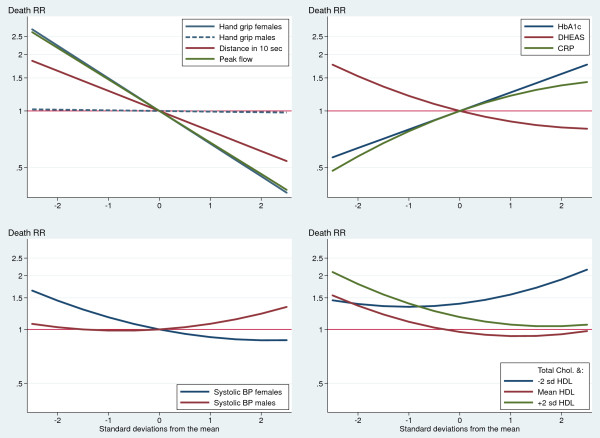
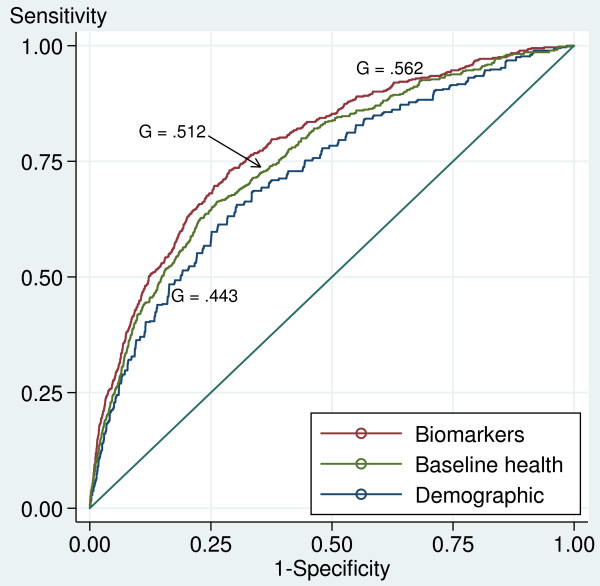
Biomarkers significantly predict future death above and beyond demographic and self-reported health conditions. The studied biomarkers account for almost half of the effect of age on mortality. However, the sex gap in mortality became several times wider after controlling for biomarkers. The most powerful predictors were simple physical tests: handgrip strength, pulmonary peak flow, and walking speed. Three blood tests also predicted prospective mortality: C-reactive protein (CRP), glycated hemoglobin (HbA1c), and dehydroepiandrosterone sulfate (DHEAS). Strikingly, high blood pressure (BP) and high total cholesterol showed little or no predictive power. Anthropometric measures also failed to show significant mortality effects.
This study adds to the growing evidence that blood markers for CRP, HbA1c, and DHEAS, along with organ-specific functional reserve indicators (handgrip, walking speed, and pulmonary peak flow), are valuable tools for identifying vulnerable elderly. The results also highlight the need to better understand an anomaly noted previously in other settings: despite the continued medical focus on drugs for BP and cholesterol, high levels of BP and cholesterol have little predictive value of mortality in this elderly population.
关于高收入国家以外的成年人健康和死亡率关系,我们知之甚少,部分原因是很少有数据集包含具有代表性人群的生物标志物数据。我们的目标是确定生物标志物与一个中等收入国家的老年人群体的总死亡率和心血管死亡率之间的预后价值,以及它们在多大程度上调节年龄和性别对死亡率的影响。
这是一项针对哥斯达黎加老年人的全国代表性样本的前瞻性人群研究。基线访谈主要在 2005 年进行,死亡率随访至 2010 年 12 月。在排除具有缺失值的观察值后,样本量为:2313 人,564 人死亡。
通过风险回归模型估计了 22 项基线生物标志物的前瞻性死亡率比值。
生物标志物可显著预测未来死亡,超过了人口统计学和自我报告的健康状况。所研究的生物标志物几乎占年龄对死亡率影响的一半。然而,在控制生物标志物后,性别差距使死亡率扩大了数倍。最有力的预测因素是简单的身体测试:握力、肺峰流速和步行速度。三项血液测试也预测了前瞻性死亡率:C 反应蛋白(CRP)、糖化血红蛋白(HbA1c)和脱氢表雄酮硫酸盐(DHEAS)。令人惊讶的是,高血压(BP)和高总胆固醇显示出几乎没有或没有预测能力。人体测量指标也未能显示出显著的死亡率影响。
本研究增加了越来越多的证据,表明 CRP、HbA1c 和 DHEAS 的血液标志物以及特定器官的功能储备指标(握力、步行速度和肺峰流速)是识别脆弱老年人的有价值工具。研究结果还强调了需要更好地理解以前在其他环境中注意到的异常现象:尽管医学继续关注血压和胆固醇的药物,但在这个老年人群体中,BP 和胆固醇水平高对死亡率的预测价值很小。