Council of Scientific and Industrial Research, CSIR-Institute of Microbial Technology, Sector - 39A, Chandigarh 160 036, India.
Microb Cell Fact. 2012 Jun 20;11:86. doi: 10.1186/1475-2859-11-86.
Gold nanoparticles (AuNPs) have found wide range of applications in electronics, biomedical engineering, and chemistry owing to their exceptional opto-electrical properties. Biological synthesis of gold nanoparticles by using plant extracts and microbes have received profound interest in recent times owing to their potential to produce nanoparticles with varied shape, size and morphology. Marine microorganisms are unique to tolerate high salt concentration and can evade toxicity of different metal ions. However, these marine microbes are not sufficiently explored for their capability of metal nanoparticle synthesis. Although, marine water is one of the richest sources of gold in the nature, however, there is no significant publication regarding utilization of marine micro-organisms to produce gold nanoparticles. Therefore, there might be a possibility of exploring marine bacteria as nanofactories for AuNP biosynthesis.
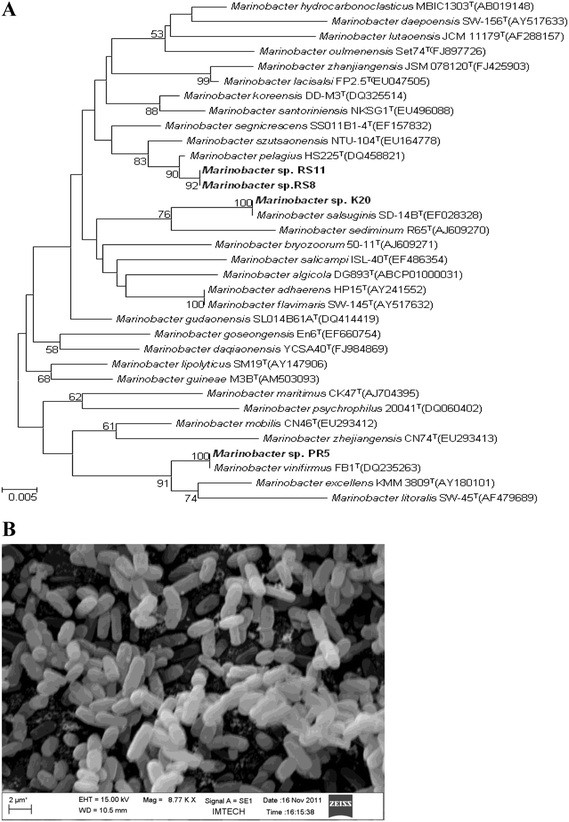
In the present study, marine bacteria are exploited towards their capability of gold nanoparticles (AuNPs) production. Stable, monodisperse AuNP formation with around 10 nm dimension occur upon exposure of HAuCl(4) solution to whole cells of a novel strain of Marinobacter pelagius, as characterized by polyphasic taxonomy. Nanoparticles synthesized are characterized by Transmission electron microscopy, Dynamic light scattering and UV-visible spectroscopy.
The potential of marine organisms in biosynthesis of AuNPs are still relatively unexplored. Although, there are few reports of gold nanoparticles production using marine sponges and sea weeds however, there is no report on the production of gold nanoparticles using marine bacteria. The present work highlighted the possibility of using the marine bacterial strain of Marinobacter pelagius to achieve a fast rate of nanoparticles synthesis which may be of high interest for future process development of AuNPs. This is the first report of AuNP synthesis by marine bacteria.
由于其独特的光电特性,金纳米粒子(AuNPs)在电子学、生物医学工程和化学领域得到了广泛的应用。由于其具有生产具有不同形状、大小和形态的纳米粒子的潜力,近年来,利用植物提取物和微生物生物合成金纳米粒子受到了广泛关注。海洋微生物具有耐受高盐浓度和逃避不同金属离子毒性的独特能力。然而,这些海洋微生物的金属纳米粒子合成能力尚未得到充分探索。虽然海洋水是自然界中最丰富的黄金来源之一,但关于利用海洋微生物生产金纳米粒子的研究却很少。因此,探索海洋细菌作为 AuNP 生物合成的纳米工厂可能是一种可行的方法。
本研究利用海洋细菌生产金纳米粒子(AuNPs)。当 HAuCl4 溶液暴露于一种新型海洋杆菌(Marinobacter pelagius)的全细胞时,会形成稳定的、单分散的 10nm 左右的 AuNP,这一特性通过多相分类学进行了表征。通过透射电子显微镜、动态光散射和紫外-可见光谱对合成的纳米粒子进行了表征。
海洋生物在 AuNPs 生物合成中的潜力仍然相对未知。虽然有一些关于利用海洋海绵和海藻生产金纳米粒子的报道,但目前还没有关于利用海洋细菌生产金纳米粒子的报道。本研究工作强调了利用海洋杆菌 Marinobacter pelagius 快速合成纳米粒子的可能性,这可能对未来 AuNPs 的工艺开发具有很高的兴趣。这是海洋细菌合成 AuNP 的首次报道。