Department of Pharmaceutical Chemistry, University of California San Francisco, San Francisco, CA 94158-2330, USA.
J Med Chem. 2012 Jul 26;55(14):6582-94. doi: 10.1021/jm300687e. Epub 2012 Jul 5.
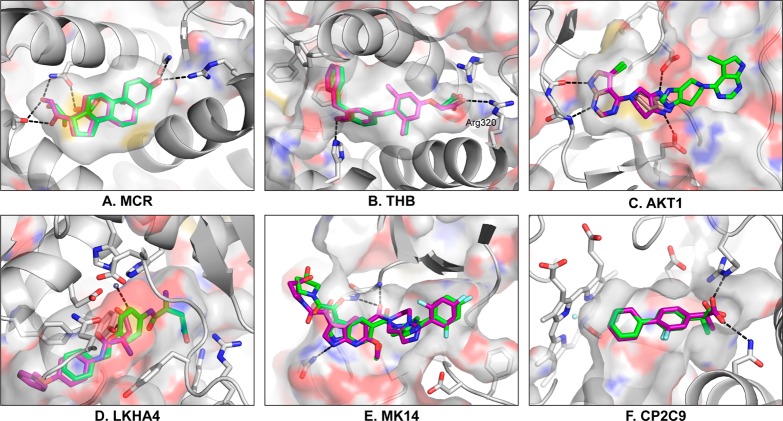
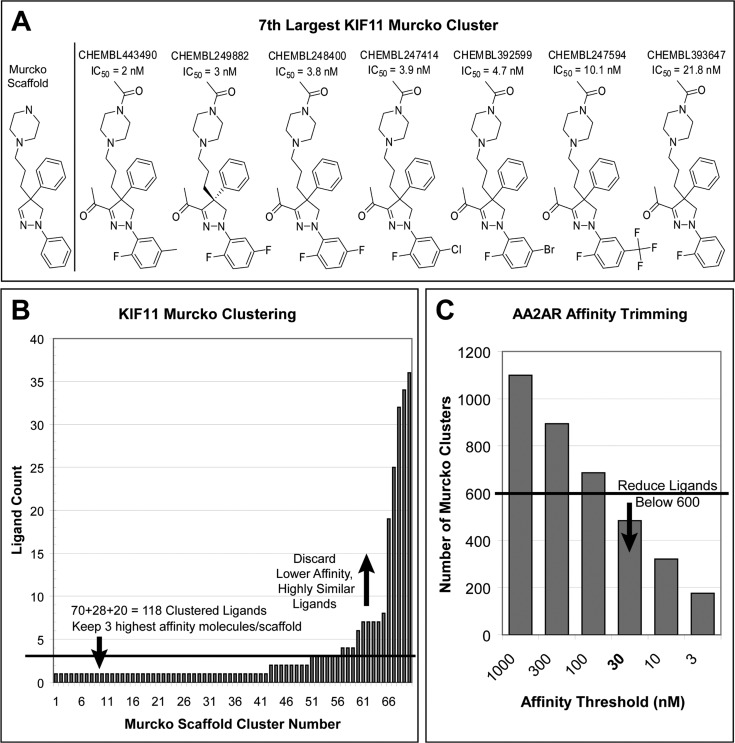
A key metric to assess molecular docking remains ligand enrichment against challenging decoys. Whereas the directory of useful decoys (DUD) has been widely used, clear areas for optimization have emerged. Here we describe an improved benchmarking set that includes more diverse targets such as GPCRs and ion channels, totaling 102 proteins with 22886 clustered ligands drawn from ChEMBL, each with 50 property-matched decoys drawn from ZINC. To ensure chemotype diversity, we cluster each target's ligands by their Bemis-Murcko atomic frameworks. We add net charge to the matched physicochemical properties and include only the most dissimilar decoys, by topology, from the ligands. An online automated tool (http://decoys.docking.org) generates these improved matched decoys for user-supplied ligands. We test this data set by docking all 102 targets, using the results to improve the balance between ligand desolvation and electrostatics in DOCK 3.6. The complete DUD-E benchmarking set is freely available at http://dude.docking.org.
评估分子对接的一个关键指标是针对具有挑战性的伪药物配体进行配体富集。虽然有用的伪药物目录(DUD)已经被广泛使用,但仍有明显的优化空间。在这里,我们描述了一个改进的基准集,其中包括更具多样性的靶点,如 GPCR 和离子通道,共包含 102 种蛋白质和 22886 个从 ChEMBL 中提取的聚类配体,每个蛋白质都有 50 个从 ZINC 中提取的具有匹配性质的伪药物。为了确保化学类型的多样性,我们通过其 Bemis-Murcko 原子结构对每个目标的配体进行聚类。我们在匹配的物理化学性质中添加净电荷,并仅包括与配体拓扑结构最不相似的伪药物。一个在线自动工具(http://decoys.docking.org)为用户提供的配体生成这些改进的匹配伪药物。我们通过对接所有 102 个目标来测试这个数据集,使用这些结果来改进 DOCK 3.6 中配体去溶剂化和静电相互作用之间的平衡。完整的 DUD-E 基准集可在 http://dude.docking.org 上免费获得。