Department of Chemical Engineering, University of Michigan, Ann Arbor, Michigan 48109, United States.
Nano Lett. 2012 Jul 11;12(7):3391-8. doi: 10.1021/nl3015632. Epub 2012 Jun 26.
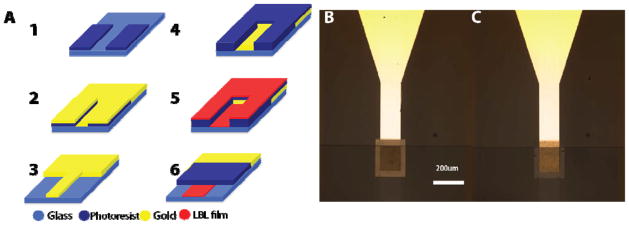
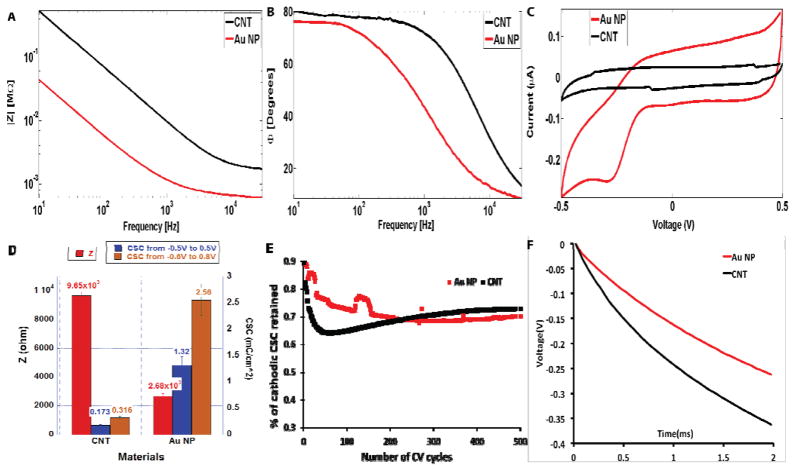
Treatments of neurological diseases, diagnostics of brain malfunctions, and the realization of brain-computer interfaces require ultrasmall electrodes that are "invisible" to resident immune cells. Functional electrodes smaller than 50 μm are impossible to produce with traditional materials due to high interfacial impedance at the characteristic frequency of neural activity and insufficient charge storage capacity. The problem can be resolved by using gold nanoparticle nanocomposites. Careful comparison indicates that layer-by-layer assembled films from Au NPs provide more than 3-fold improvement in interfacial impedance and 1 order of magnitude increase in charge storage capacity. Prototypes of microelectrodes could be made using traditional photolithography. Integration of unique nanocomposite materials with microfabrication techniques opens the door for practical realization of the ultrasmall implantable electrodes. Further improvement of electrical properties is expected when using special shapes of gold nanoparticles.
神经系统疾病的治疗、大脑功能障碍的诊断以及脑机接口的实现都需要对驻留免疫细胞“不可见”的超小型电极。由于在神经活动的特征频率处存在高界面阻抗以及电荷存储容量不足,传统材料不可能制造出小于 50μm 的功能性电极。金纳米颗粒纳米复合材料可以解决这个问题。仔细比较表明,由 Au NPs 组成的层层组装膜在界面阻抗方面提高了 3 倍以上,在电荷存储容量方面提高了 1 个数量级。可以使用传统的光刻技术来制造微电极原型。将独特的纳米复合材料与微制造技术集成在一起,为实际实现超小型可植入电极开辟了道路。当使用特殊形状的金纳米粒子时,预计其电性能会进一步提高。