Computational Systems Biology Lab, Department of Biochemistry and Molecular Biology and Institute of Bioinformatics, University of Georgia, Athens, GA 30605, USA.
Nucleic Acids Res. 2012 Sep 1;40(17):8210-8. doi: 10.1093/nar/gks605. Epub 2012 Jun 26.
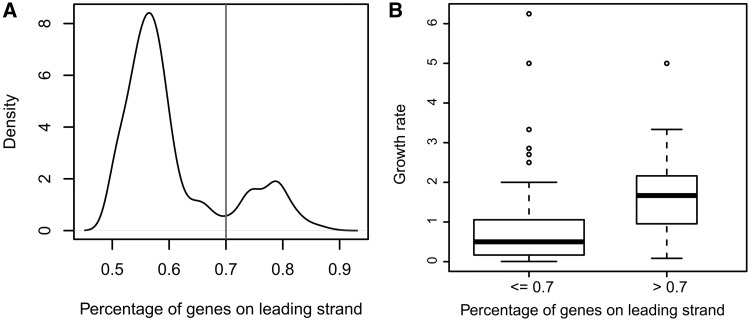
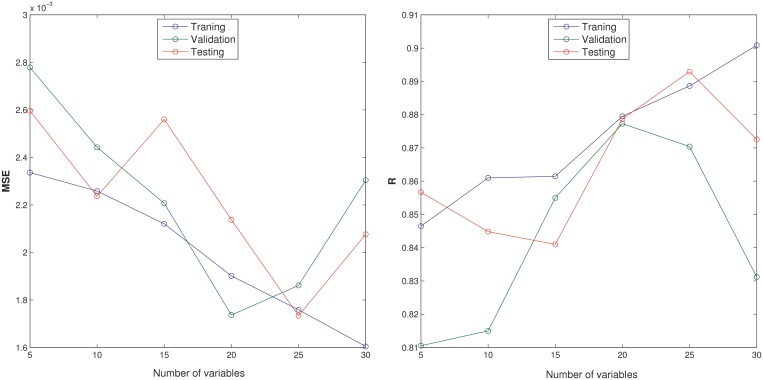
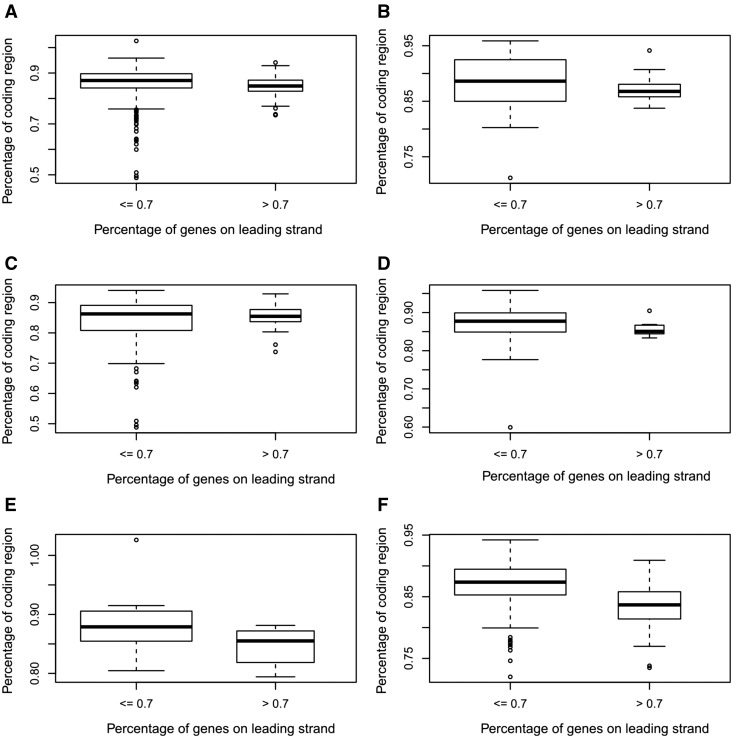
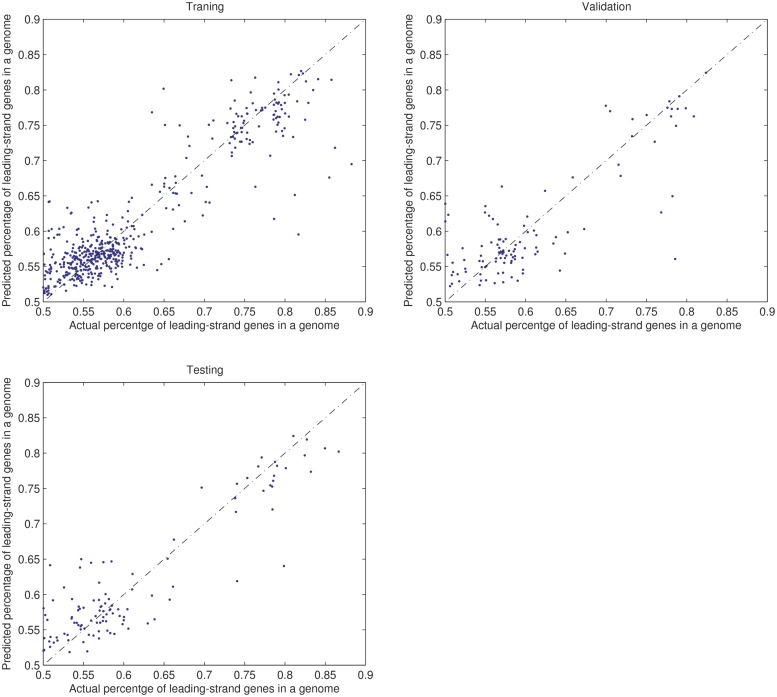
The majority of bacterial genes are located on the leading strand, and the percentage of such genes has a large variation across different bacteria. Although some explanations have been proposed, these are at most partial explanations as they cover only small percentages of the genes and do not even consider the ones biased toward the lagging strand. We have carried out a computational study on 725 bacterial genomes, aiming to elucidate other factors that may have influenced the strand location of genes in a bacterium. Our analyses suggest that (i) genes of some functional categories such as ribosome have higher preferences to be on the leading strands; (ii) genes of some functional categories such as transcription factor have higher preferences on the lagging strands; (iii) there is a balancing force that tends to keep genes from all moving to the leading and more efficient strand and (iv) the percentage of leading-strand genes in an bacterium can be accurately explained based on the numbers of genes in the functional categories outlined in (i) and (ii), genome size and gene density, indicating that these numbers implicitly contain the information about the percentage of genes on the leading versus lagging strand in a genome.
大多数细菌基因位于前导链上,而这种基因的百分比在不同细菌之间有很大的差异。尽管已经提出了一些解释,但这些解释最多只是部分解释,因为它们只涵盖了一小部分基因,甚至没有考虑到那些偏向滞后链的基因。我们对 725 个细菌基因组进行了计算研究,旨在阐明可能影响细菌中基因链位置的其他因素。我们的分析表明:(i) 核糖体等一些功能类别的基因在前导链上有更高的偏好;(ii) 转录因子等一些功能类别的基因在滞后链上有更高的偏好;(iii) 有一种平衡力量,倾向于阻止所有基因都移到前导链和更有效的链上;(iv) 一个细菌中前导链基因的百分比可以根据(i)和(ii)中概述的功能类别、基因组大小和基因密度的基因数量来准确解释,表明这些数量隐含了基因组中前导链与滞后链上基因的百分比信息。