Division of Infectious Diseases, Ospedale Generale, Bolzano, Italy.
Med Sci Monit. 2012 Jul;18(7):CS57-62. doi: 10.12659/msm.883198.
Drug-induced hypersensitivity syndrome/drug reaction with eosinophilia and systemic symptoms (DIHS/DRESS) is a rare and severe adverse drug reaction with an associated mortality of 10-20%. Clinical worsening despite discontinuation of the culprit drug is considered a characteristic feature of DIHS/DRESS. Besides the early recognition of the syndrome and discontinuation of its causative drug, the mainstay of treatment is systemic corticosteroids. Nevertheless, treatment of severe DIHS/DRESS is not well defined, as corticosteroids may sometimes not be effective, and decreasing the dose may be associated with flaring of the disease.
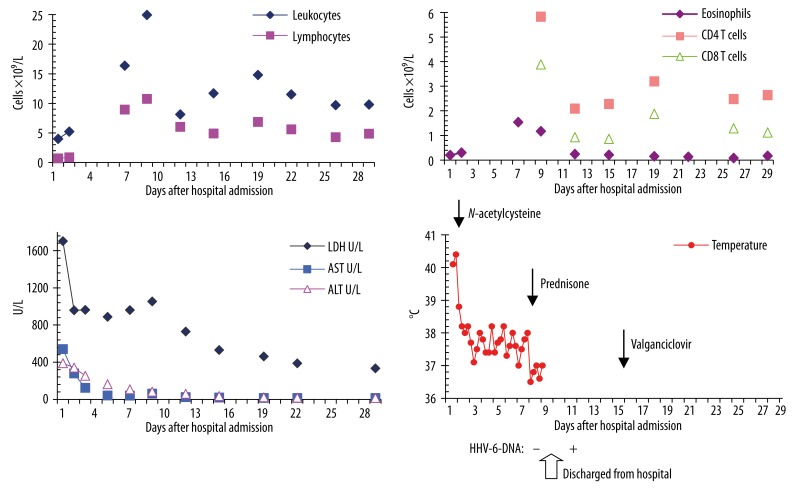
A 38-year-old woman with high fever, malaise, abdominal pain, rash, and elevated liver enzymes received immediate high-dose N-acetylcysteine, because acetaminophen hepatotoxicity was suspected. N-acetylcysteine administration was associated with a significant clinical improvement. However, within the next week DIHS/DRESS syndrome was diagnosed, which explained all the symptoms, and which was subsequently treated with prednisone and valganciclovir.
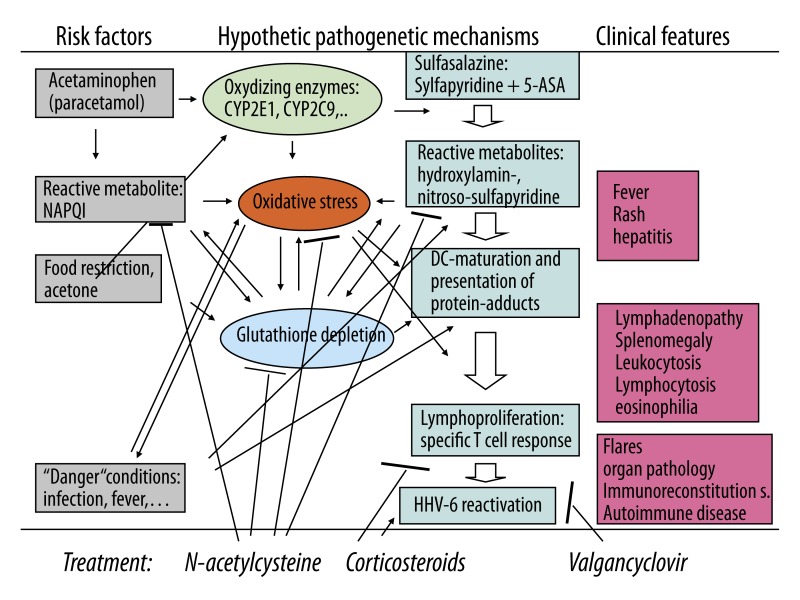
New options necessary to improve treatment of severe DIHD/DRESS have to consider its sequential pathogenetic mechanisms. N-acetylcysteine might neutralize the drug-derived reactive metabolites, which are responsible for protein adduct formation and specific T cell stimulation, and replete the glutathione stores that counterbalance oxidative stress. Prednisone might inhibit lymphoproliferation and valganciclovir might prevent complications related to HHV-6 reactivation. We therefore propose the unprecedented combination of N-acetylcysteine, prednisone and valganciclovir as a treatment option for DIHS/DRESS.
药物诱导的超敏反应/伴有嗜酸性粒细胞增多和全身症状的药物反应(DIHS/DRESS)是一种罕见且严重的药物不良反应,死亡率为 10-20%。尽管停用了致病药物,但病情仍在恶化,这被认为是 DIHS/DRESS 的特征性表现。除了早期识别综合征并停用致病药物外,治疗的主要方法是全身性皮质类固醇。然而,严重 DIHS/DRESS 的治疗方法尚未明确,因为皮质类固醇有时可能无效,减少剂量可能会导致疾病恶化。
一名 38 岁女性因高热、乏力、腹痛、皮疹和肝酶升高而立即接受大剂量 N-乙酰半胱氨酸治疗,因为怀疑对乙酰氨基酚肝毒性。N-乙酰半胱氨酸给药后临床显著改善。然而,在接下来的一周内,诊断出 DIHS/DRESS 综合征,该综合征解释了所有症状,并随后用泼尼松和缬更昔洛韦治疗。
为了改善严重 DIHD/DRESS 的治疗,需要考虑其连续的发病机制,需要新的治疗选择。N-乙酰半胱氨酸可能会中和导致蛋白加合物形成和特定 T 细胞刺激的药物衍生的反应性代谢物,并补充谷胱甘肽储存,以抵消氧化应激。泼尼松可能抑制淋巴细胞增殖,缬更昔洛韦可能预防与 HHV-6 再激活相关的并发症。因此,我们提出了将 N-乙酰半胱氨酸、泼尼松和缬更昔洛韦联合应用作为 DIHS/DRESS 治疗选择的前所未有的方案。