Prince Mutaib Chair for Biomarkers of Osteoporosis, King Saud University, Riyadh, Kingdom of Saudi Arabia.
BMC Pediatr. 2012 Jul 3;12:92. doi: 10.1186/1471-2431-12-92.
Accumulating evidence suggests an increased prevalence of vitamin D deficiency in the Middle East. In this context, we aimed to determine whether the prevalence of vitamin D deficiency is related to degree of physical activity and sun exposure among apparently healthy Saudi children and adolescents, a little studied population.
A total of 331 Saudi children aged 6-17 years (153 boys and 178 girls) were included in this cross sectional study. Levels of physical activity and sun exposure were determined using a standard questionnaire. Anthropometry, serum calcium and 25-(OH) vitamin D were analyzed.
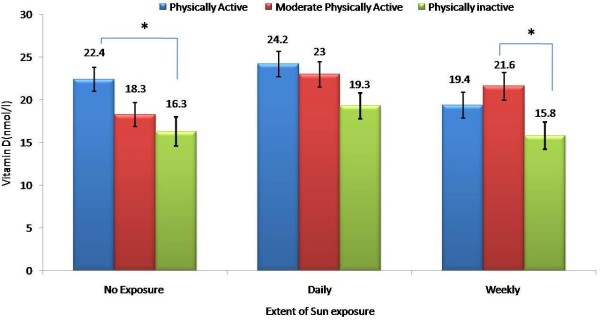
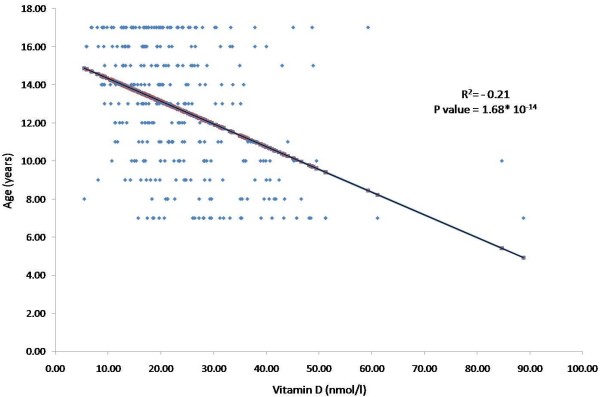
All subjects were vitamin D deficient, the majority being moderately deficient (71.6%). Age was the single most significant predictor affecting 25 (OH) Vitamin D levels, explaining 21% of the variance perceived (p = 1.68 x 10⁻¹⁴). Age-matched comparisons revealed that for groups having the same amount of sun exposure, those with moderate or are physically active will have higher levels of vitamin D status, though levels in across groups remained deficient.
Vitamin D deficiency is common among Saudi children and adolescents, and is influenced by both sun exposure and physical activity. Promotion of an active outdoor lifestyle among Saudi children in both homes and schools may counteract the vitamin D deficiency epidemic in this vulnerable population. Vitamin D supplementation is suggested in all groups, including those with the highest sun exposure and physical activity.
越来越多的证据表明,中东地区维生素 D 缺乏症的患病率有所上升。在这种情况下,我们旨在确定维生素 D 缺乏症的患病率是否与沙特儿童和青少年(一个研究较少的人群)的体力活动和阳光暴露程度有关。
本横断面研究共纳入 331 名 6-17 岁的沙特儿童(男 153 名,女 178 名)。使用标准问卷确定体力活动和阳光暴露水平。分析人体测量、血清钙和 25-(OH)维生素 D。
所有受试者均存在维生素 D 缺乏,大多数为中度缺乏(71.6%)。年龄是影响 25(OH)维生素 D 水平的唯一最重要的预测因素,解释了 21%的方差(p=1.68x10⁻¹⁴)。年龄匹配的比较显示,对于接受相同阳光暴露量的组,那些中度活跃或体力活动活跃的组将具有更高的维生素 D 状态水平,尽管在整个组中,水平仍然不足。
维生素 D 缺乏症在沙特儿童和青少年中很常见,并且受到阳光暴露和体力活动的影响。在家庭和学校中促进沙特儿童积极的户外生活方式可能会抵消这一脆弱人群中维生素 D 缺乏症的流行。建议所有组(包括接受阳光暴露和体力活动最多的组)都进行维生素 D 补充。