Department of Neurosciences, Medical University of South Carolina, Charleston, SC, USA.
J Neurol Neurosurg Psychiatry. 2012 Sep;83(9):903-9. doi: 10.1136/jnnp-2012-302476. Epub 2012 Jul 4.
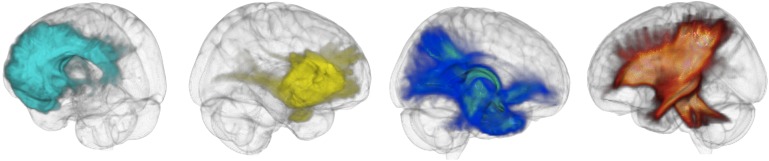
It has been hypothesised that seizure induced neuronal loss and axonal damage in medial temporal lobe epilepsy (MTLE) may lead to the development of aberrant connections between limbic structures and eventually result in the reorganisation of the limbic network. In this study, limbic structural connectivity in patients with MTLE was investigated, using diffusion tensor MRI, probabilistic tractography and graph theory based network analysis.
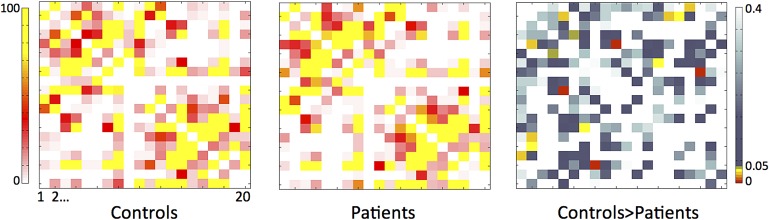
12 patients with unilateral MTLE and hippocampal sclerosis (five left and seven right MTLE) and 26 healthy controls were studied. The connectivity of 10 bilateral limbic regions of interest was mapped with probabilistic tractography, and the probabilistic fibre density between each pair of regions was used as the measure of their weighted structural connectivity. Binary connectivity matrices were then obtained from the weighted connectivity matrix using a range of fixed density thresholds. Graph theory based properties of nodes (degree, local efficiency, clustering coefficient and betweenness centrality) and the network (global efficiency and average clustering coefficient) were calculated from the weight and binary connectivity matrices of each subject and compared between patients and controls.
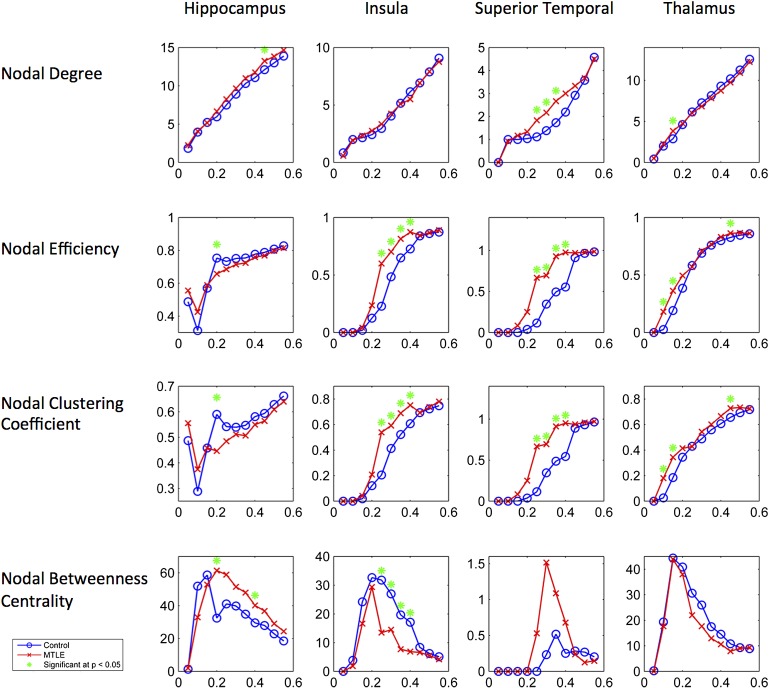
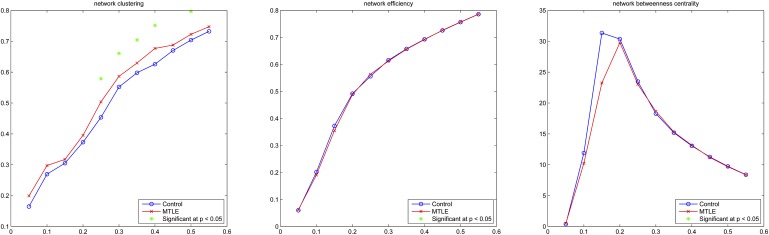
MTLE was associated with a regional reduction in fibre density compared with controls. Paradoxically, patients exhibited (1) increased limbic network clustering and (2) increased nodal efficiency, degree and clustering coefficient in the ipsilateral insula, superior temporal region and thalamus. There was also a significant reduction in clustering coefficient and efficiency of the ipsilateral hippocampus, accompanied by increased nodal degree.
These results suggest that MTLE is associated with reorganisation of the limbic system. These results corroborate the concept of MTLE as a network disease, and may contribute to the understanding of network excitability dynamics in epilepsy and MTLE.
已有假说认为,颞叶内侧癫痫(MTLE)中癫痫发作引起的神经元丢失和轴突损伤可能导致边缘结构之间的异常连接的发展,并最终导致边缘网络的重组。在这项研究中,我们使用弥散张量 MRI、概率追踪和基于图论的网络分析来研究 MTLE 患者的边缘结构连接。
研究了 12 例单侧 MTLE 伴海马硬化患者(5 例左侧 MTLE,7 例右侧 MTLE)和 26 名健康对照者。通过概率追踪来绘制 10 对双侧边缘感兴趣区的连接,并将每对区域之间的概率纤维密度用作它们加权结构连接的度量。然后,使用一系列固定密度阈值,从加权连接矩阵中获得二进制连接矩阵。使用节点(度、局部效率、聚类系数和中间中心性)和网络(全局效率和平均聚类系数)的基于图论的属性,从每个受试者的权重和二进制连接矩阵中计算,然后在患者和对照组之间进行比较。
与对照组相比,MTLE 患者的纤维密度存在区域性降低。矛盾的是,患者表现出(1)同侧岛叶、颞上回和丘脑的边缘网络聚类增加,(2)同侧脑岛、颞上回和丘脑的节点效率、度和聚类系数增加。同侧海马的聚类系数和效率也显著降低,同时节点度增加。
这些结果表明,MTLE 与边缘系统的重组有关。这些结果证实了 MTLE 作为一种网络疾病的概念,并可能有助于理解癫痫和 MTLE 中的网络兴奋性动力学。