Division of Infectious Diseases and Tropical Medicine, Medical Center of the University of Munich (LMU), Munich, Germany.
PLoS One. 2012;7(6):e39529. doi: 10.1371/journal.pone.0039529. Epub 2012 Jun 29.
To evaluate the diagnostic performance of two rapid detection tests (RDTs) for HIV 1/2 in plasma and in whole blood samples.
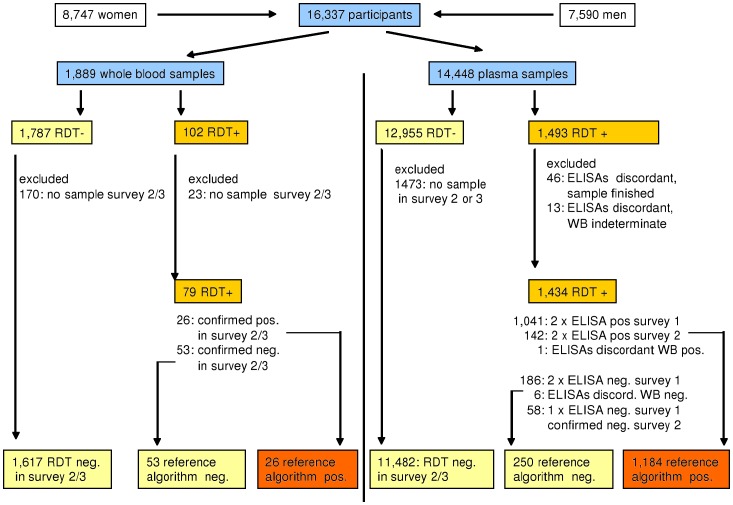
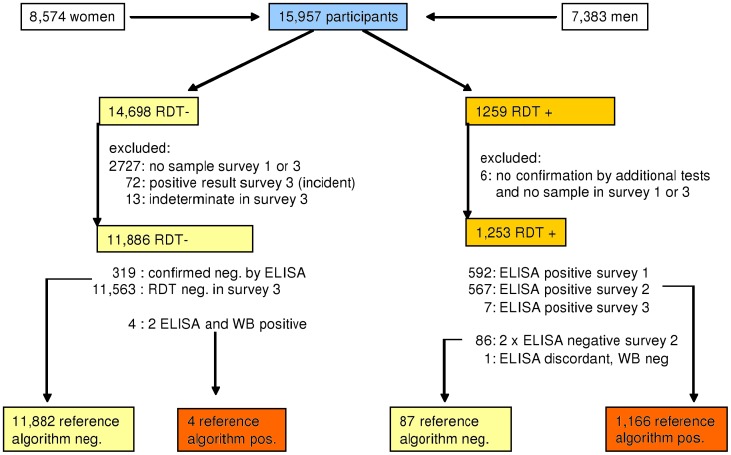
More than 15,000 study subjects above the age of two years participated in two rounds of a cohort study to determine the prevalence of HIV. HIV testing was performed using the Determine HIV 1/2 test (Abbott) in the first (2006/2007) and the HIV 1/2 STAT-PAK Dipstick Assay (Chembio) in the second round (2007/2008) of the survey. Positive results were classified into faint and strong bands depending on the visual appearance of the test strip and confirmed by ELISA and Western blot.
The sensitivity and specificity of the Determine RDT were 100% (95% confidence interval= 86.8 to 100%) and 96.8% (95.9 to 97.6%) in whole blood and 100% (99.7 to 100%) and 97.9% (97.6 to 98.1%) in plasma respectively. Specificity was highly dependent on the tested sample type: when using whole blood, 67.1% of positive results were false positive, as opposed to 17.4% in plasma. Test strips with only faint positive bands were more often false positive than strips showing strong bands and were more common in whole blood than in plasma. Evaluation of the STAT-PAK RDT in plasma during the second year resulted in a sensitivity of 99.7% (99.1 to 99.9%) and a specificity of 99.3% (99.1 to 99.4%) with 6.9% of the positive results being false.
Our study shows that the Determine HIV 1/2 strip test with its high sensitivity is an excellent tool to screen for HIV infection, but that--at least in our setting--it can not be recommended as a confirmatory test in VCT campaigns where whole blood is used.
评估两种用于血浆和全血样本的 HIV 1/2 快速检测试验(RDT)的诊断性能。
超过 15000 名年龄在两岁以上的研究对象参加了两轮队列研究,以确定 HIV 的流行率。HIV 检测使用第一(2006/2007 年)轮的 Abbott 公司的 Determine HIV 1/2 试验和第二轮(2007/2008 年)的 Chembio HIV 1/2 STAT-PAK 试条检测(化学免疫斑点法)。阳性结果根据试条的视觉外观分为弱和强条带,并通过 ELISA 和 Western blot 进行确认。
在全血中,Determine RDT 的灵敏度和特异性分别为 100%(95%置信区间=86.8 至 100%)和 96.8%(95.9 至 97.6%),在血浆中分别为 100%(99.7 至 100%)和 97.9%(97.6 至 98.1%)。特异性高度依赖于所测试的样本类型:当使用全血时,67.1%的阳性结果为假阳性,而在血浆中为 17.4%。仅显示弱阳性条带的试条比显示强阳性条带的试条更容易出现假阳性,并且在全血中比在血浆中更为常见。在第二年对 STAT-PAK RDT 在血浆中的评估结果显示,其灵敏度为 99.7%(99.1 至 99.9%),特异性为 99.3%(99.1 至 99.4%),其中 6.9%的阳性结果为假阳性。
我们的研究表明,高灵敏度的 Determine HIV 1/2 条带试验是一种筛查 HIV 感染的优秀工具,但至少在我们的环境中,它不能作为使用全血的 VCT 活动中的确认试验推荐。