Instituto de Química, Pontificia Universidad Católica de Valparaíso, Valparaíso, Chile.
PLoS One. 2012;7(6):e40254. doi: 10.1371/journal.pone.0040254. Epub 2012 Jun 29.
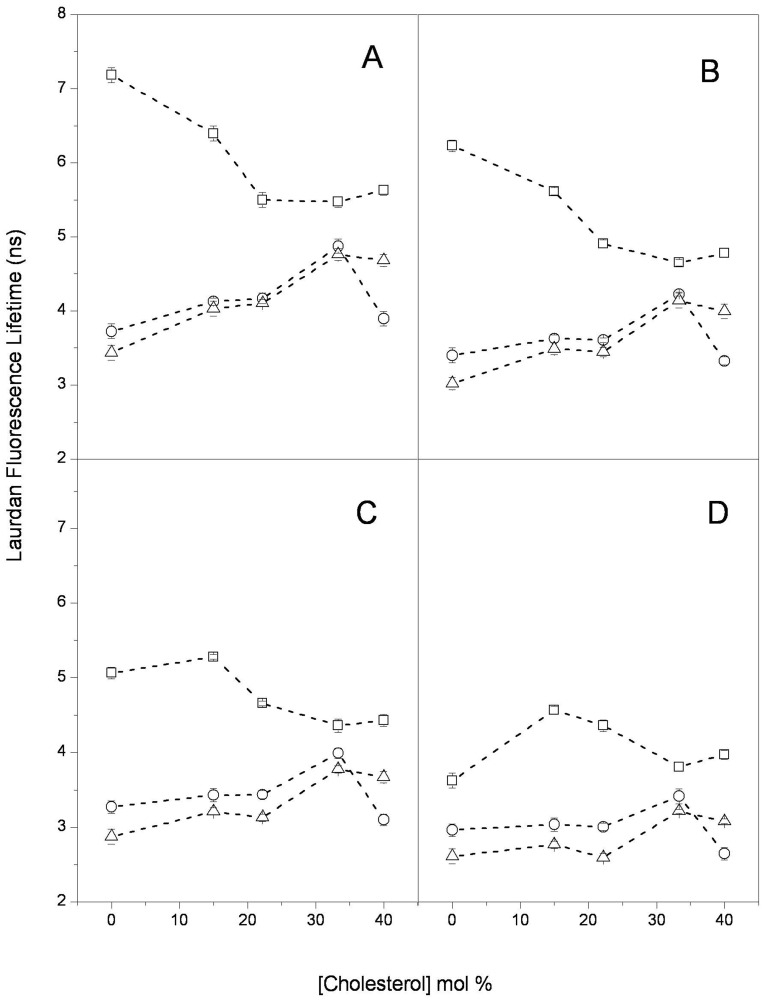
Changes in the cholesterol (Chol) content of biological membranes are known to alter the physicochemical properties of the lipid lamella and consequently the function of membrane-associated enzymes. To characterize these changes, we used steady-state and time resolved fluorescence spectroscopy and two photon-excitation microscopy techniques. The membrane systems were chosen according to the techniques that were used: large unilamellar vesicles (LUVs) for cuvette and giant unilamellar vesicles (GUVs) for microscopy measurements; they were prepared from dipalmitoyl phosphatidylcholine (DPPC) and dioctadecyl phosphatidylcholine (DOPC) in mixtures that are well known to form lipid domains. Two fluorescent probes, which insert into different regions of the bilayer, were selected: 1,6-diphenyl-1,3,5-hexatriene (DPH) was located at the deep hydrophobic core of the acyl chain regions and 2-dimethylamino-6-lauroylnaphthalene (Laurdan) at the hydrophilic-hydrophobic membrane interface. Our spectroscopy results show that (i) the changes induced by cholesterol in the deep hydrophobic phospholipid acyl chain domain are different from the ones observed in the superficial region of the hydrophilic-hydrophobic interface, and these changes depend on the state of the lamella and (ii) the incorporation of cholesterol into the lamella induces an increase in the orientation dynamics in the deep region of the phospholipid acyl chains with a corresponding decrease in the orientation at the region close to the polar lipid headgroups. The microscopy data from DOPC/DPPC/Chol GUVs using Laurdan generalized polarization (Laurdan GP) suggest that a high cholesterol content in the bilayer weakens the stability of the water hydrogen bond network and hence the stability of the liquid-ordered phase (Lo).
生物膜中胆固醇(Chol)含量的变化已知会改变脂质双层的物理化学性质,从而改变膜相关酶的功能。为了表征这些变化,我们使用稳态和时间分辨荧光光谱学以及双光子激发显微镜技术。膜系统是根据使用的技术选择的:大单室脂质体(LUVs)用于比色杯和巨单室脂质体(GUVs)用于显微镜测量;它们由二棕榈酰磷脂酰胆碱(DPPC)和二硬脂酰基磷脂酰胆碱(DOPC)组成,这些物质在混合物中形成众所周知的脂质域。选择了两种插入双层不同区域的荧光探针:1,6-二苯基-1,3,5-己三烯(DPH)位于酰链区域的深疏水区,2-二甲氨基-6-月桂酰基萘(Laurdan)位于亲水头基与疏水区的膜界面。我们的光谱学结果表明:(i)胆固醇在深疏水性磷脂酰链域引起的变化与在亲水头基疏水区界面观察到的变化不同,并且这些变化取决于双层的状态;(ii)胆固醇掺入双层会增加磷脂酰链深区的取向动力学,同时相应降低靠近极性脂质头基的区域的取向。使用 Laurdan 广义极化(Laurdan GP)的 DOPC/DPPC/Chol GUV 的显微镜数据表明,双层中高胆固醇含量会削弱水氢键网络的稳定性,从而削弱液有序相(Lo)的稳定性。