Department of Community Medicine, Teikyo University School of Medicine, Tokyo, Japan.
PLoS One. 2012;7(7):e40375. doi: 10.1371/journal.pone.0040375. Epub 2012 Jul 5.
We examined how the prevalence of individuals diagnosed with diabetes differs by age and sex using the diagnostic criteria of fasting plasma glucose (FPG) and/or glycated haemoglobin (HbA1c) in a large Japanese population.
We conducted a cross-sectional study using a dataset of 33,959 people (16,869 men and 17,090 women) without known diabetes who underwent health checkups from 1998 to 2006. We divided the age range of the participants into six groups of similar numbers. We compared the prevalence of diabetes using the criteria of FPG ≥7.0 mmol/l (126 mg/dl), HbA1c ≥48 mmol/mol (6.5%), or both, in men and women in each age group.
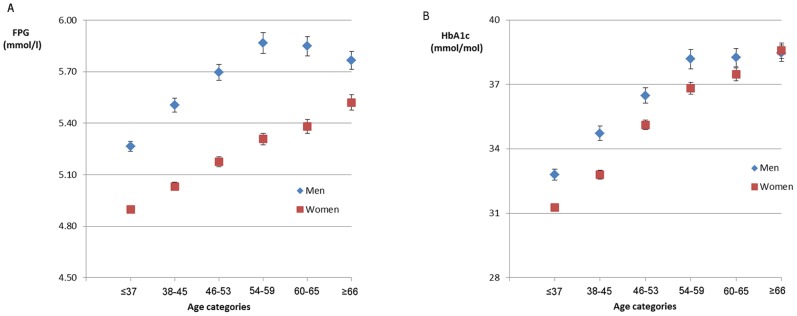
Men had higher prevalence of diabetes than women using the criterion of either FPG or HbA1c (7.5% men vs. 3.4% women, P<0.001), or both (4.3% men vs. 1.8% women, P<0.001). HbA1c increased steadily in women through the six age groups. In the oldest group (≥66 years), the proportion of women among those diagnosed with diabetes was as high as 42.3% (215/508) using the criterion of either FPG or HbA1c, and 41.6% (116/279) using both criteria.
Using either FPG or HbA1c, the prevalence of people diagnosed with diabetes would almost double compared to using the criterion of both scores, and this would include more elderly women than men. The impact of introducing HbA1c for diabetes diagnosis should be considered in terms of age and sex.
本研究使用空腹血糖(FPG)和/或糖化血红蛋白(HbA1c)的诊断标准,在一个大型的日本人群中,研究了按年龄和性别诊断为糖尿病的个体的患病率差异。
我们进行了一项横断面研究,使用了 1998 年至 2006 年间接受健康检查的 33959 名无已知糖尿病患者(男性 16869 名,女性 17090 名)的数据。我们将参与者的年龄范围分为六组,每组人数相近。我们比较了男性和女性在每个年龄组中使用 FPG≥7.0mmol/l(126mg/dl)、HbA1c≥48mmol/mol(6.5%)或两者均符合诊断标准的糖尿病患病率。
男性使用 FPG 或 HbA1c 任一标准(7.5%男性比 3.4%女性,P<0.001)或两者均符合诊断标准(4.3%男性比 1.8%女性,P<0.001)的糖尿病患病率均高于女性。女性的 HbA1c 随年龄组逐渐升高。在年龄最大的组(≥66 岁)中,使用 FPG 或 HbA1c 任一标准诊断为糖尿病的女性比例高达 42.3%(215/508),使用两项标准的比例为 41.6%(116/279)。
与使用两项标准相比,使用 FPG 或 HbA1c 任一标准诊断为糖尿病的人数几乎会增加一倍,而且会包括比男性更多的老年女性。在考虑引入 HbA1c 用于糖尿病诊断时,应考虑年龄和性别因素。